


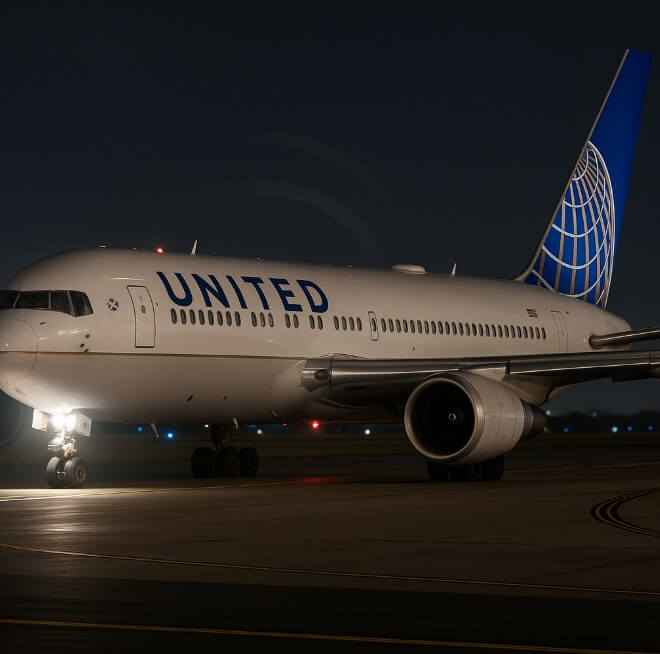
WASHINGTON, Oct. 16, 2025 — A United Airlines Boeing 767 bound for Rome made an unexpected return to Washington Dulles International Airport late Tuesday after an unusual but potentially risky incident: a passenger’s laptop computer slipped into the aircraft’s cargo compartment shortly after takeoff.
Flight UA126, operated by a Boeing 767-400ER, departed Washington Dulles (IAD) for Rome Fiumicino (FCO) at approximately 11:45 p.m. local time on October 15. Roughly 100 miles southeast of Boston, the pilots informed air traffic controllers they intended to turn back after learning that a passenger’s active laptop had fallen through the cabin sidewall and into the cargo area—an inaccessible space beneath the main deck.
While the situation did not present an immediate hazard, the flight crew determined it was unsafe to continue the transatlantic journey with an electronic device powered by a lithium-ion battery lodged out of reach. The aircraft landed safely back at Dulles around 12:35 a.m. and, following inspection and recovery of the item, later departed again for Rome at 3:24 a.m.
Calm Coordination and Clear Communication
In radio transmissions captured by the aviation-monitoring channel You Can See ATC, the United 126 crew reported the situation calmly and emphasized that no emergency was being declared.
Pilot (United 126): “Yeah, unfortunately, we’re going to have to get a clearance to return to Dulles. Um, we have a minor situation here with a passenger who has somehow dropped a laptop that was on down the sidewall into the cargo pit area of the airplane, and we’re just, you know, we don’t know the status of it. We can’t access it. We can’t see it. So, our decision is to return to Dulles and find this laptop before we can continue over the ocean.”
When asked by air traffic control whether an emergency was being declared, the pilot replied, “Negative.” The crew stressed the decision stemmed from an “abundance of caution.”
Pilot: “This is just out of abundance of caution and just precautionary, you know, due to the lithium battery in the cargo area, where it’s actually not even near the suppression system we have for fires down there. So, this is just a safety precaution.”
Controllers acknowledged the unusual nature of the report, with one remarking, “That’s a new bird story. I’ve never heard anything like that before—good story to tell in the lounge.”
Safety First: Lithium-Ion Battery Risks
Aviation safety specialists note that the pilots’ decision aligns squarely with standard safety protocol. Lithium-ion batteries—common in laptops and other personal electronics—can pose a fire risk if damaged, short-circuited, or exposed to extreme heat. In confined areas without temperature regulation or fire-suppression coverage, such batteries have been known to ignite spontaneously.
While the cargo hold of a wide-body jet like the 767 includes built-in fire suppression systems, those systems typically protect only designated zones. If a device lodges outside that protected area, the crew has limited ability to respond in flight.
“Returning to the departure airport is the prudent move in a case like this,” said an independent aviation safety analyst not involved in the incident. “Over the Atlantic, you can’t divert quickly if something starts to smolder.”
United Airlines confirmed the aircraft—registration N76054, a 24-year-old 767-400ER—was inspected after landing and cleared for service before continuing to Rome. All passengers arrived safely following the brief delay.
Established Protocols and Industry Context
Airlines worldwide have adopted strict handling procedures for lithium-powered electronics. Cabin crews routinely instruct passengers to keep devices within reach and to alert flight attendants immediately if an item slips between seats or becomes inaccessible. In several prior cases, overheating batteries have prompted precautionary landings when electronic devices were trapped in seat mechanisms or cargo areas.
The Federal Aviation Administration classifies lithium-ion batteries as hazardous materials under certain conditions, particularly when they cannot be monitored during flight. The agency has previously issued guidance directing crews to treat missing or damaged batteries with caution, underscoring the importance of immediate recovery before long-haul operations.
In this incident, United’s cockpit crew acted according to those principles. Though the episode caused a short delay, it underscored the broader culture of risk mitigation that governs modern air transport.
A Measured Response to an Unusual Event
The quick decision to reverse course and the absence of panic reflect the professionalism that passengers rarely see behind the cockpit door. For United 126’s pilots, the choice to prioritize safety over schedule proved uncontroversial.
As one controller put it succinctly after the aircraft was cleared to return: “Understood. Thank you.”
The Boeing 767’s return to Washington may have been prompted by a simple dropped laptop, but it served as a reminder of how seriously airlines treat even the most unlikely hazards—especially when lithium batteries are involved.
