


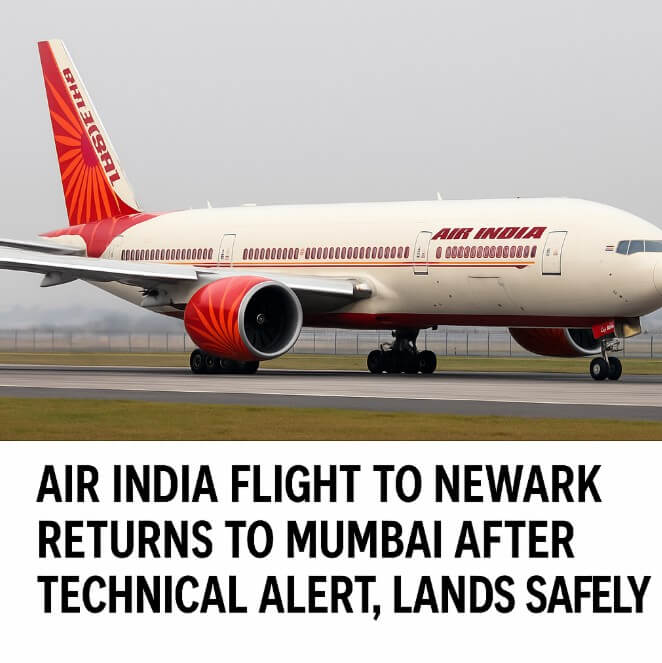
Mumbai, India (October 22, 2025) — An Air India Boeing 777 operating from Mumbai to Newark made a precautionary return to Mumbai’s Chhatrapati Shivaji Maharaj International Airport on Wednesday morning after the crew reported a suspected technical issue shortly after takeoff. The aircraft landed safely without incident, and all passengers disembarked normally, according to the airline.
The flight, operating as AI191, was bound for Newark Liberty International Airport when the crew decided to return to Mumbai “out of an abundance of caution,” an Air India spokesperson said. The airline confirmed that the Boeing 777-300ER, registered as VT-AEQ, was immediately taken out of service for a detailed technical inspection following its return.
“The decision was made purely out of caution and in line with standard safety procedures,” the spokesperson said. “Engineers began examining the aircraft soon after landing to determine the cause of the suspected issue before it re-entered service.”
The aircraft involved is a 12.5-year-old Boeing 777-300ER powered by GE90 engines. It was previously operated by Etihad Airways before joining Air India’s fleet.
Flights Canceled, Passengers Rebooked
As a result of the incident, Air India canceled both the outbound AI191 service from Mumbai and the corresponding AI144 Newark-to-Mumbai return flight. The airline said all affected passengers were provided with accommodation and rebooked on alternative flights to minimize disruption.
“We are working to minimize inconvenience and ensure passengers reach their destinations as soon as possible,” an airline spokesperson said, adding that “passenger safety remains Air India’s highest priority.”
Passengers departing from Newark were notified of the cancellation and offered assistance with rebooking. The airline said it would resume operations on the Mumbai–Newark route once the aircraft inspection is complete and the airworthiness of the plane is verified.
Second Technical Event This Month
The latest air turnback follows another technical-related precaution involving a different Air India aircraft earlier this month. On October 16, a Boeing 787-8 Dreamliner operating as flight AI315 from Hong Kong to Delhi was delayed after an onboard system alert prompted additional safety checks prior to departure.
According to Air India, the Dreamliner, registered as VT-ANO, was scheduled to depart Hong Kong at 8:50 a.m. local time when cockpit instruments detected an anomaly. Following established safety protocols, the aircraft remained on the ground while engineers carried out diagnostic inspections and system resets.
The airline said the delay “resulted from a minor fault that required a component reset—a common procedure for advanced aircraft like the Boeing 787-8.” Once maintenance teams verified system stability, the flight departed at approximately 11:30 a.m. and landed safely in Delhi that afternoon.
Air India emphasized that “passenger safety was never compromised” and that such precautionary holds are standard practice in modern aviation to ensure system reliability and compliance with international safety regulations.
Regulator Oversight and Fleet Inspections
The Directorate General of Civil Aviation (DGCA), India’s aviation regulator, has been monitoring Air India’s handling of technical issues, particularly those affecting its widebody fleet. Earlier in October, the DGCA directed the airline to reinspect Ram Air Turbine (RAT) units across its Boeing 787 fleet after the same Dreamliner, VT-ANO, experienced an unexpected RAT deployment while approaching Birmingham Airport.
The RAT is an emergency device that deploys automatically to provide backup power to critical flight systems in the event of total electrical or hydraulic failure. Aviation experts note that while such incidents are rare, follow-up inspections are routine to ensure continued airworthiness and system integrity.
The regulator continues to coordinate with Boeing to assess Air India’s compliance with maintenance advisories and ensure consistent fleet reliability. The airline, which has embarked on a multibillion-dollar modernization program since being acquired by the Tata Group, operates one of the largest fleets of Boeing widebody aircraft in Asia.
Routine Safety, but Heightened Scrutiny
While technical alerts and air returns are not uncommon in commercial aviation, they often draw public attention due to the safety sensitivities surrounding long-haul international operations. Industry analysts note that Air India, amid its fleet renewal and operational upgrades, faces heightened scrutiny as it integrates older aircraft while introducing new-generation jets under its major order with Boeing and Airbus.
For now, Air India officials reiterated that the precautionary landing of AI191 was handled according to protocol, and the situation was managed without any safety compromise or injury.
The airline said it will provide updates once the engineering investigation into the 777’s technical issue is complete and the aircraft is cleared for service.
