


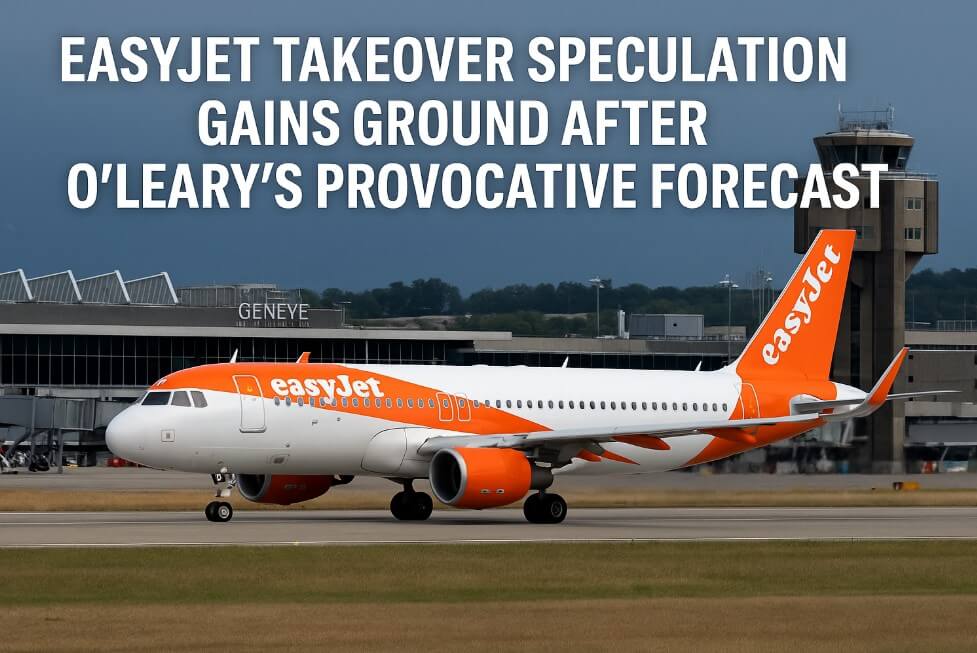
LONDON — When Ryanair chief executive Michael O’Leary predicted that EasyJet would one day be carved up by Europe’s aviation giants, most observers dismissed it as another of his provocative quips. But weeks later, the comment seems less like mischief and more like foresight.
The London-listed carrier, long viewed as one of Europe’s most resilient low-cost airlines, is now facing renewed scrutiny from investors and industry analysts amid growing speculation about its independence. The rumors have intensified following reports that shipping conglomerate MSC Group may be eyeing a potential takeover bid—claims both sides have denied, though not before EasyJet shares spiked sharply in response.
Recovery and Rival Pressures
EasyJet’s post-pandemic recovery has been steady but uneven. While demand for European leisure travel has rebounded strongly, the carrier has struggled to regain the market momentum that once made it Ryanair’s closest rival. Ryanair’s fleet is now nearly double EasyJet’s in size, and Wizz Air has overtaken the British carrier in several Eastern European markets, underscoring shifting competitive dynamics across the region.
“EasyJet’s slot holdings at London Gatwick (LGW) and Paris Charles de Gaulle (CDG) remain its strongest assets—ironically, the very prize O’Leary predicted would be carved up between British Airways (BA) and Air France-KLM (AF),” analysts noted. Those high-value airport positions make EasyJet strategically appealing to legacy carriers seeking to expand without triggering major regulatory obstacles.
Still, the airline faces headwinds that could test its ability to stay independent. Rising fuel prices, persistent wage inflation, and delays in aircraft deliveries have constrained EasyJet’s ability to grow at pace. Its cautious expansion strategy—once praised as financially prudent—is increasingly seen as conservative in a market where rivals are seizing post-pandemic opportunities.
While the company’s balance sheet remains healthy, investors are skeptical that slow, organic growth will be enough to restore EasyJet’s market capitalization to pre-2020 levels. The airline’s valuation, at roughly £3.7 billion according to The Irish Times, is less than half of what it was before the pandemic—a figure that makes it an appealing acquisition target for larger players looking to consolidate Europe’s fragmented aviation landscape.
A Consolidation Wave Across Europe
The speculation surrounding EasyJet comes amid a wider consolidation trend reshaping the European airline industry. Lufthansa is finalizing its acquisition of Italy’s ITA Airways, while International Airlines Group (IAG), the parent of British Airways, continues its pursuit of Air Europa. Air France-KLM, too, has been exploring partnerships and minority stakes in regional carriers.
Analysts argue that EasyJet’s network of bases—stretching across Gatwick, Paris, and Geneva—positions it as one of the most strategically valuable independent operators left in Europe. Any of the major airline groups could benefit from acquiring its routes and slots, particularly as regulators appear more receptive to consolidation following the disruptions of recent years.
For its part, EasyJet maintains that independence remains the company’s clear priority. Chief executive Johan Lundgren has emphasized operational efficiency, cost discipline, and a focus on core markets. He has repeatedly pointed to strong summer travel demand and a rise in ancillary revenue—from seat selection to baggage fees—as evidence that the airline’s strategy is paying off.
Nonetheless, the combination of a subdued valuation, competitive pressure, and renewed interest from potential suitors suggests the company could soon face hard choices. O’Leary’s comments, once regarded as mere industry banter, now seem to echo a growing belief among analysts that Europe’s low-cost landscape is headed for consolidation—and that EasyJet’s scale may not be sufficient to resist it indefinitely.
Market and Investor Sentiment
The takeover chatter has clearly caught the attention of investors in London and Geneva, EasyJet’s two main financial centers. Trading volumes have climbed as speculation mounts over possible bids, and several market analysts have revised their outlooks on the stock to reflect its potential acquisition value.
Traders note that EasyJet’s position is both enviable and precarious. Its brand remains strong, its customer base loyal, and its operational footprint extensive across short-haul European routes. But those same strengths make it an attractive target. “Even so, traders in London (LON) and Geneva (GVA) note that the airline’s depressed valuation makes it a likely target,” one industry observer said. “With a market capitalization of about £3.7 billion, less than half its pre-pandemic peak, EasyJet’s once-dominant position looks increasingly fragile.”
As consolidation reshapes the industry, few believe EasyJet can entirely avoid the attention of rivals looking to expand capacity or enter congested markets. Whether it will be a major airline or a diversified player such as MSC that makes the first move remains to be seen.
The Outlook Ahead
Michael O’Leary’s early warning about EasyJet’s vulnerability no longer sounds far-fetched. The same forces driving Europe’s flag carriers toward consolidation—high costs, competitive pricing, and the need for scale—could soon draw EasyJet into the fray.
“Whether a shipping group or rival flag carrier makes the first move, the structural logic of consolidation in European aviation is hard to ignore,” industry analysts agree.
For EasyJet, the next challenge may not be competition in the skies, but control of its future ownership.
