


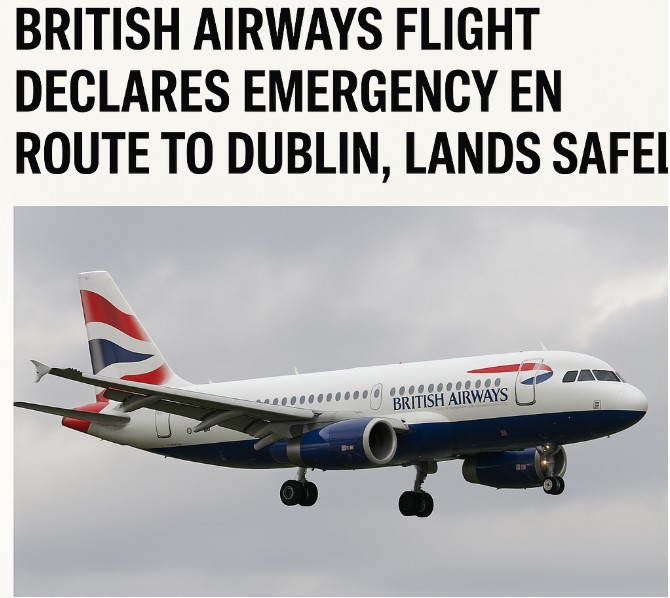
DUBLIN — A British Airways flight traveling from London Heathrow to Dublin declared a midair emergency on Monday morning before landing safely at Dublin Airport, according to flight tracking data and official reports.
Flight BA832, operated by an Airbus A320neo registered G-TTNH, was en route across Welsh airspace when the crew transmitted a “squawk 7700” transponder code, the internationally recognized signal for a general emergency. The aircraft had initially climbed to cruising altitude at flight level 300, or roughly 30,000 feet, before beginning an unscheduled descent.
Midair Emergency Declaration
The incident unfolded shortly after takeoff from London Heathrow, when the aircraft began losing altitude and the crew reported the emergency. At approximately 06:23 UTC, the flight was observed descending through 15,000 feet while still maintaining the emergency code.
Despite the declared emergency, the aircraft continued on course toward Dublin Airport. Aviation data showed the aircraft remaining on its planned route, indicating that the crew believed the situation remained manageable. The nature of the emergency has not yet been disclosed.
Approach to Dublin Airport
As the flight drew closer to Dublin, data indicated the situation may have stabilized. At 06:30 UTC, the crew canceled the emergency transponder code and returned to a normal signal while preparing for an approach to runway 28L. By that time, the jet had descended through 4,000 feet.
Observers noted that canceling the 7700 code is often a sign that the emergency is under control or resolved, though official confirmation of the cause was not immediately available.
Safe Landing
At 06:38 UTC, the Airbus A320neo landed without incident on Dublin’s runway 28L. British Airways has not released a statement regarding the emergency, and there has been no confirmation whether passengers or crew were at risk during the event.
The aircraft involved in the flight, G-TTNH, is a 6.6-year-old narrowbody A320neo in service with British Airways, part of the carrier’s modern short-haul fleet. The A320neo is widely used across Europe for intra-continental flights and is regarded as a reliable, fuel-efficient workhorse of the aviation industry.
Passenger and Industry Context
Flight BA832 is one of the airline’s regular morning services between London and Dublin, a route that typically carries business travelers as well as leisure passengers. British Airways is the United Kingdom’s flag carrier, operating an extensive network across Europe, North America, and beyond.
While in-flight emergencies are rare, they are not unheard of. A squawk 7700 alert is designed to immediately notify air traffic control and other aircraft of a potential problem, granting priority handling for the flight in distress. In many cases, such alerts are precautionary, enabling the crew to secure immediate landing clearance should the situation worsen.
Awaiting Further Information
As of Monday, no details have been released about the cause of the emergency declaration, whether it involved a mechanical issue, medical situation, or another operational concern. British Airways is expected to review the incident, with maintenance checks likely underway for the Airbus involved.
Dublin Airport officials confirmed the landing but provided no further comment. Aviation analysts note that the swift return to a normal transponder signal before landing suggests that the crew regained confidence in the aircraft’s systems.
The event is a reminder of the aviation industry’s layered safety protocols, where emergency procedures are designed to ensure rapid response and minimize risks. Passengers were able to disembark in Dublin without disruption, and no delays were reported to other flights in connection with the incident.
