


The Boeing 747-8 remains a cornerstone of long-haul aviation, engineered to handle nonstop flights that regularly exceed ten hours. While passengers often focus on seating comfort and inflight amenities, the aircraft’s design places equal emphasis on crew endurance—an essential factor in operational safety and regulatory compliance.
On ultra-long-haul routes, pilots and cabin crew face extended duty periods that can stretch well beyond a standard workday once pre-flight preparation and post-flight responsibilities are included. To address fatigue risks, Boeing incorporated dedicated crew rest facilities into the 747-8, allowing flight and cabin crews to sleep in enclosed spaces away from passengers.
Why Crew Rest Is a Safety Requirement
Fatigue management is a core pillar of modern aviation safety. Regulatory authorities require airlines to provide suitable onboard rest areas when flights exceed defined duty-time thresholds. These standards govern everything from bunk dimensions and ventilation to noise insulation and privacy, ensuring that rest periods provide meaningful recovery rather than brief, low-quality dozing.
For airlines operating the 747-8 on intercontinental routes, these facilities are not optional extras. Alert cabin crew are essential throughout the flight—not only during service but also during turbulence, medical situations, or unexpected emergencies. Likewise, pilots must remain fully attentive during critical phases such as descent and landing, even after many hours in the air.
Inside the Boeing 747-8 Crew Rest Design
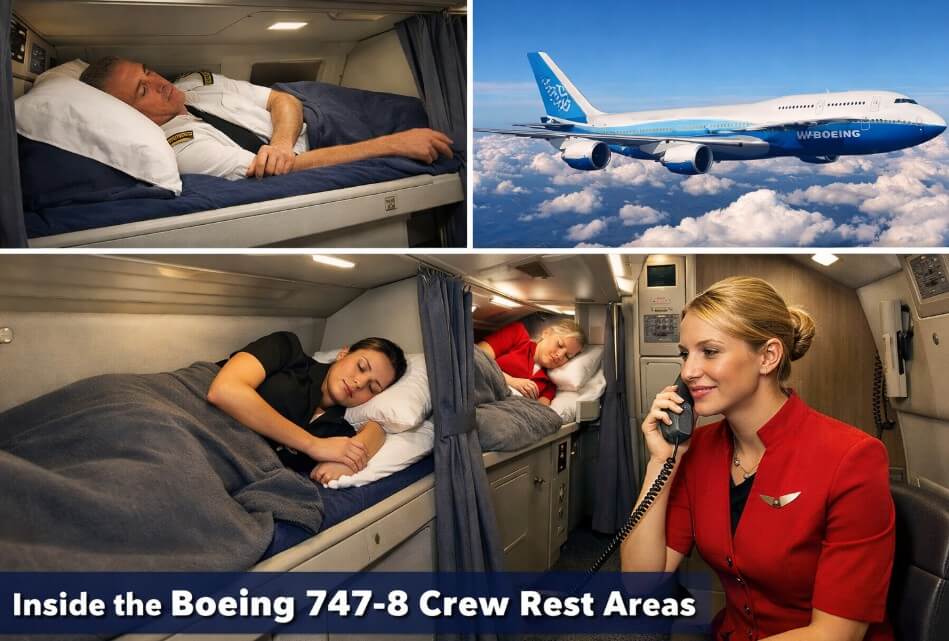
The Boeing 747-8 features two fully enclosed and separate rest areas: one dedicated to pilots and another designed for cabin crew.
The pilot rest compartment is located directly behind the flight deck, above the forward passenger cabin. It includes multiple bunks arranged on two levels, allowing flight crew members to rotate rest periods during cruise. This proximity to the cockpit enables quick recall if needed, while still offering isolation from passenger activity.
The cabin crew rest area is positioned toward the rear of the aircraft, above the aft main deck seating. Accessed by a steep staircase, the space is compact but purpose-built. Depending on airline configuration, it typically includes several horizontal bunks, storage lockers, and an intercom system that connects directly with the working crew.
Some layouts also feature a small antechamber used for changing or brief communication before entering the sleeping area. Although ceiling height is limited and movement is restricted, the bunks are equipped with bedding, individual reading lights, ventilation, and privacy curtains—features designed to support restorative sleep during long flights.
Operational Flexibility for Airlines
From an airline perspective, the 747-8’s crew rest configuration provides valuable staffing flexibility. By housing rest areas above passenger seating rather than within the cabin itself, airlines can roster additional cabin crew without sacrificing revenue-generating seats.
This capability is especially important on extended routes, where regulatory rest requirements must be met while maintaining full service coverage. As flagged by Simple Flying, such designs allow airlines to balance safety compliance with commercial efficiency.
How the 747-8 Compares With the Airbus A380
When compared with the Airbus A380, the 747-8’s crew rest facilities are generally viewed as more utilitarian. The A380’s larger fuselage allows for more spacious pilot bunks, individual doors, and, in some configurations, dedicated seating for non-sleep rest.
Cabin crew rest areas on the A380 are often installed beneath the main deck and accessed by stairs leading downward. These lower-deck modules can include up to a dozen bunks, a lavatory, independent climate control, and sometimes personal entertainment screens.
Despite these differences, the fundamental purpose remains the same across both aircraft types: reducing fatigue-related risk and ensuring compliance with duty-time regulations.
Bottom Line
While it may lack the space and amenities of newer superjumbos, the Boeing 747-8’s crew rest design reflects decades of long-haul operational experience. Its dedicated pilot and cabin crew rest areas meet all regulatory standards and provide a significantly higher level of fatigue management than improvised solutions such as curtained-off passenger seats.
For airlines and regulators alike, the 747-8 continues to demonstrate that effective crew rest is not a luxury—it is a necessity for safe, reliable intercontinental operations.
