


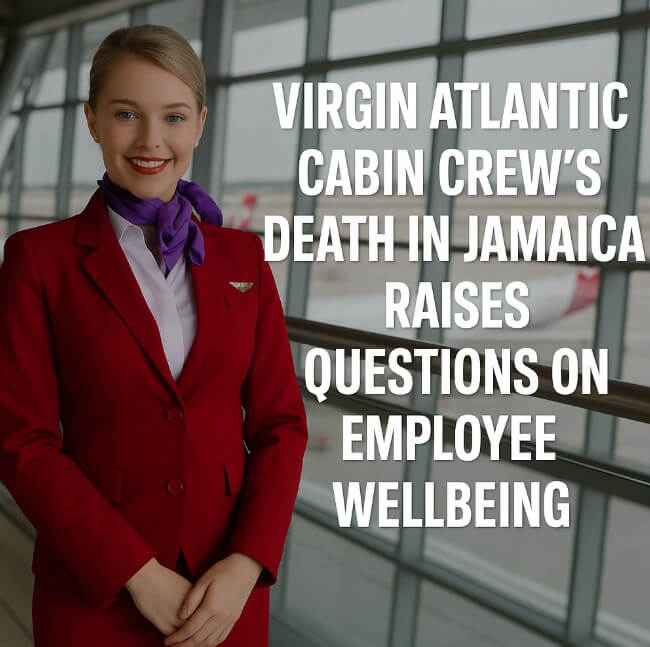
A 25-year-old Virgin Atlantic cabin crew member was found dead during a layover in Jamaica following several days of illness and growing anxiety about possible disciplinary action by her employer. Authorities later confirmed no foul play, and a UK coroner ruled the death a suicide, prompting broader discussions about mental health support for aviation workers stationed overseas.
Illness Leads to Extended Layover in Jamaica
Jasmin Winthrop, 25, had been operating a January 2025 Virgin Atlantic flight from London Heathrow (LHR) to Montego Bay (MBJ). Upon arrival, she was deemed unfit for duty due to a sinus infection and was required to remain in Jamaica while the rest of her crew returned to the United Kingdom.
Virgin Atlantic arranged accommodations for Winthrop at the airline’s designated crew resort in Montego Bay. Over the next several days, her health improved, and she later encountered colleagues from another Virgin Atlantic flight who were also staying at the property. According to testimony presented at an inquest, Winthrop socialized with the group and consumed alcohol, eventually becoming intoxicated. Colleagues assisted her back to her room when she began to feel unwell.
Messages Reveal Growing Distress and Fear of Disciplinary Action
Testimony shared during the inquest revealed that Winthrop became overwhelmed with anxiety after being left alone in her room. Although there was no indication she faced pending disciplinary measures, she reportedly worried that drinking alcohol during a period of medical grounding could jeopardize her employment.
Her messages to friends reflected escalating distress. She questioned whether her flight service manager was upset with her and expressed fears about losing her job. A voice note later indicated she contemplated harming herself if terminated. These communications were cited by investigators as evidence of her mental and emotional turmoil while isolated far from home.
Crew Raise Alarm After Unsuccessful Welfare Checks
The following day, Winthrop’s colleagues were unable to contact her and alerted the flight service manager. Hotel security, accompanied by airline staff and a pilot, conducted a welfare check. Authorities later confirmed she had died by hanging. Jamaican police ruled out foul play after an investigation, and a note found in the room expressed her deep regret and strong attachment to her role at Virgin Atlantic.
Virgin Atlantic issued a statement expressing “profound sadness” and offering condolences to her family and coworkers. The airline described her as a dedicated crew member who took pride in her work.
Coroner Concludes Suicide; Cites Fear and Embarrassment as Factors
During the inquest, Senior Coroner Rachael Griffin formally concluded the death as suicide. The ruling stated that fear of job loss and personal embarrassment contributed significantly to Winthrop’s emotional state before her death.
While Winthrop’s mother indicated she had not observed immediate mental health concerns, the inquest noted a history of anxiety, underscoring her heightened vulnerability while alone abroad. The coroner’s findings highlight the amplified pressures cabin crew can face in unfamiliar locations, particularly when ill or temporarily separated from colleagues.
Aviation Industry Faces Renewed Scrutiny on Mental Health Support
Winthrop’s death has renewed calls for airlines to strengthen mental health resources for employees who spend significant periods away from home. Although international crew accommodations are often seen as a perk of the profession, long-haul operations can involve extended stretches of solitude, irregular rest, and fatigue—conditions that can exacerbate emotional stress.
The case also underscores gaps that may arise when crew members are grounded overseas due to illness. Unlike standard layovers shared with colleagues, prolonged isolation can limit access to real-time peer or managerial support, leaving employees vulnerable during moments of distress.
Airlines across the industry have expanded wellness initiatives in recent years, including confidential hotlines, peer-support programs, and mental-health training for supervisors. Still, experts argue that more comprehensive frameworks are needed for scenarios in which crew members remain abroad without direct oversight or companionship.
A Tragedy That Challenges Industry Norms
Virgin Atlantic has not disclosed additional findings from any internal review but reaffirmed its commitment to employee wellbeing. The tragedy has resonated throughout the aviation community, prompting difficult conversations about the expectations placed on frontline airline staff and the emotional challenges of working far from home.
As global travel continues to rebound and long-haul operations expand, airlines face mounting pressure to demonstrate that mental-health safeguards are not only available but truly accessible—especially for crew members navigating unexpected medical or personal crises abroad.
If you’d like, I can also format this into AP style, create a shorter or longer version, or craft a headline selection suitable for business news editors.
