


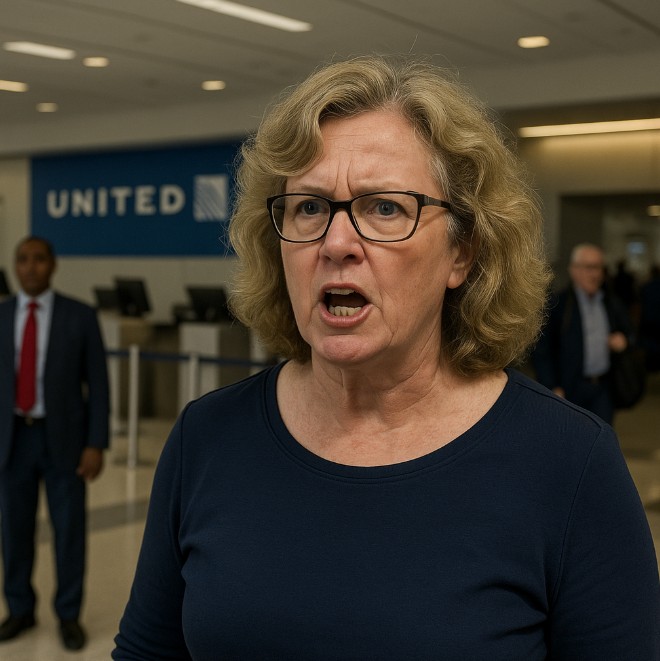
HOUSTON — A longtime United Airlines flight attendant is challenging her termination after confronting Houston Independent School District Superintendent Mike Miles at George Bush Intercontinental Airport, arguing she was off duty and speaking as a private citizen.
Virginia “Ginny” McDavid, a veteran United employee and former union activist, was dismissed weeks after the April incident at a United Club lounge. McDavid says she was acting in a personal capacity when she expressed frustration with Miles’ leadership of the Houston school system. United Airlines, however, determined her behavior violated company conduct policies.
The case has drawn attention from labor advocates and airline industry observers who say it underscores growing tensions over how off-duty behavior can impact employees’ careers—especially when it occurs in company-branded spaces.
The Confrontation
According to accounts from those involved, McDavid was traveling as a passenger and not in uniform when she recognized Miles and his deputy in the United Club at Bush Intercontinental Airport (IAH). Miles, appointed by the Texas Education Agency in 2023 to overhaul Houston’s struggling public schools, has been a divisive figure among parents and educators.
McDavid, who has a child in the Houston Independent School District, reportedly approached Miles and expressed her dissatisfaction with his leadership. The exchange lasted about two minutes and was partially recorded. McDavid later shared the video on her personal social media account.
In the footage, she accused Miles of harming the city’s schools and told him to “get the hell out of town.” The Houston Independent School District later confirmed it filed a formal complaint with United Airlines, describing McDavid’s behavior as “vulgar and aggressive.”
United’s Response
United Airlines declined to disclose detailed reasons for McDavid’s dismissal but cited broad employee conduct policies that apply on and off duty. The carrier maintains that its professional standards extend to all company-associated environments, including airport lounges bearing the United brand.
The airline’s employee handbook outlines expectations that staff members “uphold the company’s reputation and values in all public settings,” even when not working. McDavid’s actions, United said, violated those standards and potentially harmed the airline’s image.
“United expects all employees to demonstrate respect and professionalism at all times,” the company said in a statement. “We take seriously any behavior that reflects poorly on our team or our brand.”
The Union’s Involvement
McDavid is appealing the termination with backing from her union, which has not been named publicly but represents thousands of United flight attendants nationwide. Union representatives argue that the airline overreached in disciplining McDavid for actions taken on personal time.
Labor experts say the case highlights a recurring conflict in corporate workplaces: when and where employers can hold workers accountable for off-duty conduct. “The question is whether she was acting as a private citizen or as a representative of United simply because she was in a company-affiliated space,” said an aviation labor specialist familiar with similar disputes.
United Club lounges are restricted to ticketed passengers, but they also function as part of the airline’s premium brand environment—an ambiguity that may have influenced the company’s decision.
Broader Implications
McDavid’s case is being closely watched across the aviation industry, where airlines have increasingly disciplined employees for behavior in semi-public settings or on social media. Flight attendants, in particular, face heightened scrutiny because they serve as the public face of carriers.
“This is about more than one flight attendant,” said one union source. “It’s about how far an employer can reach into someone’s private life when they happen to be standing in a space with a logo on the wall.”
If McDavid’s appeal succeeds, it could set a precedent for how airlines handle employee expression in company-related environments. If it fails, it may reinforce corporate authority to police behavior that occurs even tangentially under the company’s brand.
Either way, the outcome is expected to resonate well beyond United Airlines, raising fresh questions about free speech, professionalism, and personal accountability in a hyperconnected workplace era.
