


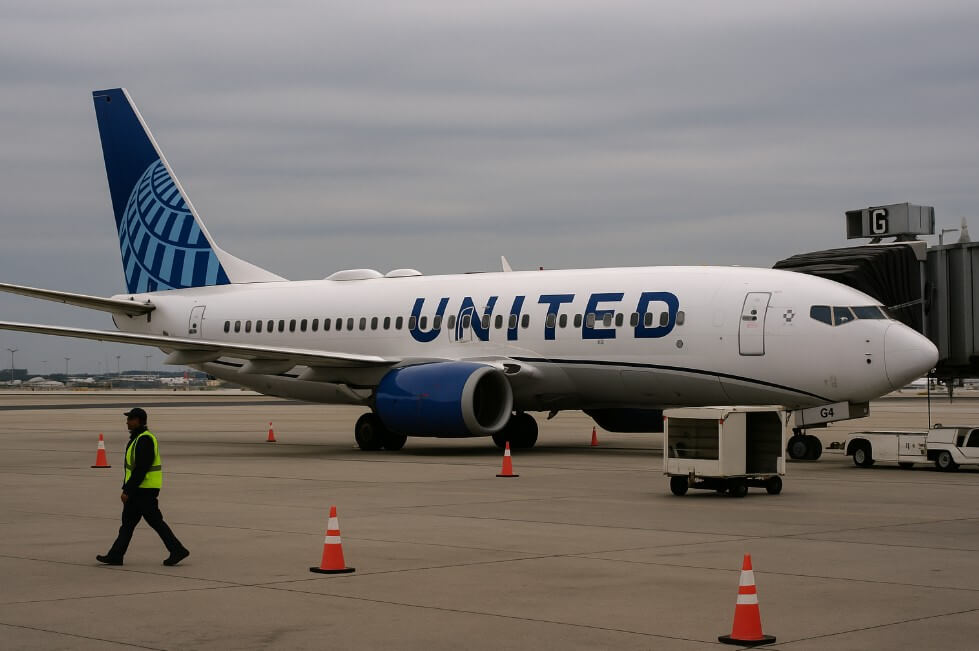
WASHINGTON— United Airlines temporarily grounded flights across the United States and Canada on Tuesday after a connectivity malfunction disrupted the carrier’s operations, causing widespread delays at major hubs.
The ground stop, initiated in the mid-afternoon, forced aircraft at key airports—including Chicago O’Hare International Airport (ORD), Newark Liberty International Airport (EWR), and Denver International Airport (DEN)—to remain on the ground until the issue was resolved. While the pause lasted only a short period, its impact rippled through hundreds of departures and arrivals nationwide.
Connectivity Issue Triggers Halt
United Airlines confirmed the disruption stemmed from a technology-related malfunction rather than a security breach. “United Airlines confirmed that the brief ground stop was initiated to address a connectivity malfunction affecting its operations,” the carrier said in a statement. The airline emphasized that safety protocols remained uncompromised throughout the incident.
According to the Federal Aviation Administration (FAA), the agency issued the stop at United’s request. Once the malfunction was corrected, flights gradually resumed. United’s spokesperson said the company had already taken corrective action to minimize operational disruption.
This marks the second time in less than two months that the airline has requested a nationwide pause in its departures, according to CBS News.
Disruptions at Major Hubs
Flight-tracking services showed hundreds of aircraft idling at gates or taxiways across U.S. and Canadian airports during the outage. Both domestic and international flights were affected, with disruptions particularly acute at United’s busiest hubs.
Travelers reported extended wait times at boarding gates and crowded customer service counters as passengers sought re-bookings and updates. At San Francisco International Airport (SFO) and Washington Dulles International Airport (IAD), travelers described long lines and mounting frustration as schedules shifted.
The impact extended north of the border as well. At Toronto Pearson International Airport (YYZ), planes bound for the United States were unable to depart until the issue was resolved.
FAA and Airline Response
The FAA said it coordinated closely with United as the airline worked through the connectivity problem. “The FAA stated it had issued the ground stop at United’s request while the airline worked to resolve the underlying problem,” the agency confirmed.
United stressed that the issue was not related to a cyberattack, underscoring its commitment to operational safety. “United Airlines reassured passengers that the issue did not result from a cybersecurity incident and emphasized that safety protocols remained uncompromised,” the company said.
Broader Industry Context
The incident comes amid a string of technology-related disruptions across the aviation sector in recent years. Earlier in 2023, the FAA itself grounded all flights nationwide after its Notice to Air Missions (NOTAM) system suffered a technical malfunction. Other carriers worldwide have also experienced widespread delays tied to software glitches and air traffic management failures.
While Tuesday’s United disruption was relatively brief, analysts say repeated interruptions carry significant reputational risk. “They argue that resilient IT infrastructure is now as essential to airline reliability as physical aircraft maintenance,” noted industry observers.
Back to Normal
United Airlines said operations quickly stabilized after the ground stop was lifted. “United Airlines stated that its operations quickly returned to normal following the incident and that further disruptions were not expected,” the company said. The carrier pledged to review its systems to prevent similar malfunctions in the future.
Despite the swift recovery, travelers faced lingering delays as airports worked through the backlog of grounded flights. Some passengers reported missed connections and rescheduled departures stretching into the evening.
Bottom Line
The episode highlights the airline industry’s growing reliance on complex digital systems—and the vulnerabilities that can come with it. While United moved quickly to resolve the connectivity failure, the disruption served as another reminder of how swiftly technical issues can cascade through the aviation network.
As airlines expand their operations and digital infrastructure, ensuring technology resilience may prove as critical as maintaining aircraft fleets. For passengers caught in Tuesday’s stoppage, the message was clear: even brief outages can bring global operations to a halt.
