


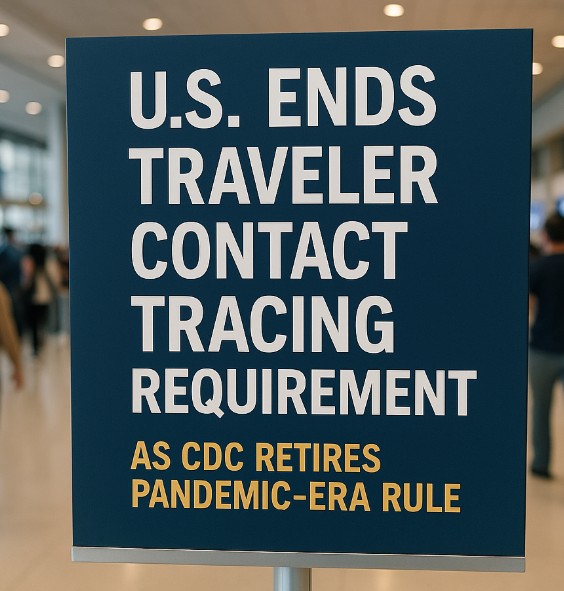
Federal Policy Shift Streamlines Entry for International Passengers
WASHINGTON — The United States has formally ended its long-running requirement for inbound international travelers to submit contact tracing information prior to boarding, marking one of the final reversals of pandemic-era aviation regulations. The action follows the Centers for Disease Control and Prevention’s decision to allow interim final rule 0920-AA75, governing foreign quarantine procedures, to expire.
The change applies universally to airlines operating flights into the country — including major carriers such as Delta Air Lines (DL) and United Airlines (UA) — and affects passengers arriving through major international gateways such as New York–JFK (JFK) and Los Angeles (LAX). Effective immediately, travelers will no longer be asked to provide contact details during the booking or check-in process.
Regulation Formally Expires
The CDC confirmed that interim final rule 0920-AA75 officially expired on December 4, 2025. The rule, introduced during the COVID-19 public health emergency, had required all inbound passengers to submit personal contact information through booking platforms, online check-in tools, or airport counters.
Airlines were obligated to store the data for 30 days and make it available to federal health authorities upon request. The policy was originally intended to support public health investigations by helping identify travelers who may have been exposed to communicable diseases.
With the expiration now in effect, airlines are working to remove associated data fields from their systems — a process expected to conclude within weeks. Industry officials describe the update as a relatively straightforward technical adjustment that should not disrupt normal operations.
Rationale Behind the Policy Reversal
The rollback aligns with the broader unwinding of pandemic-era aviation controls, which have been scaling back as global air travel returns to pre-2020 patterns. Passenger volumes have fully recovered, and public health agencies no longer view large-scale contact tracing of airline passengers as necessary or effective.
The contact information requirement had remained in place long after other COVID-19 restrictions were lifted, resulting in millions of travelers completing forms that delivered limited benefit to authorities. Even during the peak of the pandemic, the United States struggled to deploy comprehensive, tech-based contact tracing systems capable of analyzing the collected data at scale.
Airlines repeatedly noted that the requirement imposed operational burdens while offering little measurable public health protection. Despite this, carriers complied throughout the emergency period, citing the need for regulatory consistency and international coordination.
Effects on Travelers and Airline Operations
For passengers, the removal of the rule translates to a streamlined check-in experience. International travel already demands verification of passports, visas, and in some cases destination-specific documentation. Eliminating an additional administrative step is expected to reduce both processing times and the likelihood of delays at airport counters.
Travelers connecting through major hubs such as Chicago O’Hare (ORD) and Miami (MIA) are unlikely to notice any changes during the transition period, as airlines phase out the data fields without interrupting normal flow.
For carriers, the change yields meaningful operational relief. Removing data-collection responsibilities reduces system complexity, cuts administrative overhead, and aligns U.S. aviation regulations with international norms. Most major markets had already dropped similar requirements, leaving the United States among the last to unwind its pandemic-era tracing protocols.
A Shift Toward Modernized Border Management
The policy change also underscores a broader federal shift toward streamlined border procedures and reduced emphasis on post-travel monitoring. With current public health conditions no longer warranting the extraordinary measures implemented in 2020 and 2021, policymakers are focusing on efficiency, traveler experience, and alignment with global standards.
Industry analysts note that while the data-collection rule played a role during the height of COVID-19, it offered diminishing returns as vaccination rates increased and surveillance strategies evolved. The expiration of rule 0920-AA75 signals the government’s view that such measures are no longer necessary in the modern operational environment.
Bottom Line
The United States has officially ended its contact tracing requirement for inbound international air travel, following the expiration of a pandemic-era CDC regulation. The change simplifies travel procedures, reduces administrative work for airlines, and aligns national policy with current global aviation standards. Although the rule served a purpose during the height of the pandemic, its continuation offered minimal value in the modern operational environment.
Stay tuned with us. Further, follow us on social media for the latest updates.
