


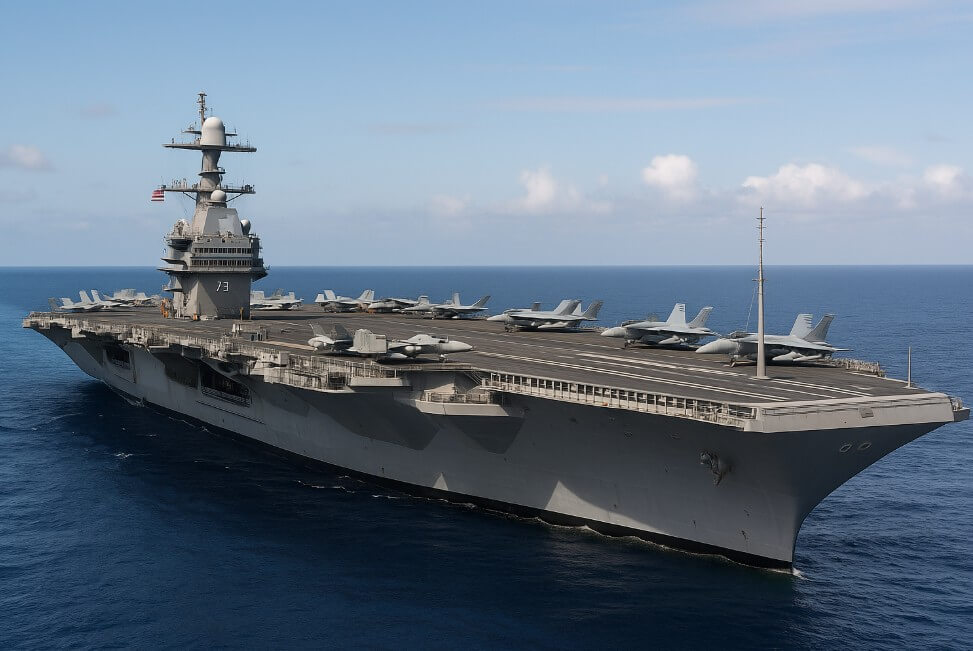
WASHINGTON — The Pentagon has ordered the USS Gerald R. Ford (CVN-78), the world’s largest and most advanced aircraft carrier, to the U.S. Southern Command (USSOUTHCOM) area of operations near Venezuela — a move that expands America’s naval footprint in the Western Hemisphere and signals a sharper focus on counter-narcotics and transnational crime missions.
Pentagon spokesperson Sean Parnell confirmed that the Gerald R. Ford Carrier Strike Group will operate from bases linked to U.S. Southern Command in Miami as part of a broader directive “to intensify counter-narcotics missions in Latin America.” The deployment, he said, represents a “major expansion of U.S. naval presence in the region” at a moment of renewed tension with Venezuela and growing concern among neighboring states.
Expanding Operations in the Western Hemisphere
Built by Huntington Ingalls Industries in Newport News, Virginia, the Gerald R. Ford is the first of a new class of supercarriers designed to replace the aging Nimitz class. At 1,092 feet long and displacing roughly 100,000 tons, the nuclear-powered carrier supports a formidable mix of aircraft, including F-35C Lightning II fighters, F/A-18 Super Hornets, EA-18G Growlers, E-2D Hawkeyes, C-2A Greyhounds, and MH-60R/S Seahawks.
Powered by two A1B nuclear reactors, the Ford produces 25 percent more energy than its predecessors — capacity that Pentagon planners say will eventually support advanced systems such as directed-energy weapons. Costing more than $13 billion, the vessel stands as both a technological showcase and a potent symbol of U.S. deterrence strategy.
According to Pentagon officials, the mission forms part of an expanded campaign to “detect, monitor, and dismantle” transnational criminal organizations (TCOs) across Latin America. U.S. forces attached to USSOUTHCOM will work alongside allied militaries and local law enforcement agencies to track smuggling routes and disrupt the maritime flow of narcotics northward.
Escalation and Political Fallout
President Donald Trump authorized the mission earlier this year, describing it as a renewed effort to combat “narco-terrorism” and protect U.S. borders. Defense Secretary Pete Hegseth said recent operations in the region destroyed at least ten vessels “allegedly used by drug smugglers,” resulting in multiple casualties. He vowed that the United States would pursue traffickers “day or night” throughout the hemisphere.
However, the deployment has triggered a wave of political reaction from Caracas to Brasília. Venezuelan President Nicolás Maduro accused Washington of preparing “a new eternal war,” alleging that the real purpose of the operation is to destabilize his government. Venezuela’s defense ministry announced that the country possesses 5,000 Russian-made man-portable air-defense systems intended to deter any attack.
Brazilian officials have also expressed concern that a U.S. military buildup so close to South American shores could escalate regional instability. Celso Amorim, foreign policy advisor to President Luiz Inácio Lula da Silva, warned that any U.S. intervention “would inflame the continent and radicalize politics.”
Strategic and Economic Dimensions
Behind the show of force lies a deeper layer of strategic and economic calculation. The operation comes as Washington and Brasília negotiate agreements over access to Brazil’s vast rare earth mineral reserves — materials essential for producing electric vehicles, jet engines, and next-generation defense technologies.
Brazil possesses the world’s second-largest known reserves of rare earths, a position that could make it either a vital U.S. partner or a geopolitical rival. The talks come amid a broader struggle to diversify supply chains dominated by China, which currently controls most of the world’s extraction and refining capacity.
U.S. officials see cooperation with Brazil as key to reducing dependence on Beijing’s industrial ecosystem. Yet Brazilian economists argue that maintaining close ties with China could yield greater long-term benefits in infrastructure and industrial investment, complicating Washington’s diplomatic calculus in the hemisphere.
A Risk of Broader Confrontation
The Gerald R. Ford’s arrival in Caribbean waters underscores a dual message: the United States’ determination to confront transnational criminal threats and its intent to preserve strategic influence in Latin America. But the deployment also heightens the risk of miscalculation between the U.S., Venezuela, and other regional actors, potentially expanding what began as a counter-narcotics mission into a wider geopolitical contest blending security, trade, and diplomacy.
As one senior defense official put it privately, “this is about far more than drugs — it’s about keeping the Western Hemisphere stable in an increasingly contested world.”
Follow American Business Desk for continued coverage of U.S. defense and foreign policy developments in Latin America.
