


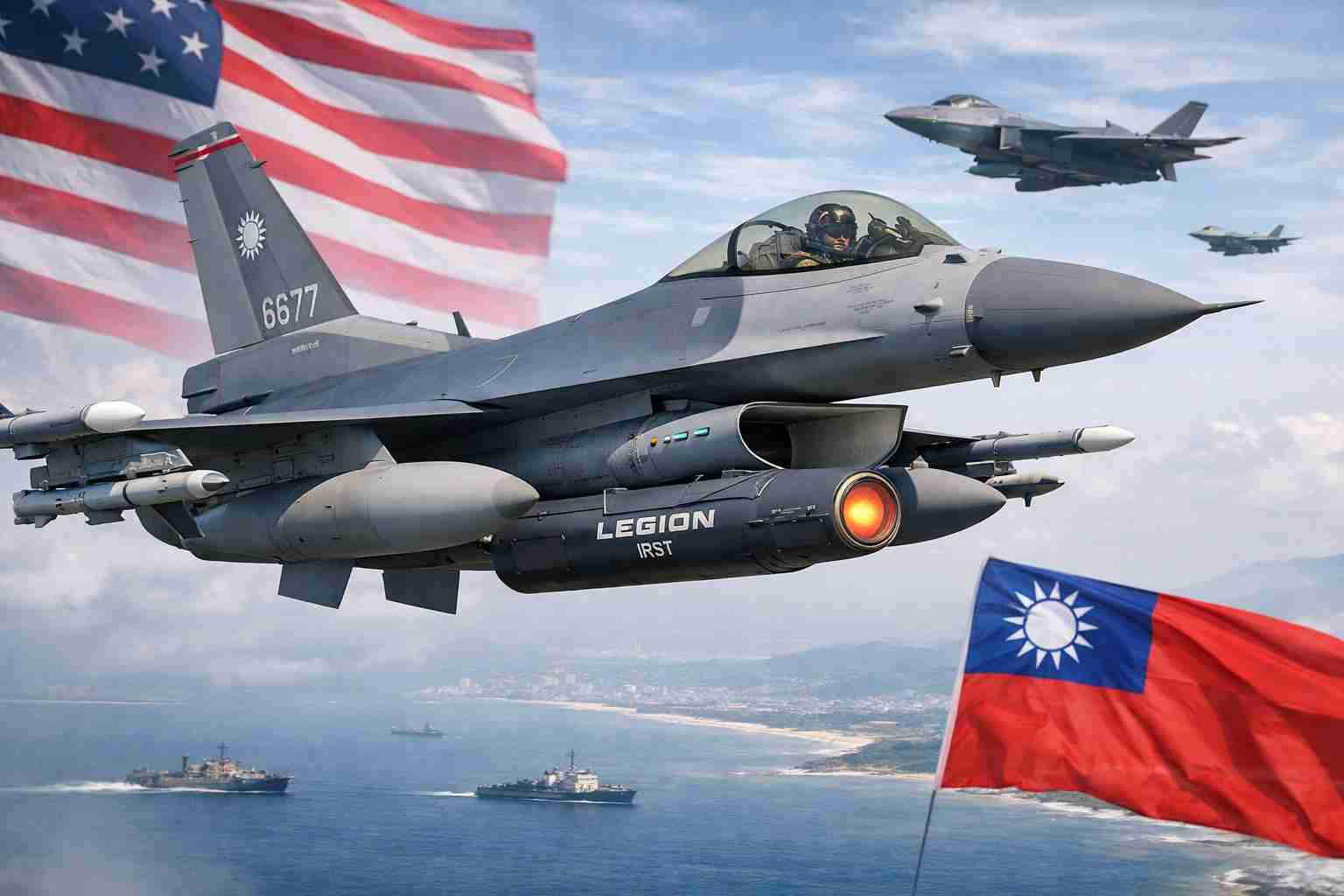
The United States has approved a major foreign military sales agreement that will see Taiwan acquire 55 Legion Infrared Search and Track (IRST) pods from Lockheed Martin, a move aimed at strengthening the island’s air combat capabilities as regional security pressures continue to rise
The contract, valued at up to $328.5 million, was awarded by the U.S. Department of Defense under the Foreign Military Sales (FMS) program. It addresses what U.S. officials described as an urgent operational requirement to enhance Taiwan’s air force readiness by upgrading its F-16 fighter fleet with advanced passive sensing technology.
Once delivered, the Legion pods will be integrated across Taiwan’s F-16 aircraft, providing pilots with improved detection, tracking, and targeting performance in increasingly contested airspace.
Advanced Passive Sensing for Modern Air Combat
The Legion IRST pod is built around Lockheed Martin’s IRST21 sensor architecture, which detects heat signatures emitted by aircraft rather than relying on traditional radar emissions. This passive approach allows aircraft to identify and track targets while minimizing their electromagnetic footprint.
Such capability is particularly valuable in environments where electronic warfare, radar jamming, or stealth technologies limit the effectiveness of conventional radar systems. By relying on infrared detection, the Legion pod enables pilots to maintain situational awareness without revealing their position.
Lockheed Martin has described the system as a collaborative targeting sensor, capable of sharing passive tracking data between aircraft. During U.S. Air Force testing, fighters equipped with Legion pods successfully exchanged infrared data and triangulated targets without activating radar systems, demonstrating effectiveness in emission-controlled environments
Enhancing Taiwan’s F-16 Modernization Strategy
The Legion pod procurement forms part of a broader effort to sustain and modernize Taiwan’s existing fighter fleet. In 2023, Taiwan completed the upgrade of its F-16A/B aircraft to the F-16V configuration, which included new avionics, enhanced electronic warfare systems, and the AN/APG-83 active electronically scanned array (AESA) radar.
In parallel, Taipei is awaiting delivery of 66 newly built F-16V Block 70 aircraft approved by the U.S. in 2019. While delivery timelines have faced production pressures, the aircraft are expected to significantly enhance Taiwan’s air defense capabilities once fully operational.
By adding Legion IRST pods, Taiwan extends the operational relevance of both upgraded and future aircraft without requiring major structural modifications.
Technology Designed for Contested Airspace
The Legion pod is housed in a 16-inch diameter structure and includes an advanced onboard processor with an open architecture design. This allows additional sensors to be integrated without redesigning the aircraft or modifying flight software.
The system has already completed successful flight testing on F-16 and F-15C platforms, validating readiness for operational use. During testing, the pod demonstrated the ability to detect and track airborne threats in realistic, high-threat environments.
A key technical advantage is its dedicated wideband pod-to-pod datalink. Traditional IRST systems struggle with range determination, but Legion addresses this limitation by allowing multiple pods to share data, enabling near real-time range calculation through triangulation.
Plug-and-Play Integration and Fleet Flexibility
Legion’s common interface design allows it to be installed on multiple aircraft types without changes to operational flight programs. This “plug-and-play” capability reduces integration time, lowers program risk, and controls lifecycle costs.
Because the system is platform-independent, operators can deploy it across mixed aircraft fleets, supporting scalable mission planning and faster fielding of new capabilities.
The system currently employs the Tactical Targeting Network Technology (TTNT) waveform, enabling secure data sharing across platforms and supporting emerging Joint All Domain Operations concepts.
Strategic Implications and Bottom Line
Taiwan’s acquisition of 55 Legion IRST pods highlights a strategic shift toward diversified sensing capabilities designed to counter stealth aircraft and electronic warfare threats. The deal also underscores the continued role of the U.S. FMS framework in facilitating Taiwan’s defense modernization.
All critical technology for the Legion pod is produced in U.S. facilities, with existing infrastructure supporting sustainment and long-term maintenance.
Bottom line: By integrating advanced passive infrared detection into its F-16 fleet, Taiwan enhances situational awareness while reducing reliance on active radar emissions—an upgrade aligned with evolving regional security demands and modern air combat realities
