


ARLINGTON — A Strategic Overhaul Begins
The U.S. Air Force is advancing a decades-long modernization effort that will reshape the backbone of American global mobility. In newly released planning documents, the service detailed how its Next Generation Airlift (NGAL) program will replace the Boeing C-17A Globemaster III and Lockheed Martin C-5M Super Galaxy — the heavy airlifters that have underpinned U.S. operations for more than 50 years.
As part of its earliest planning steps, the Air Force has begun referencing logistics models used by FedEx Express (FX) out of Memphis (MEM), adapting commercial hub-and-spoke efficiencies to military strategic airlift. Officials say the models offer useful benchmarks for long-range cargo planning and mission sustainment.
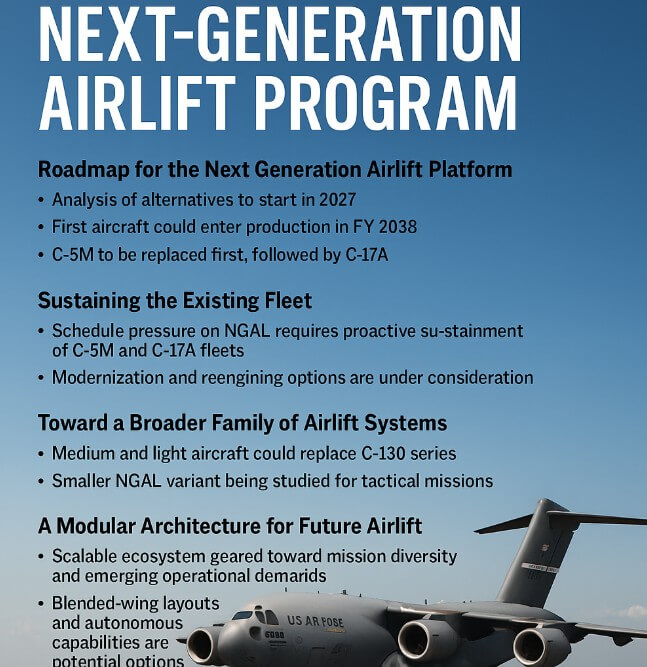
Roadmap for the Next Generation Airlift Platform
The Air Force confirmed release of its roadmap for the NGAL platform, describing how it intends to recapitalize the aging fleet. Air Mobility Command (AMC) plans to launch a full analysis of alternatives in 2027 to define requirements, assess design options, and outline acquisition paths for a new family of mobility aircraft.
If the development timeline holds, the first NGAL aircraft could begin production in fiscal 2038, with initial operational capability projected for fiscal 2041. The plan sets forth a strict replacement pattern: “One NGAL will replace each C-5M until that fleet retires around 2045.”
After the C-5M exits service, the NGAL program will shift to replacing the C-17A one-for-one. Current estimates keep the C-17A viable through 2075, though AMC notes the aircraft may require service life extensions and technology insertions to remain fully mission-capable until NGAL deliveries ramp up.
Sustaining the Existing Fleet
Near-term pressure on NGAL makes the sustainment of today’s fleet a critical priority. “The Air Force acknowledges that any schedule pressure on NGAL demands proactive sustainment of the C-5M and C-17A fleets.” Among the potential measures: extending type certificates, modernizing avionics and mission systems, and studying a C-17 reengining program to support another generation of operational demand.
Service leaders emphasize that sustaining the current fleet ensures no strategic airlift shortfalls materialize during the lengthy NGAL development window.
Toward a Broader Family of Airlift Systems
Though the strategy centers on heavy airlifters, planners expect NGAL to expand into a family of systems that also addresses medium and light airlift needs. This could eventually replace the C-130 series — a mainstay of tactical transport missions worldwide.
In parallel, AMC and Air Force Special Operations Command are evaluating a smaller NGAL variant designed for tactical and austere-environment operations. Concepts under study include higher autonomy levels and potential vertical takeoff and landing (VTOL) capabilities.
A Modular Architecture for Future Airlift
The NGAL vision marks a shift away from single-platform solutions toward a flexible, modular architecture. Instead of fielding one aircraft design, the Air Force is exploring a scalable ecosystem that adapts to diverse mission sets, distributed logistics, and future operational environments.
By integrating heavy and tactical variants under a shared technology framework, the service aims to streamline training, reduce long-term sustainment costs, and improve readiness.
Pending analysis will weigh traditional airlifter designs against emerging options such as blended-wing body aircraft, adaptive propulsion, and autonomous support vehicles meant for contested logistics missions.
Long-Term Viability and Funding
The Air Force acknowledges that developing a next-generation heavy airlift system is a decades-spanning undertaking. Heavy airlift programs historically require stable funding and consistent development pacing, and any disruption could extend timelines well past the planned 2038 production target.
AMC’s strategy emphasizes early planning and threat-informed design to reduce lifecycle risk. The first NGAL block is expected to serve the strategic lift mission, with later variants optimized for rapid distribution, humanitarian operations, and multinational logistics.
The Air Force has not excluded the possibility of a system-of-systems approach. “NGAL may involve multiple aircraft types rather than a single design, though cost remains a significant concern.” Regardless of the final architecture, service leaders say they remain committed to fielding the first next-generation aircraft within 15 years.
Looking Ahead
As analysis accelerates and sustainment efforts intensify, the NGAL program represents one of the most consequential modernization efforts in U.S. air mobility history. Its outcome will define the future of global reach operations and ensure the United States maintains rapid, reliable, and survivable airlift capabilities well into the second half of the 21st century.
