


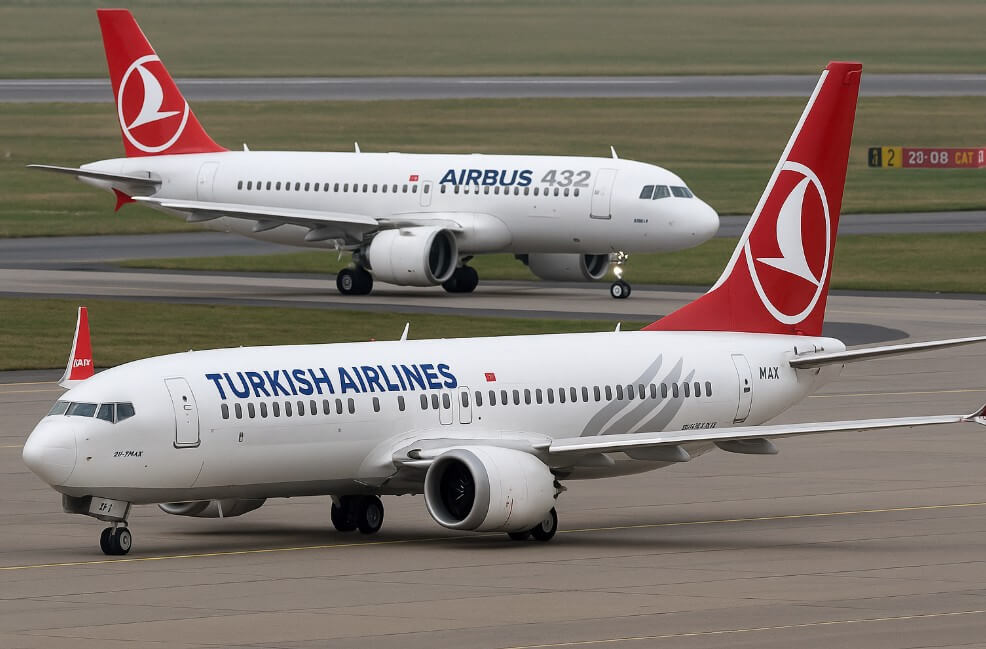
ISTANBUL — Turkish Airlines may partially redirect a major Boeing aircraft order to Airbus, as tense negotiations with engine supplier CFM International remain unresolved over pricing — a move that could reshape the carrier’s future fleet strategy and reverberate across the aviation industry.
Chairman Ahmet Bolat confirmed that discussions with CFM, a joint venture between GE Aerospace and Safran and the exclusive engine supplier for Boeing’s 737 MAX series, have advanced but are still incomplete. “If CFM continues its stance, we’ll change to Airbus. With Airbus, I have choices,” Bolat said, underscoring the leverage Airbus enjoys through its A320neo family, which can be powered by either CFM or Pratt & Whitney (PW) engines.
Engine Negotiations and Strategic Flexibility
The potential pivot highlights the growing pressure airlines face as supply chain constraints, engine shortages, and cost inflation ripple through global aviation. Turkish Airlines relies heavily on CFM engines for its 737 MAX jets — the backbone of its short- and medium-haul expansion plans — but the dispute over pricing could force a recalibration.
Airbus offers flexibility that Boeing does not. Its A320neo aircraft can use either CFM or PW engines, an advantage for carriers seeking resilience against supply bottlenecks. Turkish Airlines’ December 2023 record-breaking order for 355 Airbus jets — a mix of A320neo and A350 models — positioned the airline to balance between both manufacturers and mitigate supplier risk.
The carrier’s fleet currently includes 220 Airbus and 160 Boeing aircraft, with 60 more deliveries in the pipeline. Its strategy reflects a calculated diversification at a time when maintenance costs and parts availability have become critical variables in airline operations.
Disruptions and Industry Context
Pratt & Whitney engine issues have already impacted Turkish Airlines’ operations, grounding about 15% of its A320neo fleet in 2024. Globally, PW’s ongoing maintenance and durability challenges have led to widespread disruptions, forcing airlines to lease additional aircraft or delay route expansions.
Industry analysts suggest that despite the engine concerns, Turkish Airlines is unlikely to abandon Boeing altogether. Political momentum between Washington and Ankara, boosted by President Recep Tayyip Erdoğan’s first White House visit since 2019, supports continuity in U.S. aerospace cooperation. Furthermore, Airbus’ production lines are heavily booked through 2030, limiting immediate flexibility for large-scale orders.
Still, Bolat’s remarks signal growing frustration with suppliers as the aviation sector struggles to recover from pandemic-era production lags. Delays in aircraft and engine deliveries have strained fleet planning across carriers, with both Boeing and Airbus reporting backlogs stretching years ahead.
The Boeing Order and Its Implications
Turkish Airlines announced its Boeing deal during Erdoğan’s September 25 meeting with then-U.S. President Donald Trump. The agreement covers 100 Boeing 737 MAX jets for regional routes and 50 Boeing 787 Dreamliners for long-haul expansion into North America and Asia. The deal, valued at over $30 billion, also includes options for 75 additional aircraft, offering flexibility as Istanbul’s airport cements its role as a global transit hub.
The investment aligns with Turkish Airlines’ ambition to expand its fleet from 440 aircraft today to as many as 800 by 2033. That growth underpins broader national goals to position Turkey as a top-tier global aviation center and boost its tourism-driven economy. In 2024, Istanbul Airport handled about 85 million passengers, reinforcing its status as one of the world’s busiest hubs.
Industry Headwinds and Turkish Airlines’ Strategy
Post-pandemic recovery has intensified competition for new aircraft, while engine maintenance costs have surged roughly 20% since 2022, according to IATA data. Turkish Airlines’ scale — operating more than 4,000 weekly flights — gives it leverage in negotiations, but not immunity from the systemic pressures affecting airlines worldwide.
Bolat’s suggestion of an Airbus pivot appears to be a tactical move to extract better terms from CFM, mirroring a wider industry trend where carriers are pushing suppliers to share the financial burden of delays and maintenance issues. Yet analysts caution that Airbus’ limited manufacturing capacity could restrict Turkish Airlines’ ability to significantly shift from Boeing in the short term.
Long-Term Outlook: Confidence in Boeing’s 777X
Despite the current friction, Bolat reaffirmed Turkish Airlines’ long-term interest in Boeing’s next-generation 777X widebody, which has faced multiple certification delays and is now expected to enter service in 2027. “Once the timing is right, we’re going to order some 777X,” he said, signaling confidence in Boeing’s ability to deliver high-capacity aircraft for the carrier’s premium long-haul markets.
The 777X is seen as key to Turkish Airlines’ plans to expand business-class and ultra-long-haul services to North America and Southeast Asia, where premium travel demand is rising by about 15% annually.
Outlook
Turkish Airlines’ dual-supplier approach — balancing Boeing’s reliability with Airbus’ flexibility — underscores its pragmatic adaptation to a turbulent aviation market. As global engine shortages and delivery delays persist, the carrier’s capacity to pivot between manufacturers could prove a decisive advantage.
Bolat’s warning to CFM encapsulates the broader industry mood: airlines are no longer willing to bear the brunt of supply-side disruptions without alternatives. In an era defined by complex logistics and geopolitical competition, Turkish Airlines’ strategy may offer a blueprint for resilience — and a signal that even the world’s largest suppliers are not immune to pressure from their biggest customers.
