


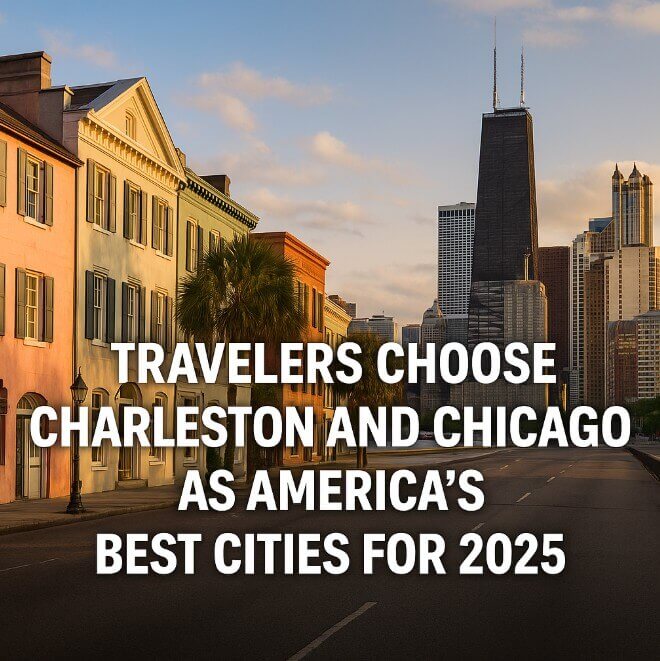
CHARLESTON, S.C. — As the post-pandemic travel landscape continues to evolve, U.S. travelers are redefining what makes a city “the best.” According to Condé Nast Traveler’s 2025 Readers’ Choice Awards, Charleston and Chicago once again top the list of America’s most popular destinations — a reflection of the growing importance of connectivity, culture, and value in shaping where travelers want to go.
The annual survey, which drew responses from more than half a million readers, ranks cities, hotels, airlines, and airports across multiple categories. For cities in particular, respondents rated destinations on walkability, dining, lodging, friendliness, and overall atmosphere. This year’s results highlight an emerging shift: travelers are favoring accessible, mid-size destinations that offer strong local culture and good value over sheer size or prestige.
Charleston and Chicago Lead the Way
For the second consecutive year, Charleston, South Carolina, claimed the title of Best Small U.S. City, while Chicago topped the Best Large U.S. City category for the sixth year running. Together, they represent the dual appeal driving modern travel — authenticity paired with accessibility.
Charleston’s rise has been supported by expanded air service through Delta Air Lines (DL), American Airlines (AA), and low-cost carrier Breeze Airways (MX). “Travelers are valuing convenience and atmosphere over sheer size or luxury,” the Condé Nast Traveler release noted. Chicago, meanwhile, continues to benefit from its world-class dining, architectural appeal, and strong aviation network centered around O’Hare International Airport (ORD), a key hub for both United Airlines (UA) and American Airlines (AA).
A New Focus on Value and Experience
The 2025 rankings reflect a broader cultural realignment in U.S. travel habits. Mid-size cities that were once considered “hidden gems” — such as Santa Fe, Savannah, and Asheville — are now firmly in the spotlight. Each has seen growth in direct air routes and hotel development as airlines respond to traveler demand for authentic, experience-driven destinations.
The inclusion of “value for money” as a more heavily weighted metric this year also shifted results toward destinations that balance affordability with premium experiences. “Cities that offer walkability, regional culture, and diverse culinary experiences — backed by easy flight access — are outperforming traditional gateways,” the report explained.
The Rise of the Mid-Size City
Airlines have been central to this transformation. Carriers including Delta, United, and Southwest Airlines (WN) have expanded beyond traditional hub systems, connecting secondary and leisure-oriented cities through point-to-point routes. Fuel-efficient aircraft such as the Airbus A321neo and Boeing 737 MAX have made it economically viable to serve smaller markets with fewer passengers but higher yield potential.
As a result, destinations like San Antonio, Boulder, Burlington, and Milwaukee (MKE) are seeing record passenger numbers and growing tourism economies. These cities offer travelers what the industry increasingly calls “access with character” — regional authenticity without the logistical hassle of major metropolitan travel.
Major Hubs Still Hold Their Own
Despite the rise of regional destinations, major cities continue to hold their place at the top of traveler wish lists. San Diego, Boston, and San Francisco ranked highly this year, each maintaining a balance between global appeal and local quality of life. San Diego, in particular, gained momentum following the completion of its airport modernization project, now positioning itself as one of the most efficient mid-size airports in the country.
Chicago’s repeat victory underscores its enduring versatility. As one of America’s leading aviation centers and a culinary and cultural capital, the city demonstrates how large urban hubs can continue to thrive by evolving with traveler expectations.
The Bigger Picture
The 2025 Condé Nast Traveler rankings offer more than just a snapshot of popular destinations — they capture a structural change in how Americans think about travel. After years of disruption, travelers are increasingly prioritizing comfort, connection, and character over marquee names or size alone.
“The strong showing of small and mid-size cities suggests that travelers are no longer simply chasing landmarks but looking for connection, comfort, and character,” the release concluded.
As airlines, city tourism boards, and investors adapt to this shifting demand, one thing is clear: America’s best cities in 2025 aren’t just the biggest — they’re the ones that feel closest, both in spirit and in reach.
