


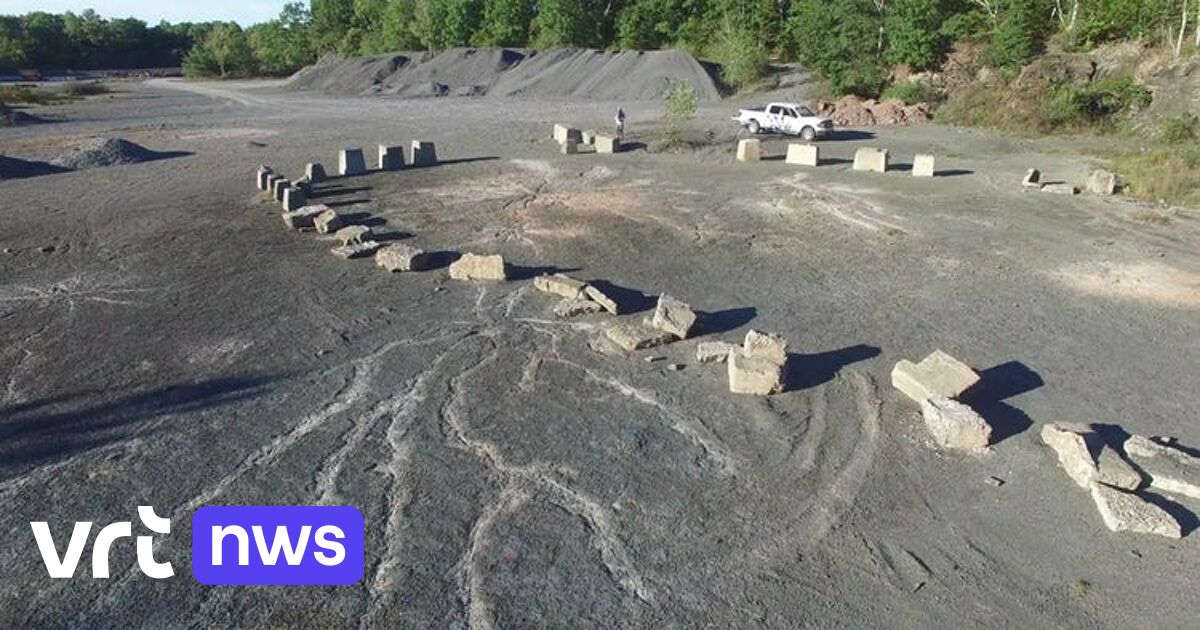
It all started in the Catskill Mountains of New York State in 2009. There, scientists discovered the fossilized remains of woody tree roots on a large slab of rock. After the discovery, more research was done on the age of the fossils.
Some roots are 15 cm in diameter. They form a horizontal pattern that extends up to 11 meters wide like the bars of a bicycle.
They may belong to Archaeopteris, a type of tree with large, woody roots, researchers reported in 2019 in the journal Current Biology.
Plants and trees grew very early in Earth's evolution, during the period when Earth evolved into a tree-filled planet. In the meantime, more research was carried out in and around the site to try to find out exactly what trees and plants grew there, and how big the forest was.
“The forest that extended over 400 kilometers”
The BBC wrote that research teams from Binghamton University in the United States and Cardiff University in Wales believe that the forest extended for more than 400 kilometers. They reached this conclusion by studying other fossil remains of trees and plants in the area. They also found confirmation that it is the oldest forest in the world. Other ancient forests can be found in the Amazon region and Yakushima in Japan.
Very old trees are likely breeding spores
The trees at the ancient American site probably did not reproduce using fruit seeds, as is often the case with today's trees. Instead, they used spores, which are very small particles released into the air that can be carried on the wind. Fern and mushrooms, among others, still use the same technique today.
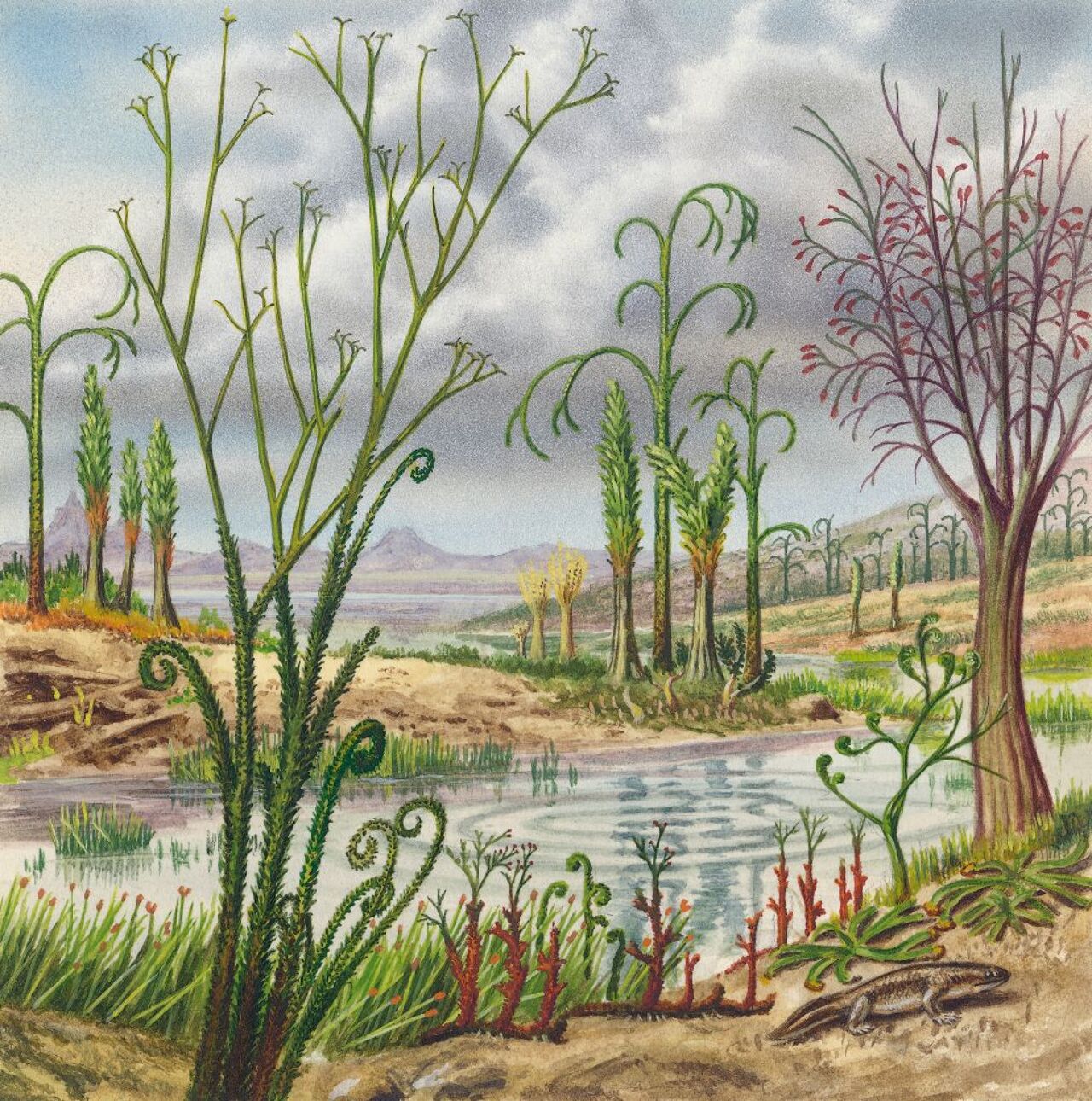
This drawing shows primitive plants, trees, and animals early in Earth's evolution, including Asteroxylon, Archaeo-Sigillaria, Pseudosporochnus, Duesbergia, Archaeopteris, Srepanophyeus, Rhynia, and Ichthyostega.
“Such big trees were acceptable before.”
Science magazine actually wrote about the significance of this discovery in 2019. Until then, Archeopterys was thought to be 365 million years old, but it turned out to be 20 million years older.
And there's more. “The size of the root network completely changes the picture,” said Patricia Gensel, a paleontologist at the University of California, California. “Until about 20 years ago, we thought that trees with such a large and complex root system could not have existed so early in our geological evolution.” “. North Carolina State University, about it.
Watch an informational video from 2019 here:
The climate changed much earlier
The fact that trees grew so long ago must have had a major impact on Earth's climate. Tree roots have opened up the rocks, causing more carbon dioxide to be extracted from the air through weathering of the rocks. The trees themselves also increased carbon dioxide uptake.
Through a process lasting millions of years, the carbon dioxide content decreased and more oxygen became available in the air. Scientists believe that 300 million years ago there was 35% more oxygen in the atmosphere, more than there is today. This may have led to the emergence of large insects with a wingspan of up to 70 cm.
