


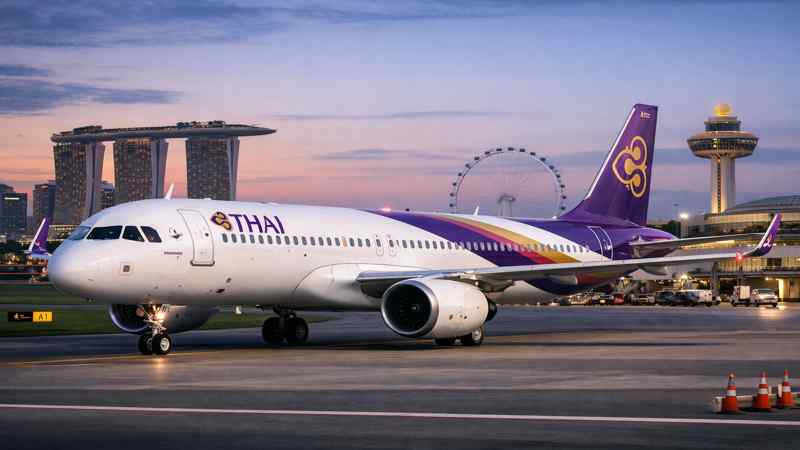
BANGKOK — Thai Airways has begun deploying its new Airbus A321neo aircraft as part of a broader regional rebuilding strategy designed to restore flight frequencies, reopen suspended routes, and reinforce Bangkok’s position as a key Asia-to-Asia transit hub. The move marks a significant milestone for the carrier following years of pandemic-driven disruption and a comprehensive fleet rationalization that reshaped its short- and medium-haul operations.
The first A321neo entered commercial service on a scheduled flight from Bangkok Suvarnabhumi Airport to Singapore Changi Airport, a route traditionally served by widebody aircraft. According to the airline, the inaugural flight posted strong demand, with business class nearly full and economy class averaging approximately 85 percent occupancy, signaling a solid recovery in premium and leisure travel on one of Southeast Asia’s busiest corridors.
A Structural Shift in Regional Strategy
The introduction of the A321neo represents a structural shift in how Thai Airways is rebuilding its regional network. Rather than positioning narrowbody aircraft solely as a cost-saving alternative to widebodies, the airline is deploying the A321neo as a full-service extension of its long-haul product. This approach allows Thai Airways to increase frequency on high-demand routes while preserving premium standards expected by corporate and connecting passengers.
The aircraft also gives the airline flexibility to reenter thinner markets that cannot yet sustain widebody capacity but remain strategically important for network breadth and connectivity. Management has emphasized that the narrowbody fleet will play a central role in restoring intra-Asia links, supporting Bangkok’s role as a transfer hub connecting Southeast Asia, China, and the Indian subcontinent.
Premium Cabin and Passenger Experience
Thai Airways has configured the A321neo with a strong emphasis on passenger comfort, reflecting its intention to maintain brand consistency across fleet types. The aircraft features 16 fully lie-flat business class seats arranged in a 1-1 configuration, providing direct aisle access for every passenger and a premium experience comparable to long-haul cabins.
In economy class, seats are slimmer and more ergonomic, enabling larger personal entertainment screens and improved legroom. The aircraft also includes enlarged overhead bins capable of accommodating standard carry-on luggage across all cabins, addressing a common pain point on regional flights where storage space is often limited.
Environmental and Operational Efficiency
From an environmental perspective, the A321neo delivers approximately 20 percent lower carbon emissions compared with older-generation narrowbody aircraft. The model is also capable of operating with up to 50 percent sustainable aviation fuel, aligning with Thai Airways’ longer-term sustainability objectives and the broader aviation industry’s push to reduce its carbon footprint.
Operationally, the aircraft’s fuel efficiency and range enable the airline to serve medium-haul Asian routes more economically while maintaining schedule reliability and product quality. These attributes are particularly valuable as carriers across the region adjust capacity in response to uneven post-pandemic demand recovery.
Fleet Simplification and Growth Plan
The A321neo will be deployed primarily across Asian markets, including China, India, Southeast Asia, and selected domestic routes within Thailand. Beijing represents the aircraft’s longest planned sector, at just under five hours from Bangkok, demonstrating the model’s capability to operate near the upper end of narrowbody range while still delivering a premium onboard product.
The additional capacity supports the restoration of routes suspended during the pandemic, particularly to secondary Chinese cities, and enables frequency growth in markets such as India and Malaysia, where demand has rebounded strongly. As part of its rehabilitation plan, Thai Airways is simplifying its fleet to four aircraft families to improve efficiency and reduce complexity.
Once all deliveries are completed, the airline expects to operate 52 narrowbody aircraft across its A320 and A321neo fleets, with new A321neos arriving almost monthly, providing steady capacity growth through the recovery phase.
Bottom Line
Thai Airways is leveraging the A321neo to rebuild its regional network with greater flexibility, resilience, and premium consistency. The aircraft supports frequency growth, environmental efficiency, and hub connectivity, reinforcing the carrier’s long-term strategy rather than signaling a shift toward low-cost competition. As regional travel demand continues to recover, the narrowbody fleet is set to become a cornerstone of Thai Airways’ next phase of growth.
