


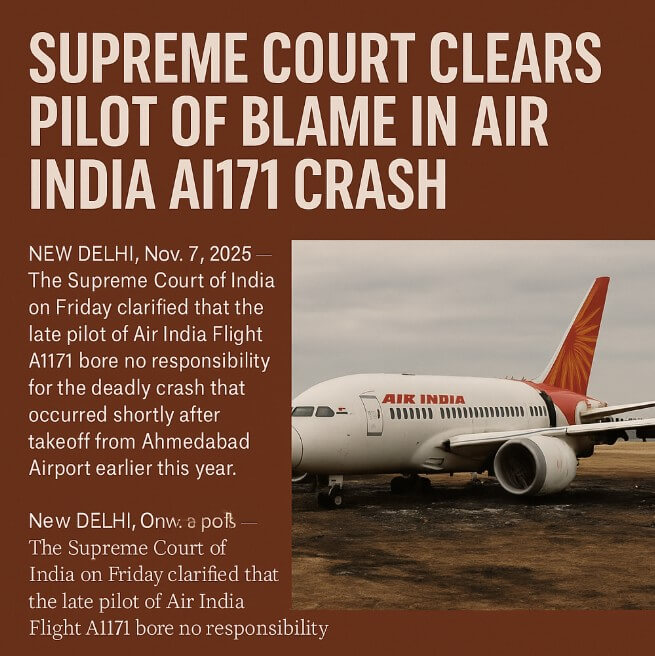
NEW DELHI, Nov. 7, 2025 — The Supreme Court of India on Friday clarified that the late pilot of Air India Flight AI171 bore no responsibility for the deadly crash that occurred shortly after takeoff from Ahmedabad Airport earlier this year. The ruling came as the Court heard a petition filed by the father of the pilot-in-command, who sought judicial recognition that his son was not at fault.
The Court’s remarks directly address widespread speculation surrounding the tragedy, which claimed the lives of more than 250 passengers and crew on June 12, 2025, en route from Ahmedabad (AMD) to London Heathrow (LHR). The justices stated that the preliminary findings of the Aircraft Accident Investigation Bureau (AAIB) do not assign culpability to the pilot.
Court Assures Family of Deceased Pilot
During the hearing, the Supreme Court reviewed excerpts from the AAIB’s initial report, which revealed that both engine fuel-control switches on the Boeing 787-8 aircraft shifted from “RUN” to “CUTOFF” nearly simultaneously moments after takeoff. Despite this technical finding, the Court underscored that there is no evidence suggesting intentional pilot error.
According to the accident report:
“In the cockpit voice recording, one of the pilots is heard asking the other why did he cutoff. The other pilot responded that he did not do so…..At about 8:09:05 UTC, one of the pilots transmitted ‘MAYDAY MAYDAY MAYDAY’. The ATCO enquired about the call sign. ATCO did not get any response but observed the aircraft crashing outside the airport boundary.”
The Court reiterated that the report merely documents factual data and does not attribute responsibility to the flight crew. Notices were issued to the Union government and the Directorate General of Civil Aviation (DGCA), with a follow-up hearing scheduled for November 10 to consider whether a judicially monitored independent inquiry should be launched.
Bench Rejects Pilot-Blame Narrative
Addressing the 91-year-old petitioner, the bench sought to ease the anguish of the pilot’s family.
“It’s extremely unfortunate this crash occurred, but you should not carry this burden that your son is being blamed. Nobody can blame him for anything,” one justice said.
Another member of the bench added:
“There is no insinuation against him in the report… We are a country of 142 crore people and none of them believe the blame has to go to the pilot.”
The Court also criticized certain foreign media outlets for publishing speculative accounts that suggested deliberate pilot action. Calling such coverage “nasty,” the justices emphasized that accident inquiries in India are governed by domestic investigative protocols, not external commentary. “Indian investigation frameworks—not external press reports—govern the process,” one justice remarked.
Legal Framework and Broader Implications
Under the Aircraft (Investigation of Accidents and Incidents) Rules, 2017, the AAIB is responsible for conducting independent investigations into air crashes. Rule 12 of the framework allows for a court-monitored review if circumstances warrant an “independent inquiry.” The current case may test the limits of that provision.
The petitioner, supported by the Federation of Indian Pilots, has argued that possible systemic or mechanical failures in the Boeing 787-8 should be thoroughly examined, rather than focusing narrowly on crew performance. They have urged that the investigation expand to assess potential malfunctions within the aircraft’s engine-control and flight-management systems.
The Court signaled, however, that any challenge to the structure or scope of the probe must be made within the confines of existing law. It observed that the petitioners would need to question the rules themselves if they wish to contest how the AAIB operates under the statutory regime.
A Turning Point for Aviation Accountability
The Supreme Court’s categorical statement—that there is “no insinuation” of fault against the pilot—represents a major development in India’s ongoing effort to balance aviation safety oversight with fairness toward flight crews. The clarification also helps counteract narratives that often arise in the aftermath of major aviation disasters, where pilot error becomes an easy but premature explanation.
The outcome of the November 10 hearing could determine whether the AI171 investigation evolves into a broader inquiry encompassing aircraft design, maintenance standards, and regulatory accountability. Aviation experts note that such a move would underscore India’s commitment to transparent, evidence-based accident investigation.
For now, the Court’s intervention offers relief to the bereaved family and restores a measure of dignity to the pilot’s legacy. It also reinforces the judiciary’s role in ensuring that technical investigations remain free from public or political bias.
As the investigation proceeds, the focus is expected to shift toward whether deeper mechanical or procedural issues played a role in one of the worst aviation tragedies in recent Indian history.
