


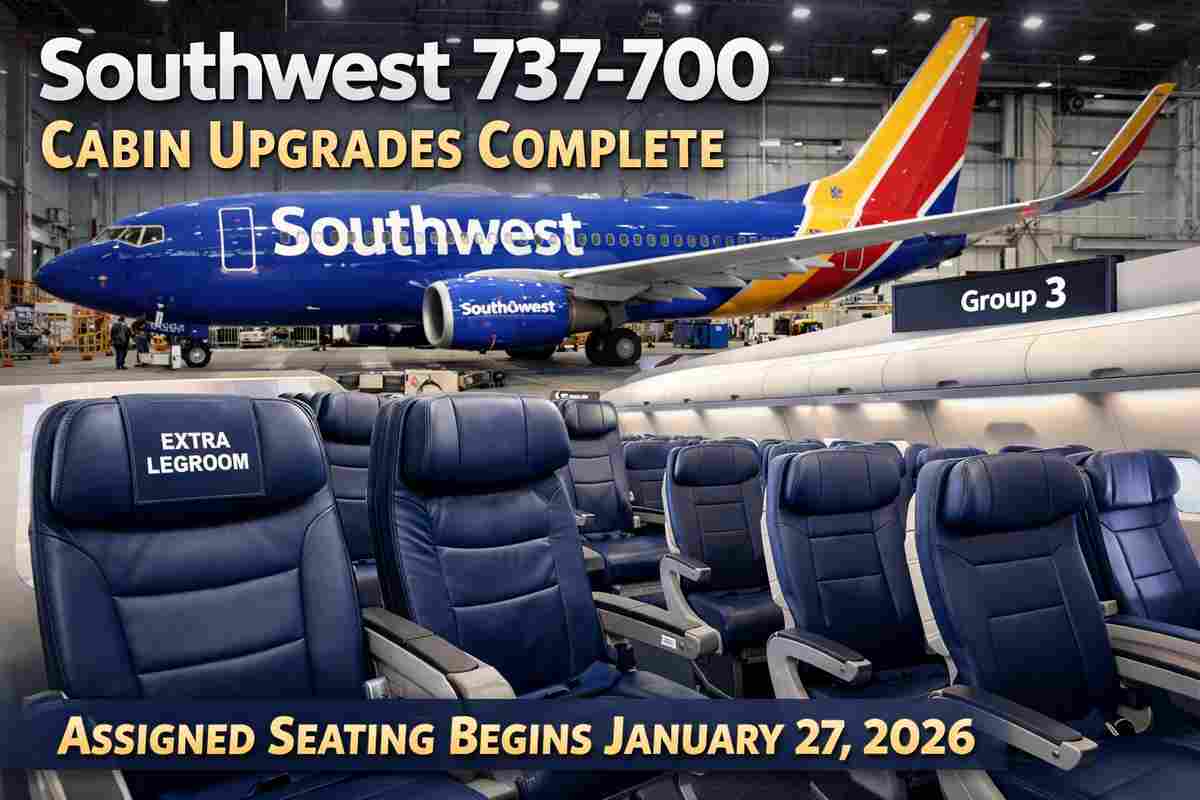
Southwest Airlines has completed a fleetwide cabin modification program across its Boeing 737-700 aircraft, marking a major operational milestone ahead of the carrier’s transition to assigned seating in early 2026.
The Dallas-based airline confirmed that all 300 Boeing 737-700 jets have now been reconfigured to support the new seating model. The work clears what Southwest described as the final technical hurdle before its long-planned move away from open seating, scheduled to launch on January 27, 2026.
Southwest’s cabin overhaul comes as the carrier works to modernize its onboard product and strengthen revenue performance amid intensifying competitive and investor pressure. The airline has positioned the upgrades as part of a broader commercial reset designed to better align with evolving passenger expectations.
Cabin Reconfiguration Creates Space for Extra-Legroom Seats
The modifications across the 737-700 fleet included seat pitch adjustments, interior hardware updates, and a full cabin reconfiguration. A key element of the program involved removing one row of seats from each aircraft.
This change was necessary to create space for extra-legroom seating while maintaining operational consistency across the fleet. Because the Boeing 737-700 has a smaller cabin than other aircraft in Southwest’s network, the retrofit was more complex than changes being made to larger models.
The completed work positions the airline to introduce a more differentiated onboard product, with extra-legroom seating expected to become a major paid offering once assigned seating launches.
Timing Designed to Avoid Holiday Revenue Disruption
Southwest executives said the airline intentionally waited to begin the cabin work until January to avoid reducing capacity during the peak holiday travel period.
Southwest’s chief financial officer, Tom Doxey, stated that the airline deliberately delayed the work until January to avoid revenue disruption during the peak holiday travel season.
Beginning the changes earlier would have forced the airline to sell fewer seats across the entire 737-700 fleet during a high-demand period, putting pressure on revenue at a time when airlines typically see some of their strongest seasonal demand.
Accelerated Overnight Modifications Finished Ahead of Schedule
Southwest’s technical operations team completed the fleet modifications at an accelerated pace, modifying multiple aircraft each night to keep the project moving quickly.
That execution allowed the airline to finish the retrofit program a full week ahead of schedule while still staying on track for the January 27, 2026 assigned seating rollout date. The faster timeline also helped limit the number of aircraft out of service at any given time, reducing disruption to the carrier’s network.
Assigned Seating Begins January 27, 2026
On January 27, Southwest will introduce assigned seating, ending its long-standing open seating policy and representing one of the most significant customer-facing changes in the airline’s history.
The new boarding process will include eight numbered groups, with higher-fare passengers and loyalty members receiving priority boarding. Southwest has said extra-legroom seating will become a key paid product, with the airline previously indicating that roughly one-third of seats will fall into this category.
The shift brings Southwest more in line with major U.S. airline competitors that have long used assigned seating and upsell seating options as an important driver of revenue.
Other Aircraft Types Seeing Different Retrofit Approach
While the 737-700 fleet required removing a full row of seats, Southwest is taking a different approach on larger aircraft.
On Boeing 737-800 and 737 MAX 8 jets, the airline is adjusting seat pitch in standard economy rather than removing rows. That approach reflects the additional cabin space available on those aircraft, allowing Southwest to introduce extra-legroom seating without reducing overall seat counts as sharply.
Southwest has not yet confirmed whether cabin retrofit work is complete across all other fleet types. However, the airline indicated that the 737-700 program represented the most complex phase due to the aircraft’s smaller cabin dimensions.
Strategy Shift Comes Amid Investor Pressure and Weaker Results
Southwest’s decision to overhaul its seating model follows several quarters of weaker financial performance, prompting calls for faster modernization and new revenue opportunities.
The airline has faced mounting pressure from investors, including activist firm Elliott Investment Management, to modernize its product and revenue strategy. In response, Southwest has increasingly signaled it is willing to adjust long-standing policies and business practices to better compete with U.S. peers.
Customer research conducted by the airline showed a clear shift in traveler preferences since the pandemic. Passengers expressed a strong desire for seat certainty, premium legroom options, and a more differentiated product compared with ultra-low-cost carriers.
Broader Policy Updates Extend Beyond Seating
The move toward assigned seating is part of a wider effort to reposition Southwest’s product in the market.
According to Flight Global, beyond seating changes, Southwest has also revised other long-standing policies.
These include ending its “free bags” positioning and expanding partnerships with international carriers to extend its global reach beyond a historically domestic-focused network.
Bottom Line
Southwest’s completion of Boeing 737-700 cabin modifications removes a major operational barrier ahead of its assigned seating debut on January 27, 2026.
The changes signal a decisive strategic shift for the airline as it adapts its onboard product and revenue model to meet changing customer preferences and compete more directly with other major U.S. carriers.
