


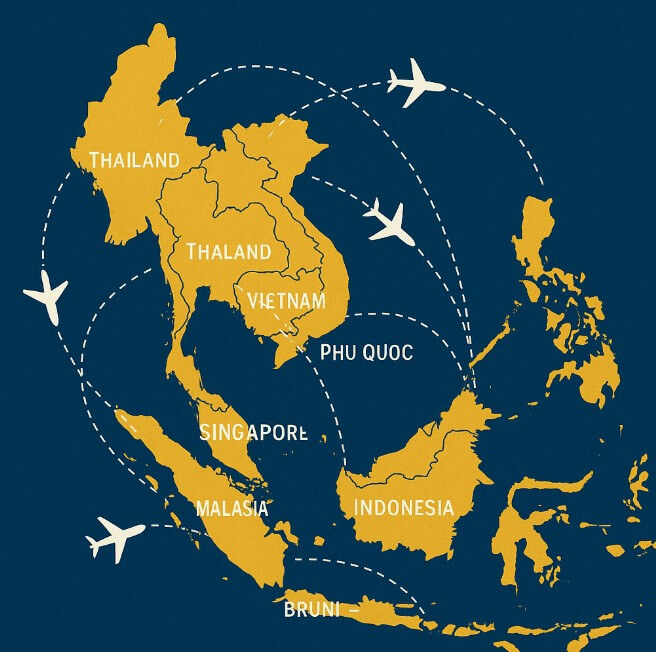
In a year marked by turbulence across global aviation, Southeast Asia is charting a steadier course. Intra-ASEAN air travel has rebounded strongly, positioning the region as one of the most resilient and fastest-recovering aviation markets worldwide.
According to recent data, Southeast Asia’s intra-regional seat capacity for Summer 2025 reached 46 million — a 7% increase from Summer 2024. While still 6% below the 2019 peak of 50 million seats, the consistent upward trend underscores the region’s growing stability and self-sufficiency in air travel.
A Regional Network Taking Flight
The Association of Southeast Asian Nations (ASEAN) — comprising Brunei Darussalam, Cambodia, Indonesia, Laos, Malaysia, Myanmar, the Philippines, Singapore, Thailand, and Vietnam — has long been defined by cultural and economic interconnectivity. Now, those connections are increasingly reflected in the sky.
Intra-ASEAN travel made up 37% of international arrivals in 2019, rising to 45% by 2024, according to OAG data. As long-haul routes face persistent headwinds from geopolitical and economic uncertainty, regional connectivity is insulating Southeast Asia’s carriers and travelers from global volatility. Airlines have redoubled efforts to rebuild networks, restore routes, and add new links between cities within the bloc.
Malaysia, Singapore, and Vietnam Lead Recovery
Malaysia currently leads the region with 19.3 million scheduled seats to other ASEAN destinations for Summer 2025, down only 5.5% from 2019. Singapore, the traditional regional hub, follows closely with 19 million seats, just 10% below pre-pandemic levels. Despite Malaysia’s narrow lead, Singapore remains a critical node: six of ASEAN’s ten busiest routes either begin or end there.
The standout performer, however, is Vietnam. The country expanded its intra-ASEAN seat capacity by 21.8% year-over-year and now surpasses its 2019 levels by 8.5%. Its number of regional routes has grown from 45 in 2019 to 51 in 2025. Emerging destinations like Danang and Phu Quoc are driving this surge — Danang added five new routes and Phu Quoc three, linking to key cities such as Bangkok and Jakarta.
The Rise of Secondary City Connections
A defining trend in Southeast Asian aviation is the shift from capital-centric to secondary city routes. In Summer 2025, seat capacity between non-capital city pairs within ASEAN rose by 18% compared to the previous year. There are now 50 more intra-ASEAN connections than in 2019, most between smaller or regional airports.
Indonesia has led the charge, accounting for 22 of the new routes, while Malaysia added ten. Notable additions include new Kuala Lumpur–Indonesia city links and connections from Kota Kinabalu. Bali, Indonesia’s top leisure hub, introduced new routes to Hanoi and Phuket. These emerging corridors are helping distribute tourism and commerce more evenly across the region, reducing pressure on major hubs.
Budget Carriers Fuel Expansion
Low-cost carriers (LCCs) such as AirAsia, VietJet, and Lion Air continue to shape the region’s aviation landscape. Their aggressive expansion across ASEAN has democratized travel, offering affordable fares that appeal to both domestic and international passengers. The proliferation of LCC routes to secondary and tertiary cities has expanded access, fueling economic growth beyond traditional centers.
Timor-Leste Joins the Network
Even as ASEAN prepares to welcome Timor-Leste as its 11th member by the end of 2025, the country is already becoming part of the region’s aviation network. Batik Air Malaysia launched service between Kuala Lumpur and Dili in June 2025, and flights between Singapore and Dili increased seat capacity by an astonishing 2,697% since 2019 — from just 354 to 9,900 seats. Though starting from a low base, this surge marks a pivotal step in integrating smaller markets into ASEAN’s aviation ecosystem.
Vietnam’s Phu Quoc: A Case Study in Leisure Growth
Phu Quoc, Vietnam’s tropical island destination, has become emblematic of ASEAN’s new aviation momentum. Seat capacity between Phu Quoc and Bangkok’s Suvarnabhumi Airport has soared 265% since 2019. Initially operated by Bangkok Airways, the route is now led by Thai Vietjet, which more than doubled its seats from 56,880 in Summer 2024 to 107,368 by April 2025. Combined with new flights from Thai AirAsia and Thai Lion Air out of Bangkok Don Mueang Airport, total seat capacity on the route has reached 183,403. This rapid expansion underscores how leisure travel is driving the region’s aviation revival.
Strength Through Regional Focus
With global air travel still vulnerable to inflation, conflicts, and shifting trade policies, ASEAN’s inward focus is proving an advantage. When land border closures between Thailand and Cambodia in mid-2025 disrupted overland transport, robust air links ensured travelers remained mobile — a testament to the resilience of the region’s network.
Industry analysts suggest that intra-ASEAN travel could be the cornerstone of Southeast Asia’s long-term aviation strategy. By emphasizing flexibility, affordability, and connectivity among neighboring nations, the region is creating a self-sustaining travel market less dependent on volatile intercontinental traffic.
A Stable Ascent
While many global markets continue to struggle for equilibrium, Southeast Asia’s aviation industry is climbing confidently. With Malaysia, Vietnam, and Indonesia leading growth, a surge in secondary city connections, and an expanding low-cost carrier ecosystem, the ASEAN bloc is building a durable foundation for sustained success.
As travelers increasingly look within the region for business and leisure, Southeast Asia may not just be the most stable — but the most strategically positioned — air travel region in the world.
