


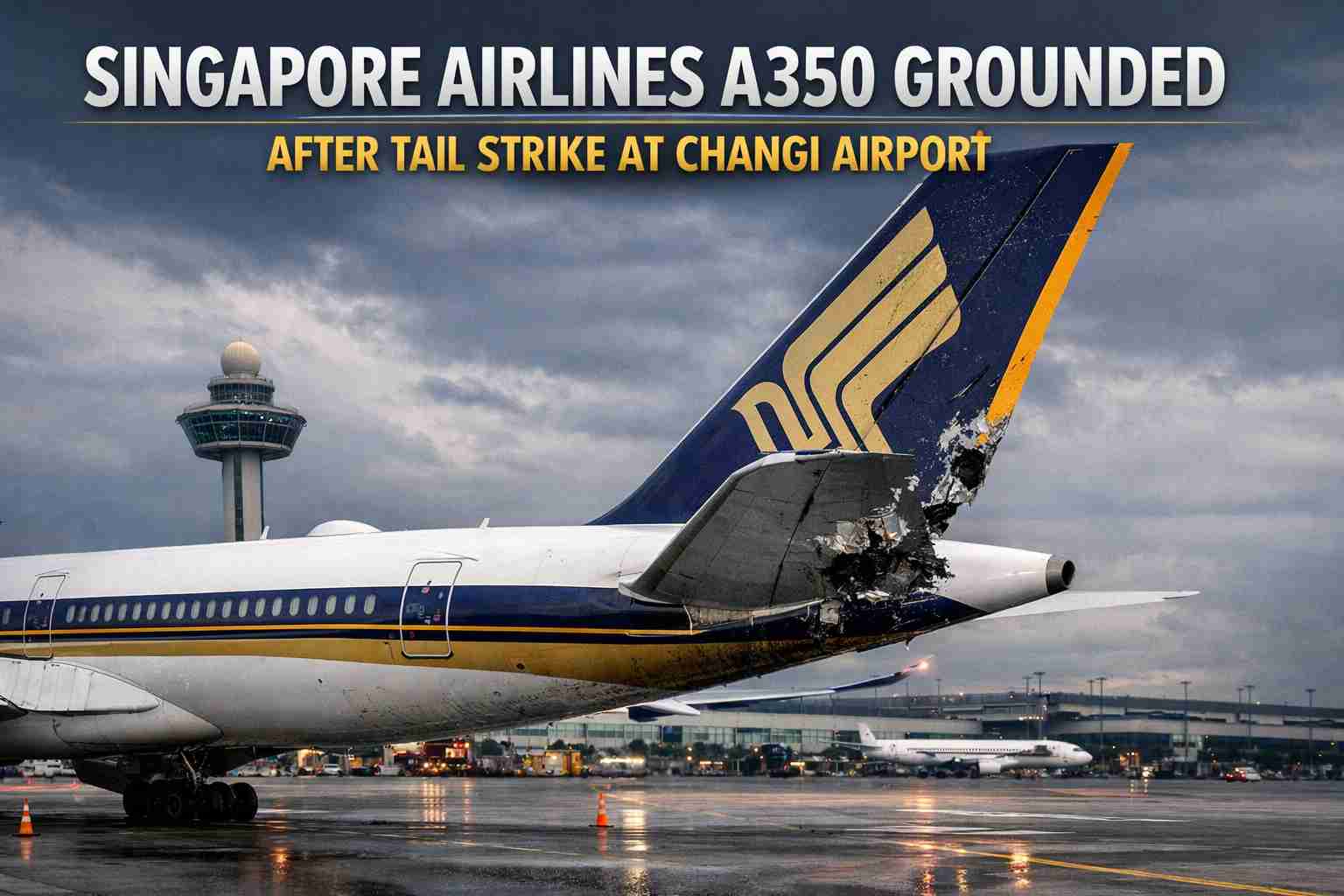
SINGAPORE — A widebody aircraft operated by Singapore Airlines has been grounded for repairs after sustaining tail damage during a landing attempt at Singapore Changi Airport, underscoring the operational challenges airlines face during adverse weather conditions and the high safety margins built into modern aviation.
The incident occurred on January 24, 2026, when an Airbus A350-900 operating flight SQ917 from Manila to Singapore encountered strong winds during its initial approach. The aircraft, carrying 256 passengers and 16 crew members, ultimately landed safely on a second attempt. No injuries were reported.
Aborted Landing Leads to Aircraft Damage
According to Singapore Airlines, the first landing attempt at approximately 6.07 p.m. local time was aborted due to unfavorable wind conditions at Singapore Changi Airport. During this rejected landing, the aircraft’s tail made contact with the runway surface.
A rejected landing—also referred to as an aborted landing—occurs when pilots discontinue the landing process shortly before or immediately after touchdown to maintain safety. While such maneuvers are a standard part of flight operations, they require precise handling, particularly in challenging weather.
After executing a go-around, the A350 returned for a second approach and landed safely at about 6.32 p.m. The aircraft then taxied to the terminal without further incident, and all passengers and crew disembarked normally.
Aircraft Grounded for Repairs
Images later circulated on the social media platform X, shared by the Breaking Aviation News page, showed visible scrape marks on the underside of the aircraft’s tail, consistent with a tail strike. Singapore Airlines confirmed that the aircraft has been grounded and is undergoing repairs.
The airline said the incident did not disrupt airport operations or subsequent flight schedules, indicating that contingency measures were sufficient to absorb the impact of the grounded aircraft.
Weather Conditions Under Review
Singapore’s aviation regulator, the Civil Aviation Authority of Singapore, has been contacted for further details regarding wind conditions at the airport at the time of the incident. As of publication, no official statement had been released on the severity of the weather or whether any specific operational advisories were in effect that evening.
Weather-related events remain a key variable in airline operations, particularly in major hubs where traffic density is high and even minor disruptions can have cascading effects.
Similar Incident Involving Cathay Pacific
The Singapore Airlines event follows a similar recent incident involving Cathay Pacific, which grounded an Airbus A350-1000 after a tail strike during a missed approach at Hong Kong International Airport.
That aircraft was operating a scheduled service from Ho Chi Minh City to Hong Kong when an unstable approach prompted the flight crew to initiate a go-around. Flight tracking data indicated the aircraft drifted left of the runway centerline during the final phase of approach.
During the go-around, the aircraft’s tail made contact with the runway as thrust and pitch were increased. Despite the strike, the aircraft climbed normally to about 6,000 feet, repositioned, and landed safely on a second attempt. The flight arrived approximately 34 minutes behind schedule, shortly before midnight local time. No injuries were reported.
Inspection and Operational Impact
The affected A350-1000, approximately four years old, has remained grounded for several days while engineers conduct detailed structural inspections. Cathay Pacific has said required repairs are underway and that the aircraft will not return to service until all safety checks are completed.
Aircraft groundings, while costly, are a routine part of airline risk management and reflect regulatory and manufacturer standards designed to prioritize safety over operational continuity.
Understanding Tail Strike Risks
A tail strike occurs when the lower rear fuselage contacts the runway, typically due to excessive nose-up pitch. Industry data shows that roughly 65 percent of tail strikes occur during landing, while about 25 percent take place during takeoff. Go-arounds carry additional risk because pilots must simultaneously apply high thrust and manage pitch during a high-workload phase.
Modern aircraft are equipped with multiple systems to reduce these risks. Airbus aircraft feature pitch limit indicators and audible warnings, while Boeing has introduced automated tail strike protection on certain models. These systems support, but do not replace, precise pilot control—particularly in challenging conditions such as strong winds.
Both recent incidents highlight how layered safety systems, pilot training, and regulatory oversight work together to ensure that even when unexpected events occur, passengers and crew are able to complete their journeys safely.
