


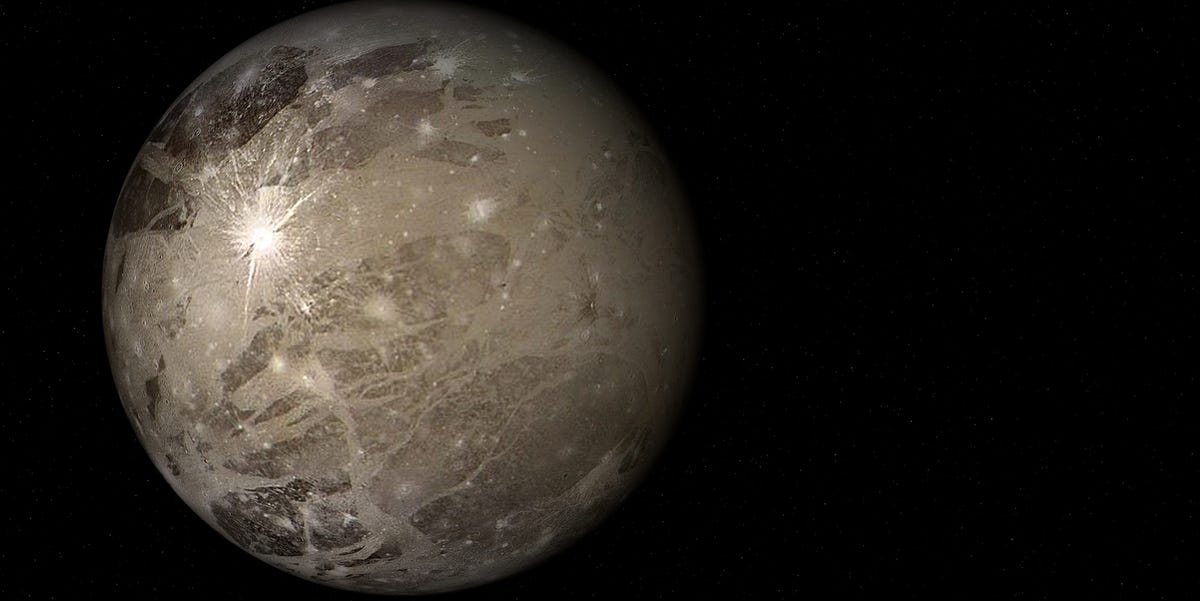
Let’s turn back the clock to January 7, 1610. Italian astronomer Galileo Galilei peered into space with an early version of a telescope. For the first time, he sees moons orbiting outside our Earth’s orbit. Gaimede, Io, Europa, and Callisto orbit Jupiter and are among the largest moons in our solar system.
Of the four Galilean moons, Ganymede stands head and shoulders above the rest. This icy world is not only the largest of Jupiter’s moons, but the largest of our entire solar system. Even the dwarf planets Mercury and Pluto lose to Ganymede in size. The giant icy moon is the focus of ESA’s Jupiter Icy Moons Explorer (JUICE). Why is this moon of Jupiter so interesting to scientists?
Aurora borealis at the poles of Ganymede
Joyce is not the first space probe to target Ganymede. NASA’s Galileo spacecraft discovered in 1996 that the Moon has its own magnetic field. A surprising discovery, because until then this seemed to be limited to planets and stars only. Ganymede’s magnetic field causes, among other things, the aurora borealis at the moon’s north and south poles.
It was precisely those aurora borealis that led scientists in 2016 to find strong evidence of a huge saltwater ocean beneath Ganymede’s surface. The Hubble Telescope studied the motions of the aurora around Ganymede, which are affected by both the Moon’s magnetic field and Jupiter’s magnetic forces.
Subterranean ocean?
It turns out that the aurora over Ganymede moves back and forth less quickly than you would expect based on magnetic fields. According to NASA research, an underground ocean could be the explanation. This salty ocean is estimated to be 100 kilometers deep, and is buried under a thicker layer of ice 150 kilometers deep. This also means that the ocean beneath Ganymede’s surface contains more water than the entire surface of the Earth.
Where there is water, there may be life, although no concrete evidence has yet been found that this is the case at Ganymede. This may change in the near future with ESA’s JUICE mission. After a successful launch in early 2023, this space probe is now on its way to Jupiter and its moons. If all goes according to plan, JUICE will reach Jupiter in December 2031.
After a few orbits around the planet, the space explorer sets course for Ganymede. Scientists hope to answer many questions about the moon there. How does the magnetic field arise around Ganymede and why do other moons not have this field? What does the underground ocean look like and does it provide the possibility of life? Hopefully time will tell.

Want to read more about space? Order the new issue of National Geographic magazine now!
Willick Van Doorn studied journalism, traveled the world for a while, and eventually ended up in the editorial offices of Quest, National Geographic, and Runner’s World across the United States, Australia, and New Zealand. She is interested in the world, prefers to travel every month and always takes her running shoes with her.
