


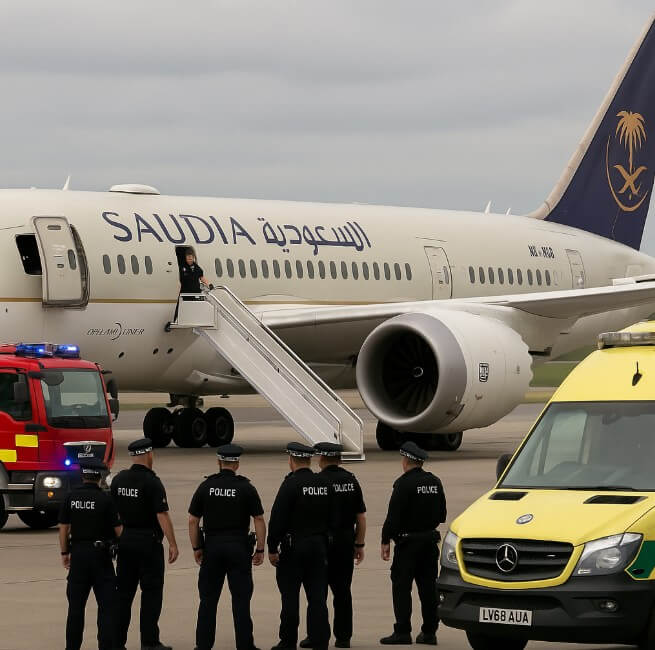
LONDON — August 28, 2025. — A Saudia Airlines Boeing 787 arriving at London Heathrow was met by a heavy emergency response Thursday after a passenger assaulted a crew member and attempted to open an aircraft door, prompting swift intervention by authorities and rattling fellow travelers.
Flight SV119, operating from Jeddah to London, landed at Heathrow’s Terminal 4 shortly before 1 p.m. local time when the situation escalated. According to officials, the passenger became unruly after an argument with a flight attendant, striking the crew member before attempting to access a door while the aircraft was still taxiing. Pilots immediately alerted air traffic control, setting off a rapid deployment of police, fire, and medical teams.
Emergency Response at Heathrow
The Boeing 787, registered HZ-AR27, was halted on the taxiway to allow emergency personnel direct access. Fire trucks, ambulances, and police vehicles converged on the aircraft as stairs were positioned to let officers board quickly. The Metropolitan Police arrested the individual on suspicion of endangering an aircraft.
“Sources described chaotic scenes on board, noting that families and other passengers were visibly shaken by the incident.” Witnesses said some travelers clutched children tightly as crew members moved swiftly to contain the disruption until the plane came to a stop.
In total, four fire trucks, six police vehicles, and multiple ground units responded. Heathrow Airport officials emphasized that while the intervention was intense, overall disruption to other flights was kept to a minimum. “Emergency crews coordinated efficiently, ensuring both the safety of passengers and the restoration of normal airport operations,” a spokesperson said.
Airline and Safety Implications
Saudia Airlines, the flag carrier of Saudi Arabia, operates a fleet of 149 aircraft, including Boeing 787 Dreamliners, with scheduled services to London from Jeddah, Riyadh, Medina, and Neom Bay. The carrier has long positioned itself as a key connector for both business and leisure travelers between the Kingdom and the UK.
While the airline did not immediately release a statement about the passenger’s arrest, aviation experts note that the incident underscores the importance of rigorous training and safety drills. Crew members on long-haul flights are regularly instructed on how to de-escalate conflicts and handle unruly passengers. Heathrow, one of the world’s busiest hubs, also maintains dedicated rapid-response teams prepared for such events.
Passengers are reminded that even attempts to tamper with aircraft doors are treated as grave threats to aviation security. Although it is not physically possible to open a pressurized door at cruising altitude, disturbances during critical phases of flight—such as takeoff or landing—can lead to diversions, delays, and serious criminal charges.
Comparisons With Similar Case
The Saudia incident comes just days after a similar disturbance on a Ryanair flight from Manchester to Morocco. On August 25, a passenger allegedly tried to open an emergency exit shortly after takeoff, forcing the Boeing 737-800 to return to Manchester Airport.
According to Greater Manchester Police, “Other passengers intervened and alerted the cabin crew.” The captain diverted the flight, and the passenger was taken into custody upon landing. Ryanair engineers inspected the aircraft before it was cleared for a later departure. Witnesses reported that only minor plastic fittings near the exit door needed replacement.
Such cases highlight a rising challenge for airlines and regulators as disruptive passenger behavior increasingly triggers costly diversions and emergency callouts. Industry groups stress that while such events remain rare, they demand serious attention due to the risks they pose to passengers, crew, and airline operations.
Broader Industry Context
In recent years, carriers and regulators have urged stricter penalties for passengers who threaten flight safety. Both the International Air Transport Association (IATA) and UK Civil Aviation Authority (CAA) have reiterated calls for zero-tolerance policies. Legal consequences for “endangering an aircraft” in the UK can include imprisonment.
Analysts say the fact that two incidents occurred within a span of days—on different carriers serving major UK airports—may renew focus on prevention measures, including stricter screening of at-risk passengers and enhanced cooperation between airlines and law enforcement.
For now, Saudia’s swift response and Heathrow’s emergency readiness ensured the situation was resolved without injury. But for travelers on board SV119, the event left a lasting impression. “Sources described chaotic scenes on board, noting that families and other passengers were visibly shaken by the incident.”
