


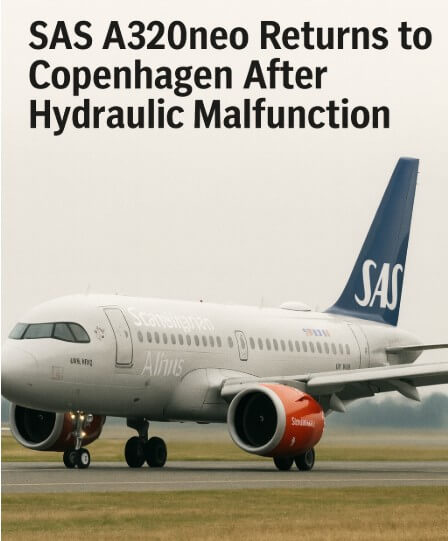
COPENHAGEN – A Scandinavian Airlines (SAS) Airbus A320neo operating flight SK1458 from Copenhagen to Oslo was forced to return to its departure airport on Sunday, August 17, after the crew reported a hydraulic system malfunction shortly after takeoff.
The aircraft, registered LN-RGN and named “Ulrik Viking,” had departed Copenhagen Airport (CPH) on time at 12:02 p.m. local time for its scheduled service to Oslo Gardermoen Airport (OSL). According to flight data, the jet’s` climb was halted at 11,000 feet before entering a holding pattern west of the airport.
SAS confirmed that the aircraft landed safely back at Copenhagen just under an hour after departure, touching down again on runway 04R, the same runway it had used for takeoff. No injuries or further complications were reported.
Incident in the Air
The problem became apparent during the initial climb when flight crew identified a malfunction in one of the aircraft’s hydraulic systems. The crew terminated the departure procedure and entered a holding pattern, where they conducted troubleshooting checks. After assessing the situation, the pilots opted for a precautionary return.
According to The Aviation Herald, a passenger on board said the flight deck announcement had advised travelers of a “hydraulic malfunction which may potentially affect the aircraft’s landing gear.”
Aviation safety experts note that hydraulic systems are critical to the functioning of flight controls, brakes, and landing gear on modern jets. While Airbus A320neos are equipped with redundant systems, carriers often treat any such malfunction with heightened caution.
Routine Response, Safe Outcome
Industry observers emphasized that the crew’s actions reflected standard aviation safety protocol. “Hydraulic malfunctions, while uncommon, are scenarios crews are trained extensively to handle,” one European aviation analyst said. “The precautionary return is the safest course of action to ensure no further risks arise.”
The flight landed without incident, and passengers later continued their journeys on alternative services. SAS has not disclosed whether the aircraft has reentered service following the technical checks that typically follow such events.
Aircraft Details
The Airbus A320neo involved is an 8.8-year-old narrowbody jet delivered to SAS in November 2016. Named “Ulrik Viking,” the aircraft has been a workhorse on the airline’s short-haul European routes.
The A320neo family, introduced by Airbus in 2016, is widely used by carriers across Europe for its fuel efficiency and lower emissions compared to previous-generation aircraft. SAS operates several of the type as part of its modernization strategy aimed at cutting fuel burn and carbon output.
Broader Context
The return of flight SK1458 is the latest reminder of how airlines and regulators emphasize precaution in flight safety. While such incidents occasionally lead to diversions or returns, they are considered routine in the industry and rarely endanger passengers.
Hydraulic issues have historically been among the most closely monitored categories of inflight malfunctions. With redundancy built into systems, aircraft can often operate safely even with partial failures, but operators generally elect to bring the aircraft back for inspection as a safeguard.
For SAS, the incident comes at a time when the airline continues its recovery from the pandemic downturn while pursuing a broader fleet renewal program. The A320neo is central to those plans, expected to underpin operations on the carrier’s dense Scandinavian and European routes for years to come.
Conclusion
Passengers on board SK1458 experienced only a brief delay and landed safely back in Copenhagen after less than an hour in the air. The airline has not reported any disruption to its broader schedule.
For SAS and the aviation industry, the event underscores the importance of cautious decision-making and well-rehearsed crew procedures in maintaining passenger safety.
