


A Landmark Boost for India’s Aviation and Defense Sectors
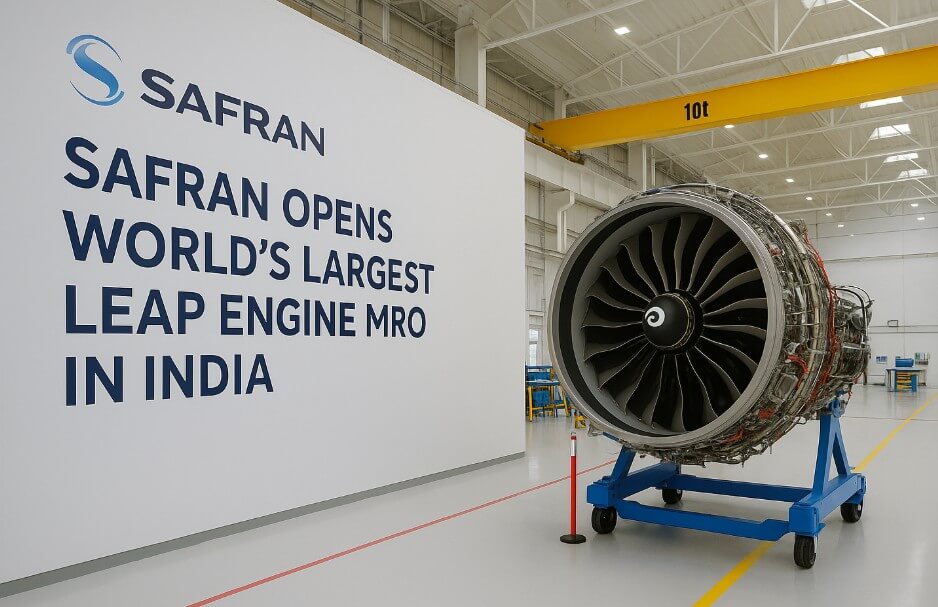
HYDERABAD — Safran has inaugurated what it describes as the world’s largest LEAP engine maintenance, repair, and overhaul (MRO) facility in Hyderabad, marking a major milestone in India’s emergence as a global aerospace hub. The opening highlights the French aerospace group’s expanding industrial footprint in the country and its long-term strategy to support India’s aviation growth and defense modernization efforts.
The new facility will service LEAP engines produced by CFM International, a joint venture between Safran Aircraft Engines and GE Aerospace, which power a majority of the single-aisle commercial aircraft operated by Indian carriers. With India projected to become one of the fastest-growing aviation markets worldwide, Safran’s investment aims to strengthen domestic capacity and reduce reliance on foreign service centers.
Strengthening India’s Civil Aviation Infrastructure
The Hyderabad MRO center is designed to significantly cut maintenance turnaround times for key carriers such as IndiGo and Air India, both of which operate large fleets of LEAP-powered aircraft. By shifting repair operations to India, airlines are expected to benefit from cost savings, shorter downtimes, and increased operational efficiency.
The new site is part of a broader push by Safran to support India’s Make in India initiative, which encourages localization of advanced manufacturing. The company said the Hyderabad facility will offer long-term value for airlines flying Airbus and Boeing models, helping to accommodate the country’s rising passenger traffic and expanding route networks.
Safran’s expansion is not limited to commercial aviation. The company is increasing its electronics and avionics production capabilities in Bengaluru, adding new capacity to support civil and military aviation programs alike. These developments reflect what Safran calls a “significant phase of industrial growth,” designed to strengthen the domestic aerospace supply chain.
Industrial Expansion and Long-Term Commitment
Safran’s latest investments include new partnerships with Indian organizations to scale local sourcing, expand production capabilities, and create skilled jobs across Hyderabad, Bengaluru, and other cities. The company also plans to triple its annual revenue from Indian operations by 2030, demonstrating strong confidence in the country’s aviation and manufacturing outlook.
As India’s commercial fleet continues to grow—driven by massive aircraft orders and increased domestic air travel demand—engine servicing capacity is becoming increasingly crucial. Localizing support for LEAP engines, which power many of India’s newest aircraft, positions the country to handle future fleet expansions more efficiently.
Defense Manufacturing Push Aligns With India’s Strategic Goals
Beyond commercial aviation, Safran is intensifying its role in India’s defense modernization efforts. One of the key initiatives includes establishing a maintenance facility for the M88 engine, which powers the Dassault Rafale fighter jets in service with the Indian Air Force. The local facility is expected to improve fleet readiness by reducing the need for overseas repair work.
Safran has also expanded its partnership with Bharat Electronics Limited (BEL) to jointly manufacture air-to-surface weapons for both imported and domestically developed fighter aircraft. This collaboration supports India’s drive toward greater defense self-reliance and a stronger indigenous manufacturing ecosystem.
The company continues to work with Hindustan Aeronautics Limited (HAL) on producing forged and machined components for commercial and military engine platforms, deepening cooperation across multiple branches of India’s aerospace sector.
Positioning India as an Emerging Global Aerospace Hub
Industry experts say Safran’s multipronged expansion strategy reinforces India’s growing importance as both a commercial aviation powerhouse and a defense manufacturing partner. With local MRO facilities, increased avionics production, and strengthened defense collaborations, India is better positioned to manage its booming aviation demand and enhance its security capabilities.
On the commercial side, domestic engine servicing promises better cost control and operational flexibility for airlines. On the defense side, increased manufacturing and repair capacity improves readiness and supports the development of high-precision engineering talent.
Together, these developments highlight Safran’s long-term strategic commitment to India and signal increased global confidence in the country’s aerospace sector.
