


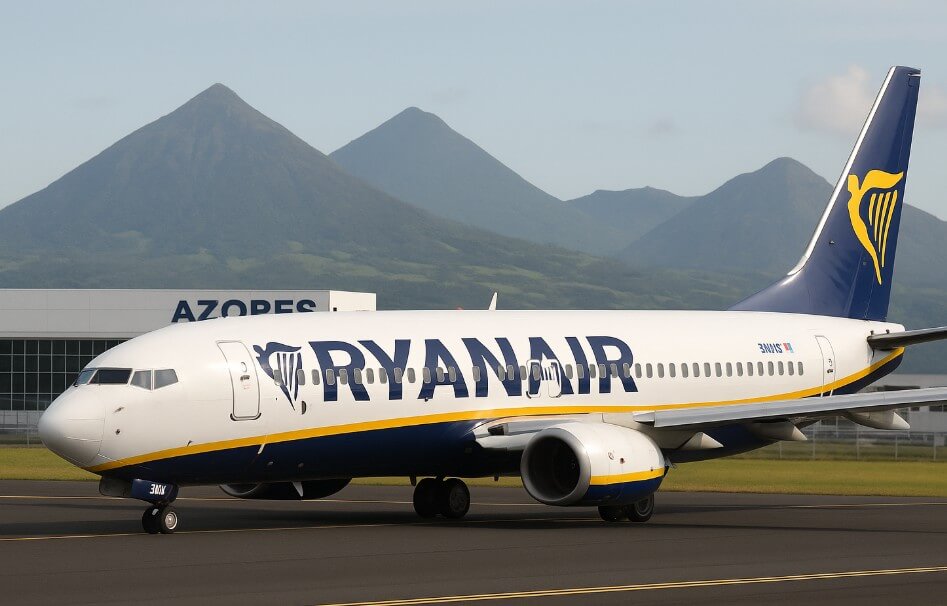
Airline Announces Full Withdrawal by March 2026
AZORES — Ryanair said it will halt all flights to the Azores beginning March 2026, a decision that immediately rattled the archipelago’s tourism-driven economy and raised alarms among local business leaders and policymakers. Citing steep increases in airport charges, the introduction of a new travel tax, and what the carrier described as years of government inaction, the move marks one of the most consequential regional pullouts for the airline in recent memory.
Officials from ANA – Aeroportos de Portugal, along with regional and national government leaders, said they were “surprised” by the announcement. But Ryanair maintained that the current operating environment leaves its low-cost model unsustainable.
Rising Charges and New Taxes Under Scrutiny
The airline said airport charges in the Azores have risen by 120 percent since the pandemic, creating what it views as a cost structure incompatible with low-fare operations. The carrier also pointed to the introduction of a €2 travel tax, arguing that it erodes competitiveness at a time when several EU nations have lowered or eliminated similar levies to support tourism recovery.
Ryanair further criticized ANA’s parent company, VINCI, arguing that it operates as a monopoly in Portugal and has “no plan to increase low-cost connectivity” to the islands. According to the airline, national aviation infrastructure should “serve the Portuguese people” rather than prioritize profit-driven strategies that overlook regional needs.
The carrier described its withdrawal as a direct consequence of the cost and policy framework imposed on airlines serving the Azores.
Tourism Sector Warns of Severe Economic Impact
Tourism leaders across the islands responded with concern, emphasizing the central role Ryanair plays in transporting visitors to the region. The Azores Short-Term Rent Association, represented by ALA, said most guests who book local accommodations arrive on Ryanair flights.
ALA spokesperson João Pinheiro warned that the impact could be significant, adding that he hopes the announcement is “an attempt to pressure the government” rather than a final operational decision. Tourism operators say the loss of the airline could lead to lower visitor numbers, strained small businesses, and weaker post-pandemic recovery.
Ryanair’s presence has historically supported local short-term rentals, small hospitality operators, and ground transport providers. Industry observers note that the airline’s low fares helped make the islands more attractive and accessible to both Portuguese and international travelers.
Government and ANA Respond With Surprise
ANA said it continues to maintain an open dialogue with the airline, while Portugal’s central government insisted that taxes on the Azores route are among the lowest in Europe. Government officials also emphasized that Ryanair has received “tens of millions of euros in incentives” in recent years, according to reporting from Portugal Resident.
Despite those statements, aviation analysts say the tone of Ryanair’s announcement appears firmer than typical pre-negotiation positioning. Several industry experts told local media they believe the airline’s decision is likely definitive unless significant financial or regulatory adjustments are made.
Residents Brace for Reduced Connectivity and Higher Fares
Beyond tourism, residents across the islands fear the broader implications of losing a major low-cost carrier. Without Ryanair, competition on several routes would shrink, potentially driving up fares and limiting travel options for locals who rely on air links for work, education, medical care, and family visits.
The Azores’ geographic isolation makes air travel essential, and any contraction in service is expected to have ripple effects throughout the region’s economy. Reduced flight availability could also weaken demand for local goods and services, affecting employment in sectors tied to visitor spending.
Short Window for Negotiations or Alternatives
Ryanair’s decision provides a four-month notice period, leaving limited time for island authorities and business leaders to negotiate modified terms with ANA or seek alternative carriers to fill the gap. Some tourism officials say even partial capacity losses could disrupt the fragile balance of visitor inflow and economic sustainability.
While stakeholders express hope for renewed talks, few predict a quick solution. With tourism associations warning of cascading impacts and government offices urging cooperation, the next several months will determine whether the region can avert a major setback.
Outlook: A Pivotal Moment for Azores Connectivity
Ryanair’s planned withdrawal represents a critical challenge for a region where aviation is a lifeline. If no agreement is reached, the Azores face the prospect of diminished accessibility, higher travel costs, and a slowdown in tourism-dependent sectors.
For now, the airline’s announcement stands, signaling broader tensions over rising aviation costs and tax policies — and underscoring the vulnerability of remote regions that depend on affordable air service to sustain economic growth.
