


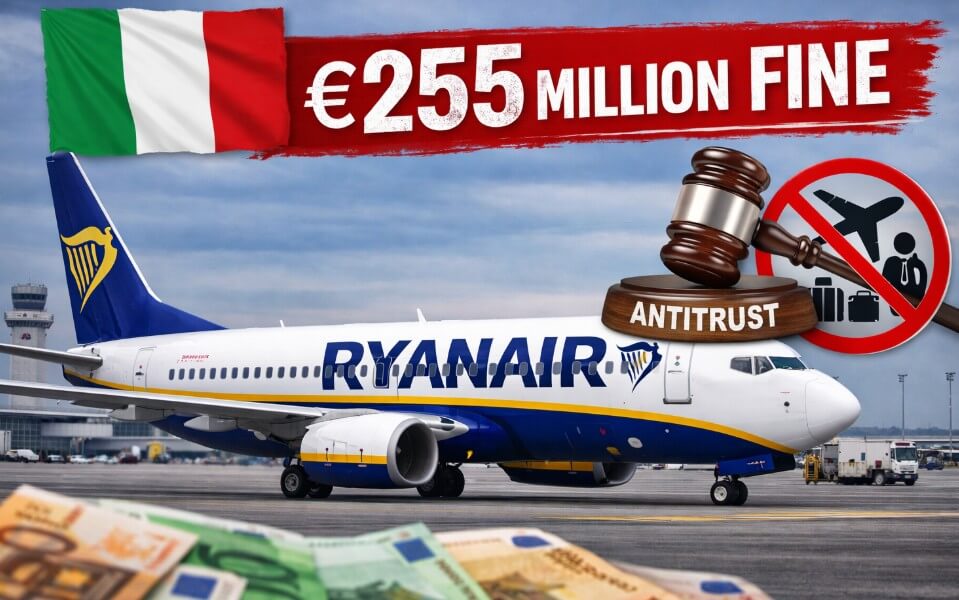
DUBLIN — Ryanair faces a €255 million fine after Italy’s competition authority ruled that the airline abused its dominant market position by restricting how travel agencies could sell its fares, a decision that adds to growing regulatory pressure on airline distribution practices across Europe.
The Italian regulator found that Ryanair implemented a series of measures that limited the ability of both online and traditional travel agents to bundle its flights with other airlines or travel services. Authorities concluded that these actions reduced consumer choice and distorted competition in the travel distribution market.
The ruling applies to bookings connected to Italy, including routes linked to Dublin Airport, and reflects a broader examination of how Ryanair’s commercial policies affect cross-border travel sales within the European Union.
Restrictions on Travel Agencies at the Center of the Case
Italy’s competition authority concluded that Ryanair used its market power to block or discourage travel agencies from freely offering its flights. According to the decision, the airline made it economically or technically difficult for agencies to combine Ryanair tickets with other airlines or complementary travel products.
Regulators determined that these restrictions effectively steered consumers toward booking directly through Ryanair’s platforms while limiting the ability of third-party sellers to compete on equal terms. The authority said this strategy undermined the role of travel intermediaries in the market and constrained the range of choices available to travelers.
“The regulator stated that these measures limited consumer choice and reduced competition across the travel distribution market.”
Step-by-Step Measures Identified by Regulators
The authority outlined a sequence of actions that, taken together, were found to constitute abusive conduct. The first involved Ryanair introducing facial recognition procedures for customers booking through third-party platforms. Regulators said these requirements created additional obstacles for travelers using online travel agencies, increasing friction compared with booking directly on Ryanair’s website or app.
Ryanair then blocked payment methods commonly used by online travel agencies, according to the ruling. This move further complicated the booking process for intermediaries and raised their operational costs, making it harder for them to compete effectively.
The final step involved imposing partnership agreements that restricted how travel agents could include Ryanair flights within broader travel packages. These agreements limited agencies’ flexibility to combine flights with hotels, car rentals, or other services, reducing their ability to offer integrated travel products.
Market Power Beyond Market Share
The watchdog emphasized that Ryanair’s dominance does not rely on market share alone. While the airline holds a significant position in short-haul European air travel, regulators also pointed to other indicators that strengthened its market power.
These included the scale of Ryanair’s route network, its strong presence at key airports, and its control over important distribution channels. Together, these factors allowed the airline to influence how its flights were sold and under what conditions.
According to the decision, this level of control enabled Ryanair to act independently of both competitors and consumers. Travel agencies, the authority said, often had little choice but to accept the airline’s terms if they wanted to continue offering its flights, a dynamic that weakened competitive pressure across the market.
Timeline of the Alleged Abuse
The Italian authority said the abusive conduct began in April 2023 and continued through at least April 2024. During this period, regulators closely examined how Ryanair’s policies evolved and assessed their impact on traditional travel agents as well as online platforms.
Investigators analyzed whether the airline’s actions had the effect of excluding competitors or placing them at a significant disadvantage, ultimately concluding that the conduct harmed competition and consumers alike.
Broader Implications for the Airline Industry
The €255 million penalty ranks among the most significant fines imposed on an airline in Europe in recent years and highlights increasing regulatory scrutiny of how carriers manage their sales channels.
As airlines continue to push for greater control over ticket distribution and customer data, regulators are signaling that strategies limiting intermediaries may face legal challenges if they restrict competition. The Ryanair decision could influence future enforcement actions across the European aviation sector, particularly as authorities examine the balance between direct sales models and open market access for travel agents.
The ruling underscores a broader debate within the industry over consumer choice, pricing transparency, and the role of intermediaries in modern air travel.
