


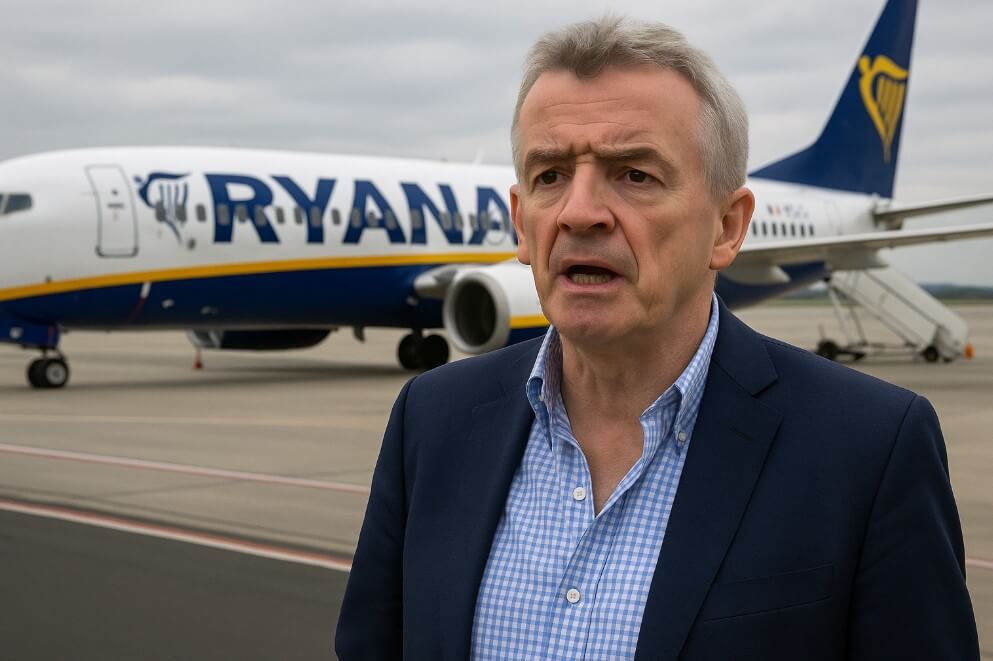
DUBLIN — Ryanair CEO Michael O’Leary has escalated his confrontation with the Austrian government over its aviation tax, calling Chancellor Christian Stocker “lazy” and warning of deeper cuts to operations at Vienna International Airport.
Europe’s largest low-cost carrier (LCC) has accused Austria of maintaining one of the continent’s most punitive aviation tax regimes, saying the €12-per-passenger levy—third highest in Europe—undermines competitiveness and drives airlines to shift capacity elsewhere.
O’Leary’s criticism follows Ryanair’s decision to scale back its Vienna base earlier this year, citing high airport access fees and what he described as Austria’s “harmful” aviation tax. “The planes will land where they are more profitable,” O’Leary said, hinting that traffic may be redirected to lower-cost airports such as Bratislava (BTS) in neighboring Slovakia.
Billion-Euro Proposal Rebuffed
According to Ryanair, the airline had presented a €1 billion investment plan to the Austrian government that would have based ten additional Boeing 737 aircraft in Vienna and created more than 500 new jobs. O’Leary said the proposal received little attention from Chancellor Stocker and Infrastructure Minister Peter Hanke.
At a meeting earlier this year, O’Leary claimed, Stocker described the plan as “interesting” and promised a follow-up by the end of September—one that never came. Hanke, he added, had “avoided further discussions” despite earlier commitments to engage, according to BrusselsSignal.
The perceived lack of government response has fueled Ryanair’s decision to reduce operations at Vienna International Airport, a move O’Leary argues was unavoidable given Austria’s policy environment. “Austria is effectively taxing its own connectivity out of existence,” one Ryanair executive said privately.
Broader Market Impact
Ryanair’s warnings echo concerns from other low-cost carriers. Wizz Air, another major European budget airline, recently announced plans to close its Vienna base by 2026, moving aircraft and staff to more cost-effective hubs.
Both airlines contend that Austria’s aviation tax discourages investment, curbs tourism, and shifts air traffic to neighboring countries. Bratislava and Budapest, for example, offer lower airport fees and no comparable passenger taxes—making them attractive alternatives for airlines operating on tight margins.
Industry observers note that the exodus of low-cost carriers could erode Vienna’s position as a regional aviation hub. “LCCs account for a significant portion of passenger growth across Europe,” said one aviation analyst in Frankfurt. “If Austria remains uncompetitive on taxes and fees, carriers will simply relocate capacity across the border.”
Government Holds Firm
Despite the mounting criticism, the Austrian government has shown no sign of changing course. Hanke’s ministry confirmed that the aviation tax would remain in place through at least 2026, citing compliance with European Union regulations and the levy’s fiscal contribution.
The tax, first introduced in 2010 under a coalition of the Social Democrats (SPÖ) and Austrian People’s Party (ÖVP), initially set a €7 fee for most European flights. It was raised in 2020 to €12 for intra-European routes and €30 for short-distance flights under 350 kilometers.
In 2024 alone, the policy generated roughly €170 million in government revenue, underscoring its budgetary importance despite pushback from airlines.
Political Fallout
O’Leary’s remarks have stirred unusual public tension in Austria, where business leaders seldom criticize senior officials directly. Minister Hanke fired back, accusing the Ryanair chief of “confusing blackmail with negotiations” and insisting that discussions on revising the aviation tax were never formally reopened.
Chancellor Stocker’s office declined to comment on the controversy. However, analysts suggest the dispute could escalate further if Ryanair follows through on its threat to continue cutting capacity at Vienna.
“Aviation is a highly mobile industry,” said a European transport economist based in Brussels. “When airlines start shifting aircraft to other airports, it’s not just lost traffic—it’s lost jobs and lost investment.”
For now, O’Leary appears determined to keep up the pressure. With Wizz Air already planning its exit and other carriers voicing concerns, Austria’s aviation sector faces growing uncertainty over whether its current tax policy can coexist with the country’s ambitions to remain a competitive air travel hub.
