


Dublin dispute turns from aircraft economics to personal attacks
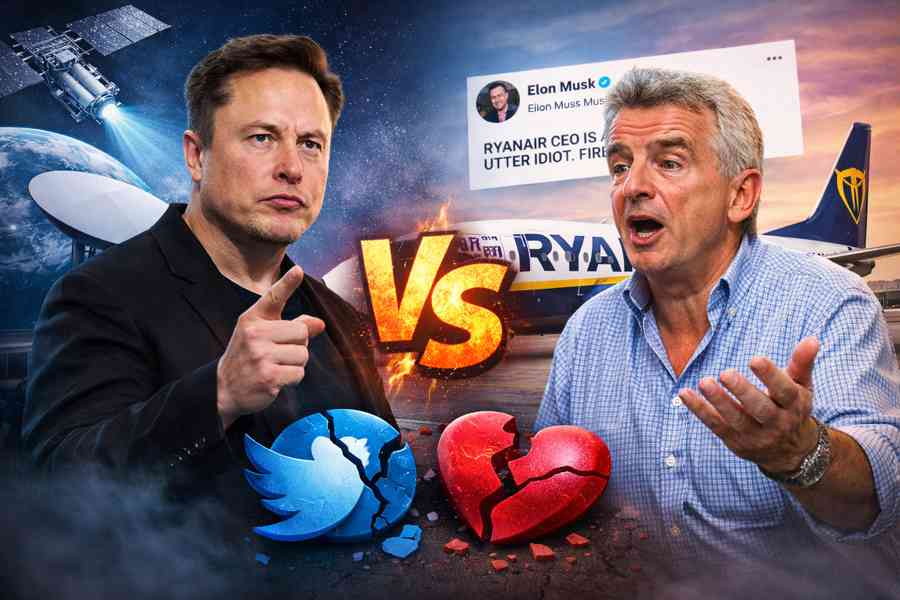
DUBLIN — A public dispute between Elon Musk and Ryanair (FR) chief executive Michael O’Leary has escalated after the airline rejected Starlink as its in-flight Wi-Fi provider, triggering a sharp exchange that has played out across interviews and social media.
What began as a disagreement over fuel burn and aircraft drag has rapidly evolved into personal criticism, with Musk publicly questioning O’Leary’s competence and O’Leary defending Ryanair’s cost-first operating model.
Ryanair says Starlink hardware would drive up fuel costs
The feud began after Ryanair ruled out installing Elon Musk’s Starlink satellite Wi-Fi across its fleet. Michael O’Leary said adding a satellite antenna to aircraft would increase both weight and drag, leading to an estimated 2% fuel penalty.
O’Leary estimated the financial impact at between $200 million and $250 million per year. He framed the increase as roughly one extra dollar per passenger, a cost he said Ryanair could not absorb without raising fares.
“Passengers will use Wi-Fi if it is free,” O’Leary argues
O’Leary also questioned whether Ryanair customers value in-flight internet enough to justify any increase in operating costs. He argued that Ryanair passengers are unwilling to pay for onboard internet access, stating that while passengers will use Wi-Fi if it is free, they will not pay even €1 to access it.
From Ryanair’s perspective, offering free Wi-Fi would permanently raise operating costs without generating additional revenue. That outcome conflicts with the airline’s ultra-low-cost business model, which is built on strict cost control and high-volume, low-margin pricing.
Musk and Starlink push back on drag and antenna claims
Musk responded by calling O’Leary misinformed about Starlink’s technology. Starlink Vice President of Engineering Michael Niccolls supported Musk’s position, saying Starlink antennas are significantly slimmer than legacy systems.
According to Starlink, the additional fuel burn would be closer to 0.3 percent on a Boeing 737-800, the backbone of Ryanair’s fleet. Musk further stated that incremental drag during short flights is difficult to measure accurately, particularly during ascent when angles of attack are already high.
War of words spills onto X and into public ridicule
The exchange intensified as the two executives traded remarks through media appearances and social platforms.
O’Leary dismissed Musk’s criticism, stating, “I would pay no attention whatsoever to Elon Musk; he’s an idiot. Very wealthy, but still an idiot.” He added that Musk knows nothing about aircraft drag and fuel economics.
O’Leary also criticized X, referring to it as a cesspit and referencing Musk’s political positions, including his support for Donald Trump, broadening the dispute beyond aviation technology and into politics and platform culture.
When a clip of O’Leary’s interview circulated on X, Musk replied, “Ryanair CEO is an utter idiot. Fire him.” Musk later added a sarcastic remark asking whether he should buy Ryanair and appoint someone actually named Ryan to run it.
Ryanair stays active on X despite O’Leary’s criticism
Despite O’Leary’s negative comments about X, Ryanair remains one of the platform’s most active and recognizable corporate accounts. The airline is known for trolling passengers and competitors with sharp, meme-driven posts that often go viral.
According to PYOK, during a temporary outage on X, Ryanair posted a message suggesting Musk might need in-flight Wi-Fi, directly referencing the Starlink dispute and amplifying the public nature of the feud.
O’Leary’s cost-cutting legacy shaped Ryanair’s strategy
Michael O’Leary became Ryanair’s chief executive in 1994, when the airline was a struggling regional operator. Inspired by Southwest Airlines (WN), O’Leary pushed the low-cost concept further by enforcing strict cost controls and aggressive pricing.
Over time, Ryanair built a reputation for bare-bones service and heavy ancillary fees, leading some passengers to avoid repeat travel. In later years, the airline softened its customer approach slightly, but the core strategy of offering the lowest possible base fare remains unchanged.
Within that framework, in-flight Wi-Fi has long been viewed as a feature that adds complexity and cost without guaranteeing meaningful revenue upside.
Musk’s takeover talk runs into EU ownership rules
Musk’s comments about buying Ryanair were widely interpreted as rhetorical, but the idea drew attention online. Musk’s own Grok AI chatbot stated that such an acquisition would not be possible under European Union regulations.
EU law requires airlines based in the bloc to be at least 50 percent owned and controlled by EU nationals or entities. That rule prevents Musk from acquiring a controlling stake in Ryanair.
Michael O’Leary, who already holds a 4% stake in the airline and is a billionaire, would still benefit financially from any partial acquisition. A takeover at a premium valuation would significantly increase his personal wealth, even without a change in leadership.
A broader clash between aviation tech and low-cost economics
The Musk and O’Leary clash highlights a growing divide between emerging aviation technology and the economics of ultra-low-cost carriers.
While Starlink focuses on performance and future connectivity standards, Ryanair prioritizes absolute cost minimization. The dispute underscores that technology adoption in commercial aviation is driven less by capability and more by whether it aligns with an airline’s core business model.
