



The Great Barrier Reef is affected by frequently warming seas, scientists now say nearly the entire region of the natural wonder has experienced coral bleaching in recent years, a worrying number that amplifies warning bells about the effects of climate change now occurring.
A new study, published Friday in the journal Current Biology, finds that only 2% of the Great Barrier Reef has survived bleaching in the past 30 years. The first major mass bleaching event in 1998 sparked dire warnings from coral biologists, who said rising seas marked the underwater apocalypse for sensitive coral ecosystems.
But climate change has continued largely unabated since then, and Professor Terry Hughes, lead author of the report and director of the ARC’s Center of Excellence for Coral Reef Studies, said bleaching events that were “unprecedented or very rare” are now common. .
Five bouts of massive bleaching since 1998 have transformed the Great Barrier Reef into a reef checkerboard with a very different recent history, ranging from 2% of reefs that survived bleaching completely, to 80% that are now at least once a year. 2016 Hughes said in a statement.
98% of coral reefs have experienced catastrophic bleaching which is significant. The Great Barrier Reef is the largest living structure in the world, spanning nearly 1,500 miles and home to more than 3,000 individual coral reefs.
Jumbo Luchtfotografie / Great Barrier Reef Marine Park Authority via Associated Press
The study adds that bleaching events should be viewed as a series of diseases rather than one-time disasters to determine how corals can recover over time. Interestingly, the authors found that areas of the Great Barrier Reef that had previously experienced massive bleaching were more tolerant of future stress, while those that had not experienced bleaching in recent years were most vulnerable.
The authors said that the accumulation of bleaching events over several decades “highlights the serious risk that without immediate global action on greenhouse gas emissions, more frequent and severe bleaching events will continue to undermine the resilience of coral reef ecosystems.”
Coral reefs are particularly vulnerable to climate change. The warmer water associated with the phenomenon can effectively cook the delicate skeletons, causing the corals to pale as the colored polyps turn white while the algae-feeding skeletons leave their skeletons. When temperatures return to normal, corals can recover over time, but if the water is kept warm for too long, coral that takes decades to grow can die.
Bleached corals can recover, but it takes years. Scientists have long warned that massive bleaching events, such as those in 2016, 2017 and 2020, don’t give corals enough time to heal.
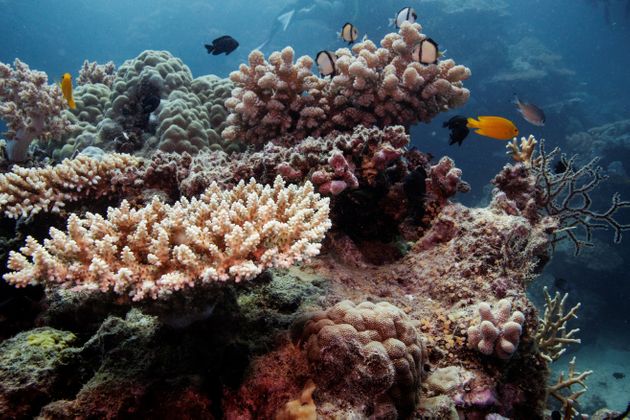
Lucas Jackson/Reuters
The outlook for coral reefs on this planet is bleak. A recent report found that the world lost 14% of its coral reefs from 2009 to 2018 due to heat waves linked to climate change. This number is staggering, actually amounting to about 4,500 square miles of reef, or more of all living reefs at the expense of Australia, including the Great Barrier.
The latest study comes at the United Nations Climate Change Summit, COP26, in Glasgow, Scotland, where world leaders and dignitaries try to find the best hope on the planet to avoid the worst effects of climate change.
Hughes said Friday that the way reefs like the Great Barrier depend on humanity’s cooperation to reduce greenhouse gas emissions, though he emphasized there was still time for the world to act. However, Australia has largely refused to sign pledges to stop coal mining and reduce methane emissions. Unlocking the vague plans instead, scientists criticized the emission reduction by the 1950s.
“Where the reef ends up depends on how warm it is,” he told Tell Watcher. “If we settle at 1.5 degrees [Celsius]Coral reefs are unlikely to be okay. …even though we won’t see the Great Barrier Reef like it did 20 years ago, we can still have reefs if countries can reduce greenhouse gas emissions in the next decade. “
