


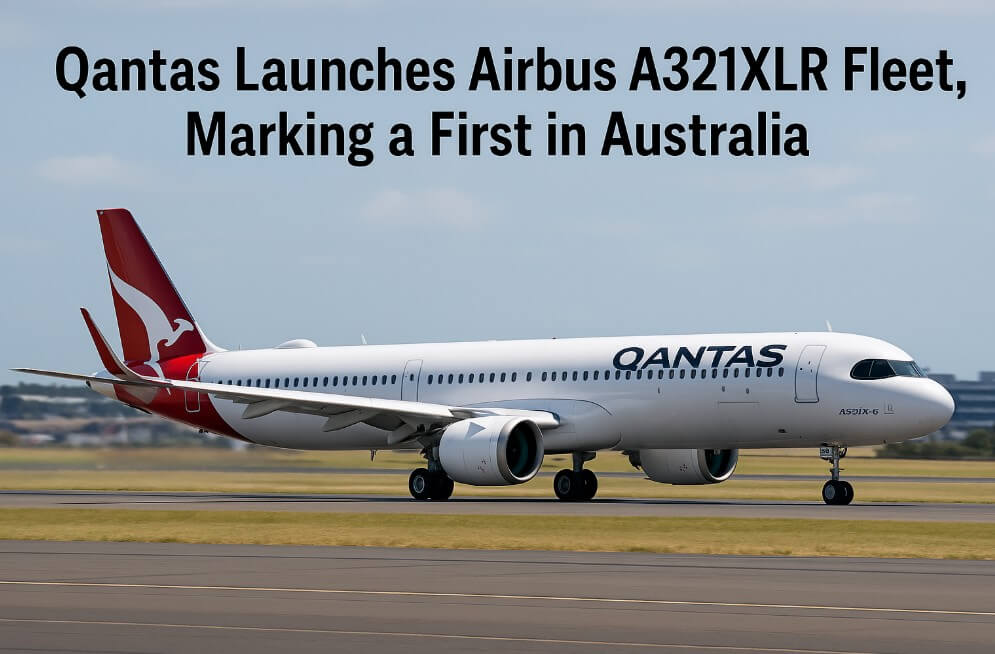
SYDNEY – Qantas Airways has launched commercial operations with its new Airbus A321XLR aircraft, becoming the first carrier in the Asia Pacific to introduce the next-generation jet into service. The move marks a major milestone in the airline’s ongoing fleet renewal program and highlights its ambitions to expand connectivity both within Australia and abroad.
On September 25, the airline deployed two aircraft — named Great Ocean Road (VH-OGA) and Outback Way (VH-OGB) — on inaugural flights from Sydney Kingsford Smith Airport. Great Ocean Road operated on the busy Sydney–Melbourne corridor, while Outback Way flew westward to Perth.
Qantas said the debut underscores its commitment to modernizing its fleet for sustainable growth. The aircraft promises a blend of efficiency, passenger comfort, and long-range capabilities that open new opportunities across domestic and short-haul international markets.
Enhanced Passenger Experience
The A321XLR introduces noticeable improvements compared to Qantas’s current Boeing 737 fleet. The aircraft features a wider cabin, taller ceilings, and larger windows, with seating configured for 20 passengers in Business and 177 in Economy. This represents a 13 percent increase in capacity without reducing seat pitch, along with a 66 percent expansion in Business class seating.
Passengers will also benefit from fast, complimentary Wi-Fi and a 60 percent increase in overhead luggage capacity, easing congestion on high-demand routes.
“Over 350 training flights and 40,000 hours of preparation have gone into ensuring these aircraft are seamlessly integrated into our operations,” said Qantas Group CEO Vanessa Hudson. She added that thousands of new equipment pieces have been deployed across the network to support the rollout. Hudson emphasized that the A321XLR would build on customer satisfaction gains following the airline’s introduction of Airbus A220s earlier this year.
Greater Efficiency and Range
The aircraft is powered by Pratt & Whitney PW1100G-JM geared turbofan engines and incorporates advanced lightweight materials, reducing fuel burn and emissions per seat. Qantas estimates the new jets will deliver significant efficiency gains over the Boeing 737-800s they are set to replace.
The A321XLR’s extended range of 8,700 kilometers—roughly 3,000 kilometers more than the 737-800—enables direct flights on routes previously beyond the reach of narrowbody aircraft. This includes new opportunities for nonstop services between Australia’s east coast and Southeast Asia, as well as expanded connections across the domestic market.
Strategic Expansion
Qantas has ambitious plans for the A321XLR fleet. A third aircraft is scheduled for delivery in November, with the fleet projected to reach seven units by June 2026.
The airline also confirmed in August that it had placed an additional order for 20 A321XLRs, bringing its total commitment to 48. Sixteen of these will feature lie-flat Business class seating to serve transcontinental and medium-haul routes. The order is part of the Qantas Group’s broader fleet renewal program, which includes more than 200 firm aircraft commitments with both Airbus and Boeing.
The company says its procurement strategy allows flexibility to scale capacity in response to shifts in travel demand, while prioritizing efficiency and enhanced customer experience.
National Identity in the Sky
Reflecting a tradition of naming aircraft after landmarks and cultural icons, Qantas has chosen to christen its A321XLRs after Australian trails, rivers, and roads. The first two aircraft — Great Ocean Road and Outback Way — symbolize both the country’s landscapes and its growing aviation connectivity.
Outlook
With the A321XLR, Qantas is positioned as a global leader in next-generation narrowbody operations, becoming the fourth airline worldwide to launch the aircraft commercially. The expanded range and efficiency align closely with the carrier’s sustainability strategy, which targets net-zero emissions by 2050.
By enabling direct, fuel-efficient flights across both domestic and regional markets, the aircraft is expected to reshape travel patterns for business and leisure passengers. Industry analysts see the introduction as a timely move, with demand for flexible, medium-range travel rising across the Asia Pacific.
For Qantas, the A321XLR represents more than a fleet upgrade. It is a strategic asset designed to reinforce the airline’s competitive edge, modernize its operations, and broaden its reach in a changing aviation landscape.
