


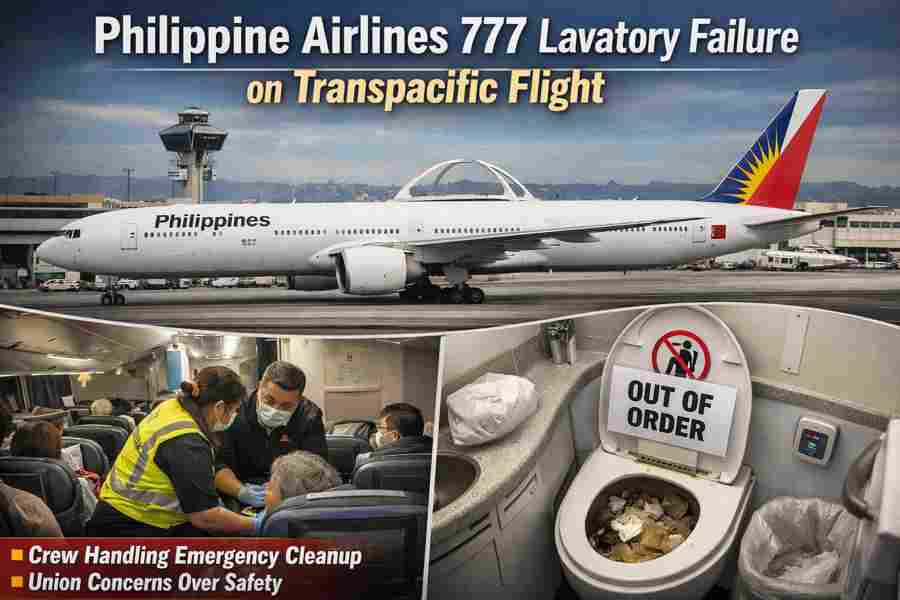
MANILA — A long-haul transpacific flight operated by Philippine Airlines encountered a rare and disruptive in-flight systems failure that left all onboard lavatories unusable for much of the journey, raising questions about operational decision-making, crew welfare, and crisis management standards in commercial aviation.
The incident occurred aboard Flight PR113, a scheduled service between Los Angeles International Airport and Ninoy Aquino International Airport. The flight was operated using a Boeing 777-300ER, a widebody aircraft commonly deployed on long-haul international routes and configured to carry hundreds of passengers on flights exceeding 14 hours.
Systemwide Lavatory Breakdown Over the Pacific
Several hours after departure from Los Angeles, while the aircraft was cruising over the Pacific Ocean, all 11 lavatories onboard reportedly malfunctioned. The toilets became clogged and lost flushing capability, rendering them unusable for the remainder of the flight.
Industry sources note that while isolated lavatory failures are not uncommon, a simultaneous systemwide failure affecting every toilet on a modern long-haul aircraft is highly unusual. The breakdown occurred when the aircraft was far from suitable diversion airports, including Guam, leaving the flight crew with limited immediate options.
Flight operations assessed the situation and elected to continue to Manila rather than divert, despite the extended remaining flight time. The aircraft still had several hours to fly, a decision that placed sustained pressure on both passengers and cabin crew as the onboard facilities remained unavailable.
Operational Decision Not to Divert
According to flight operations assessments, the aircraft’s position deep over open ocean and the logistical complexity of a diversion factored into the decision to continue to its destination. Diversions on transpacific routes can carry significant operational and financial costs, including passenger reaccommodation, aircraft repositioning, and crew duty limitations.
However, aviation safety frameworks generally emphasize that diversion should be strongly considered when onboard conditions compromise passenger health, sanitation, or basic dignity, particularly on long-haul flights with full passenger loads. The choice to proceed without functioning lavatories has since become a focal point of scrutiny.
Crew Handling Response Draws Criticism
According to OMAAT, cabin crew were instructed by a supervising authority to manually remove waste from the toilets to prevent overflow. The waste was allegedly disposed of in nearby sinks to allow limited continued use of the lavatories.
This reported response has drawn criticism from aviation professionals, as no standard airline operating procedures support such actions under any circumstances. The handling method raised immediate concerns regarding sanitation, occupational safety, and regulatory compliance, particularly given the health risks associated with direct exposure to human waste in a confined aircraft environment.
The incident has been characterized by critics as an example of frontline staff being placed in an untenable position due to upstream operational decisions.
Union Raises Crew Welfare Concerns
The strongest reaction to the incident has come from the flight attendants’ union rather than from passengers. Crew representatives described the event as a breakdown in operational leadership and escalation protocols, arguing that commercial considerations appeared to outweigh crew welfare and safety obligations.
Union statements also expressed frustration over the absence of a formal internal investigation following the flight. Crew members reportedly fear that without corrective action or procedural review, similar decisions could recur in future operations, particularly on long-haul routes where diversion options are limited.
The lack of post-incident scrutiny has amplified tensions between cabin staff and airline management, highlighting broader industry debates over how airlines balance cost control with safety culture and employee protections.
A Rare Failure With Broader Implications
While aircraft toilet malfunctions are a known operational nuisance, the complete loss of all lavatories on a transpacific flight remains extraordinary. The incident underscores the risks that arise when technical failures intersect with long-haul route constraints and high-capacity aircraft.
For airline operators, the episode serves as a case study in crisis management, emphasizing the importance of clear escalation pathways and crew-centered decision-making when unexpected failures occur at cruising altitude.
As of publication, Philippine Airlines has not publicly detailed any procedural changes stemming from the event. The incident continues to circulate within aviation safety and labor circles as an example of how rare technical failures can escalate into broader operational and reputational challenges when not managed decisively.
