


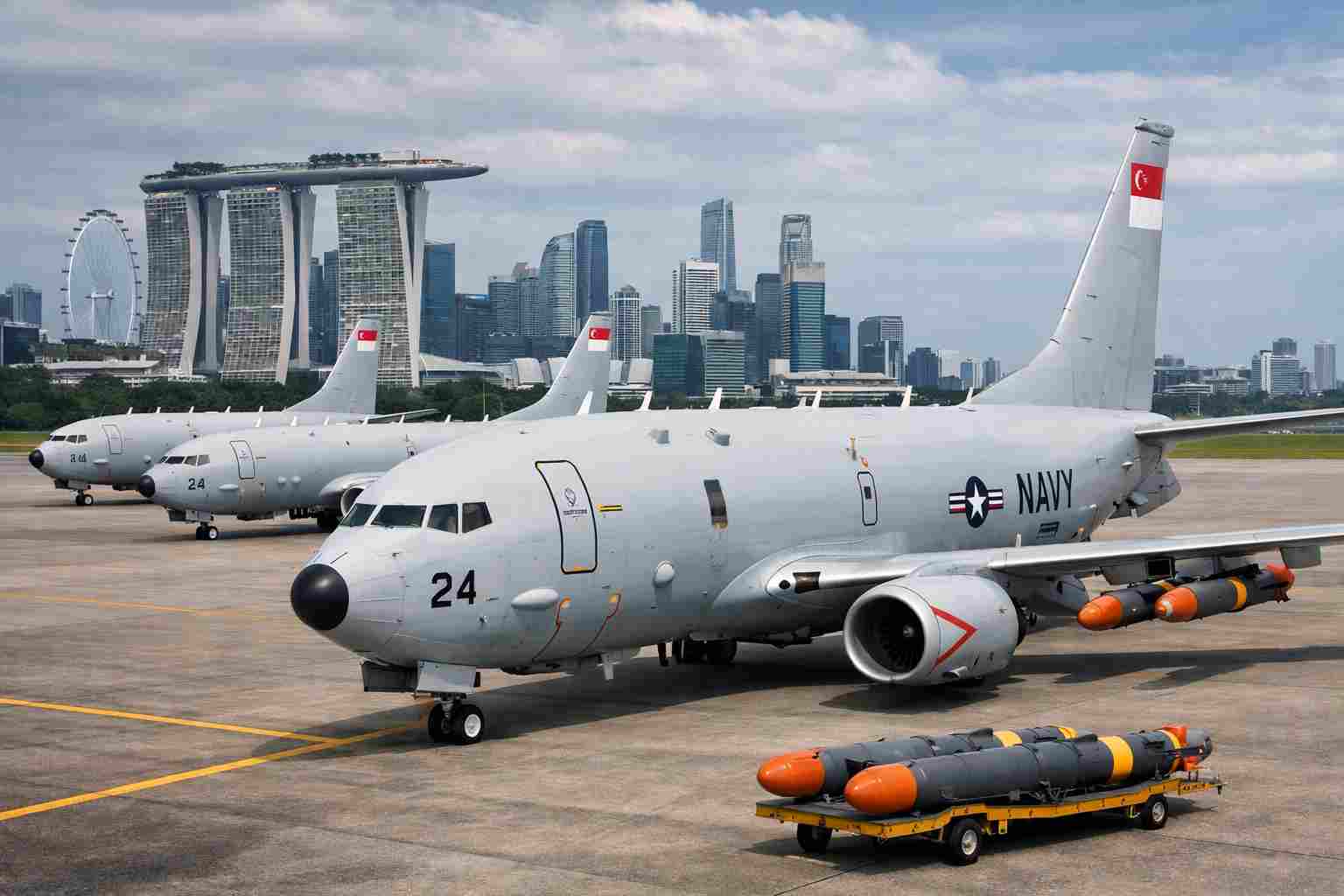
The United States has approved a planned sale of four Boeing P-8A Poseidon maritime patrol aircraft to Singapore, clearing the way for the city-state to significantly expand its long-range surveillance and anti-submarine warfare capabilities in the Indo-Pacific.
The clearance was issued through the US Defense Security Cooperation Agency, which notified Congress of the potential transaction. The deal includes not only the aircraft but also mission systems, weapons, spares, and long-term support intended to sustain operations over time.
If completed, the acquisition would mark a major upgrade for Singapore’s maritime domain awareness and strengthen its ability to monitor and secure key sea lanes that support global trade flows through Southeast Asia. The package is designed to enhance Singapore’s capacity to detect and respond to surface and subsurface threats across wide ocean areas, while also reinforcing its ability to operate alongside US and allied forces in the region.
US Approves P-8A Sale
The proposed sale covers four Boeing P-8A Poseidon aircraft configured for maritime patrol and reconnaissance missions across vast ocean areas. The P-8A, a militarized variant of the Boeing 737 Next Generation platform, is widely used for maritime surveillance, intelligence collection, and anti-submarine warfare.
According to Flight Global, the package also includes sensors, communications systems, training, logistics support, and maintenance services designed to ensure high availability and operational readiness. Those components are typically critical to maintaining operational tempo for a high-demand aircraft platform, especially one expected to conduct extended-range patrols and persistent monitoring missions.
A key element of the proposed package is the inclusion of eight MK 54 Mod 0 lightweight torpedoes sourced from existing US Navy stocks. The torpedoes are designed for anti-submarine warfare missions and would provide Singapore with a combat-proven capability for detecting, tracking, and engaging underwater threats.
These weapons give Singapore a credible and proven anti-submarine warfare capability suitable for both peacetime surveillance and high-end conflict scenarios. The MK 54 is a modern lightweight torpedo fielded by the US Navy and other allied operators, offering interoperability benefits and a mature support ecosystem.
US authorities said the transaction supports American foreign policy objectives by strengthening a strategic partner that contributes to stability and economic security in Asia. In addition to boosting Singapore’s capabilities, the deal is also expected to deepen operational integration with US and allied forces that already operate the P-8A across the Indo-Pacific.
Regional Security Impact
Once delivered, Singapore will become the Asia-Pacific region’s fifth operator of the P-8A Poseidon, joining Australia, New Zealand, and South Korea. The acquisition also makes Singapore the first Southeast Asian nation to field the type, a development that could reshape regional maritime airpower by introducing a high-end patrol platform into one of the world’s busiest maritime corridors.
The P-8A is valued for its extended range, advanced sensor suite, and networked warfare capabilities, allowing operators to build a detailed maritime picture and rapidly share information with other assets. Its combination of speed, endurance, and mission systems enables it to cover large areas efficiently, while maintaining the ability to respond quickly to emerging threats.
The aircraft will enable Singapore to deter potential adversaries while contributing to coalition operations, humanitarian assistance, and maritime security missions. Beyond deterrence, maritime patrol aircraft are often used for search-and-rescue operations, monitoring suspicious vessels, and supporting disaster response efforts by providing aerial reconnaissance and communications support.
Its integration aligns closely with allied operational concepts already in use across the Indo-Pacific. With multiple partner nations operating the same platform, Singapore’s P-8A fleet could be positioned to participate in coordinated exercises, information-sharing arrangements, and joint operations, strengthening collective situational awareness in contested or high-traffic waters.
Navy Modernisation Path
Singapore’s decision to proceed with the P-8A follows its announcement in September 2025 outlining plans to replace ageing Fokker 50 maritime patrol aircraft. The replacement effort reflects a broader modernization push as Singapore updates its defense capabilities to address increasingly complex maritime challenges, including submarine activity, gray-zone operations, and heightened competition among major powers in the region.
The country had earlier evaluated alternatives, including the Airbus Defence and Space C295, before selecting the P-8A. While smaller aircraft can offer lower operating costs, the P-8A’s performance and mission capabilities are generally viewed as a step up for long-range surveillance and high-end anti-submarine warfare requirements.
This acquisition complements the broader modernization of Singapore’s navy, which includes six Formidable-class frigates introduced between 2007 and 2009. It also aligns with plans to introduce Multi-Role Combat Vessels designed to act as motherships for unmanned air and surface systems, reflecting a shift toward more networked and autonomous maritime operations.
India’s operation of the closely related P-8I Neptune further underscores the platform’s adaptability to regional requirements, even when fitted with indigenous systems. Singapore’s version, by contrast, is expected to emphasize interoperability and integration with US and allied frameworks.
Bottom Line
The Pentagon’s approval of the P-8A sale marks a strategic upgrade for Singapore’s maritime defense posture and a reinforcement of allied security architecture in the Indo-Pacific. By moving toward a proven, interoperable platform, Singapore is positioning itself to strengthen deterrence, improve maritime awareness, and remain a capable partner in regional security operations.
