


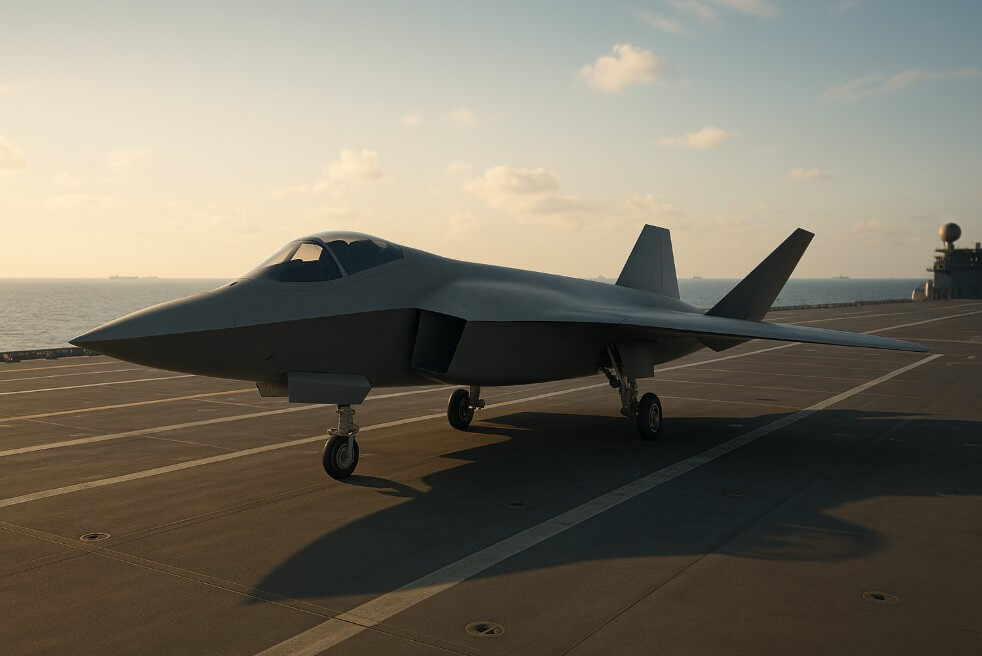
WASHINGTON, D.C. — The U.S. Department of Defense has approved the Navy’s next-generation F/A-XX program, setting the stage for the most significant leap in naval aviation since the Super Hornet. The sixth-generation stealth fighter is designed to replace the Boeing F/A-18E/F fleet and ensure U.S. carrier air wings remain dominant amid growing threats from China’s rapidly modernizing military.
Defense Secretary Lloyd Austin has reportedly signed off on the initiative, and a contract award is expected in the coming weeks. The competition has narrowed to two defense industry titans—Boeing and Northrop Grumman—after Lockheed Martin withdrew from contention in March 2025. Both companies have released conceptual renderings of their designs, signaling the Pentagon’s push to move the program from concept to development.
A Next-Generation Leap for Naval Aviation
The F/A-XX marks the centerpiece of the Navy’s Next Generation Air Dominance (NGAD) family of systems. It is intended to succeed the F/A-18E/F Super Hornet, which has been the Navy’s primary strike fighter since the late 1990s. According to officials familiar with the process, the Pentagon’s Fiscal Year 2026 budget includes funding for initial development, although full procurement remains several years away.
Sources told Reuters that the final contract decision could be announced soon, though the program has faced repeated delays due to budget disputes between Congress and the Pentagon. The Department of Defense initially requested $74 million for early-stage development, but disagreements over funding priorities postponed progress. While the current budget provides a foundation for research and design, additional appropriations will be needed to transition into full-scale production.
Defense analysts note that the F/A-XX program must balance with the Air Force’s parallel development of its own sixth-generation fighter, the F-47. The simultaneous pursuit of both programs has raised concerns about industrial capacity and funding strain. However, the House Armed Services Committee recently rejected a proposal to reallocate $500 million away from the Navy’s program, reaffirming its strategic priority.
Strategic Imperatives in the Indo-Pacific
The urgency surrounding the F/A-XX stems from Beijing’s aggressive advancements in military aviation. China is reportedly testing two sixth-generation prototypes—the J-36 and J-50—one of which is believed to be optimized for carrier operations. In addition, its fifth-generation J-35 stealth fighter is thought to have entered production, a move that could significantly enhance the People’s Liberation Army Navy’s air capabilities.
China’s third aircraft carrier, Fujian, is also expected to enter service soon, underscoring the growing challenge to U.S. naval dominance in the Pacific. U.S. defense officials view the F/A-XX as essential for maintaining the Navy’s technological edge. Its combination of stealth, range, and integration with uncrewed systems will enable the U.S. to project power across contested environments.
Rep. Ken Calvert, who chairs the House Appropriations Subcommittee on Defense, cautioned that delays could leave the Navy at a serious disadvantage. “Delaying the F/A-XX would leave the Navy ‘dangerously outmatched’ in a potential conflict with China,” Calvert warned. He emphasized the need for consistent investment, adding that “aviation programs cannot be turned on and off like a switch.”
Capabilities and Design Philosophy
While details remain classified, defense experts expect the F/A-XX to deliver roughly 25% more range than the Navy’s current F-35C, allowing deeper penetration into hostile airspace without reliance on vulnerable forward bases. The fighter will also serve as a “quarterback” platform, coordinating missions with loyal wingman drones and supporting electronic warfare, reconnaissance, and strike operations.
Equipped with next-generation sensors, secure networking, and advanced data links, the aircraft will integrate seamlessly with carrier strike groups, early warning aircraft, and surface vessels. Its design emphasizes real-time coordination and information-sharing, giving commanders a decisive edge in fast-evolving combat scenarios.
By combining superior stealth, extended endurance, and digital integration, the F/A-XX aims to counter China’s expanding anti-access/area-denial (A2/AD) systems, which threaten to restrict U.S. operations near contested waters.
Funding Path and Outlook
After months of debate, Congress took a decisive step toward accelerating the program. The Senate Armed Services Committee approved $750 million for development, while the Navy’s 2025 Unfunded Priorities List requested an additional $1.4 billion to sustain momentum. Although no official production timeline has been disclosed, officials expect the F/A-XX to achieve operational capability in the early 2030s, aligning with the planned retirement of the Super Hornet.
For defense leaders, the F/A-XX represents more than a new aircraft—it’s a strategic necessity. As global competitors advance their next-generation fleets, U.S. naval aviation faces a pivotal moment. The success of this program will determine not only the future of carrier air wings but also the nation’s ability to maintain air superiority across the Indo-Pacific for decades to come.
