


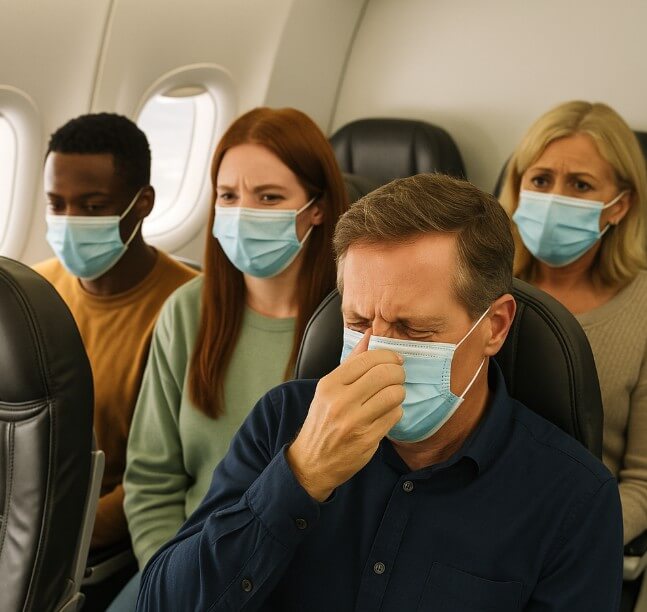
A viral passenger account from a domestic U.S. flight has sparked widespread discussion about aircraft cabin air quality after an unpleasant odor reportedly persisted for the entirety of a five-hour journey. The incident, which circulated widely on social media, drew attention not only for its unusual nature but also for what it revealed about the limitations of modern aircraft ventilation systems.
According to the account, the flight became uncomfortable when one traveler allegedly experienced repeated gastrointestinal issues, producing a strong odor that lingered throughout the cabin. Cabin crew members attempted to address the situation by distributing face masks and spraying air freshener, but the smell reportedly failed to dissipate. The episode raised questions among passengers about how such conditions could endure on an aircraft equipped with advanced air filtration technology.
How Aircraft Cabin Air Systems Work
Commercial aircraft cabins are engineered to balance comfort, safety, and efficiency through a combination of fresh and recirculated air. At cruising altitude, most modern jets use a roughly 50–50 mix of outside air and recirculated cabin air. The recirculated portion passes through high-efficiency particulate air, or HEPA, filters before being redistributed.
Cabin air is fully refreshed every two to three minutes, resulting in approximately 20 to 30 air changes per hour. This rapid turnover is specifically designed to reduce airborne particles, including dust, allergens, and pathogens, contributing to the relatively low risk of disease transmission during flights.
However, while the system is highly effective at managing particles, it is not designed to eliminate odors caused by gaseous compounds.
Why HEPA Filters Don’t Stop Smells
HEPA filters are a critical component of aircraft environmental control systems. They can capture up to 99.97 percent of solid and liquid particles above a certain size threshold, including bacteria and most virus-carrying droplets. From a health standpoint, this makes aircraft cabins comparatively clean environments.
Odors, however, are not made up of particles. Instead, they consist of gas molecules, which pass directly through HEPA filters. As a result, even when air circulation is functioning normally, unpleasant smells can remain noticeable in the cabin.
Some aircraft are equipped with additional odor-absorbing features, such as carbon-based filters, but these systems are not standard across all fleets. In their absence, repeated odor release in a confined space can overwhelm the ventilation system’s ability to dilute the smell.
Cabin Airflow and Odor Concentration
The way air moves through an aircraft cabin also affects how odors spread—or fail to spread. Airflow typically moves from ceiling vents downward toward the floor, rather than from the front of the aircraft to the back. This design helps limit the distance airborne particles travel, reducing cross-cabin contamination.
As Viewfromthewing reported, while this airflow pattern is effective for containing particles, it does little to eliminate odors near their source. When smells are repeatedly generated from the same seat area, they tend to linger locally rather than being quickly carried away.
Physiological Factors at Altitude
Human physiology during flight can further exacerbate odor issues. Lower cabin pressure causes gases in the digestive system to expand, making flatulence more common even among healthy passengers. On a full aircraft, this effect occurs across many individuals simultaneously.
When emissions come repeatedly from a single location, the ventilation system may reduce the overall intensity but cannot fully eliminate the odor before it reappears. Over several hours, this cycle can significantly affect passenger comfort.
The Role of Cabin Materials
Aircraft interiors may also contribute to how long odors persist. Fabric seat upholstery tends to absorb and retain smells more than leather or synthetic materials. In cabins where fabric seating is prevalent, odors can linger longer, even after the source has subsided.
Bottom Line
The five-hour odor incident underscores a common misunderstanding about aircraft air filtration. While modern jets excel at removing airborne particles and controlling the spread of illness, they are not designed to neutralize persistent gaseous smells.
When odors recur continuously, even the most advanced ventilation systems offer limited relief. In such situations, crew members and passengers are left relying on masks, air fresheners, and patience—an uncomfortable reminder that technological advances have their limits, even at 35,000 feet.
