


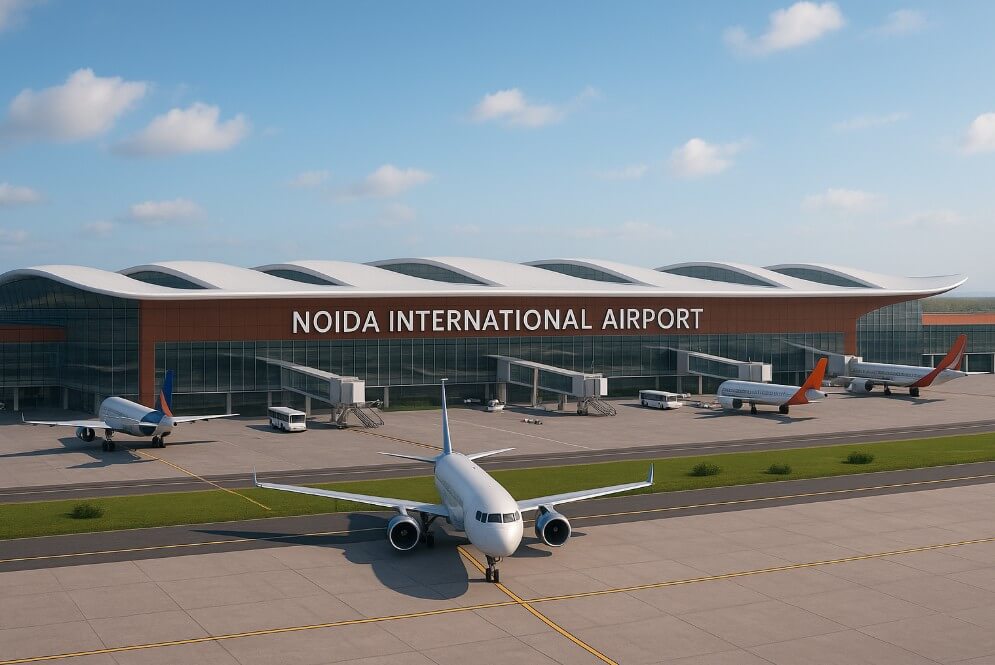
NOIDA, India — India’s ambitious plans to expand its aviation infrastructure are nearing a significant milestone as the Noida International Airport (NIA) in Jewar, Uttar Pradesh, readies for its first commercial flights by mid-December 2025. Once operational, the facility will become Asia’s largest international airport and serve as the Delhi-National Capital Region’s (NCR) second major aviation hub, complementing Indira Gandhi International Airport (DEL).
Developed by Yamuna International Airport Pvt. Ltd. (YIAPL), the upcoming airport is being positioned as a critical asset in India’s rapidly expanding air travel market. Officials said preparations for the launch are in the final phase, with regulatory clearances and route approvals nearing completion.
Major Airlines Lining Up for Inaugural Flights
According to reports, leading Indian carriers IndiGo (6E), Akasa Air (QP), and Air India Express (IX) will operate the airport’s maiden flights. Airline representatives are currently finalizing their operational schedules, which are expected to be announced in the coming weeks.
The initial phase will focus on strengthening domestic connectivity, particularly between major metro cities. “Discussions are in their final stages to confirm the first set of routes,” said Shailendra Bhatia, the nodal officer for Noida International Airport Ltd (NIAL). He added that inaugural operations are likely to include routes to Mumbai, Bengaluru, and Hyderabad, while the airport also aims to enhance regional connectivity under the government’s UDAN scheme.
The UDAN program, short for “Ude Desh ka Aam Naagrik,” seeks to improve air access between Tier-2 and Tier-3 cities. By aligning with this initiative, NIA is expected to ease the heavy passenger load currently handled by Delhi’s main airport and promote balanced air traffic distribution across northern India.
Phase 1: Green Design and Global Ambitions
Spanning 1,334 hectares, Phase 1 of the Noida International Airport includes a 3,900-meter runway and a passenger terminal capable of handling 12 million passengers annually. The facility integrates cutting-edge green technologies and a modular design that supports future expansion.
The airport’s development is a cornerstone of Uttar Pradesh’s plan to position itself as a leading logistics and aviation hub. Civil Aviation Minister Kinjarapu Rammohan Naidu underscored NIA’s long-term vision, noting that the airport “will initially connect at least ten domestic cities, with a long-term goal of developing into a major cargo hub.”
Beyond passenger operations, NIA’s infrastructure is being designed to accommodate significant freight activity. This dual focus—on both passengers and cargo—aligns with India’s broader strategy to strengthen its supply chain capabilities and enhance international trade connectivity. As cargo operations grow, the airport is projected to attract ancillary industries and spur job creation in the NCR and western Uttar Pradesh region.
Regulatory Progress and Final Approvals
Regulatory processes are progressing swiftly as NIA approaches completion. The Bureau of Civil Aviation Security (BCAS) has already approved the airside infrastructure, one of the final prerequisites before the Directorate General of Civil Aviation (DGCA) grants the aerodrome license.
Once the DGCA issues the license, airlines will be permitted to begin route testing, ground handling operations, and trial runs in preparation for the full commercial launch. Officials close to the project said that all major civil works are now finished, and final systems integration and safety checks are underway.
Boost to Regional Development
The operationalization of Noida International Airport is expected to deliver a substantial boost to the local and regional economy. The facility will support thousands of direct and indirect jobs, catalyze real estate and infrastructure investments, and serve as a gateway for both business and tourism in northern India.
The airport’s strategic location—approximately 75 kilometers from Delhi—offers seamless connectivity to major expressways, including the Yamuna Expressway and the upcoming Delhi-Mumbai Expressway. This integration is expected to significantly reduce travel times and improve logistics efficiency across the NCR and beyond.
A New Chapter in India’s Aviation Growth
For India’s aviation sector, which is on track to become the world’s third-largest market by 2030, the opening of Noida International Airport represents more than just an infrastructure milestone—it marks a new chapter in sustainable, regional, and capacity-driven growth.
With leading carriers preparing to launch operations and regulatory clearances nearing completion, the airport’s debut in December 2025 is poised to redefine air travel in northern India. Its success will not only enhance connectivity for millions of passengers but also strengthen India’s position as a regional aviation hub.
As the countdown to takeoff begins, industry observers say NIA’s launch underscores the country’s commitment to building next-generation airports that balance passenger comfort, environmental responsibility, and economic impact.
