


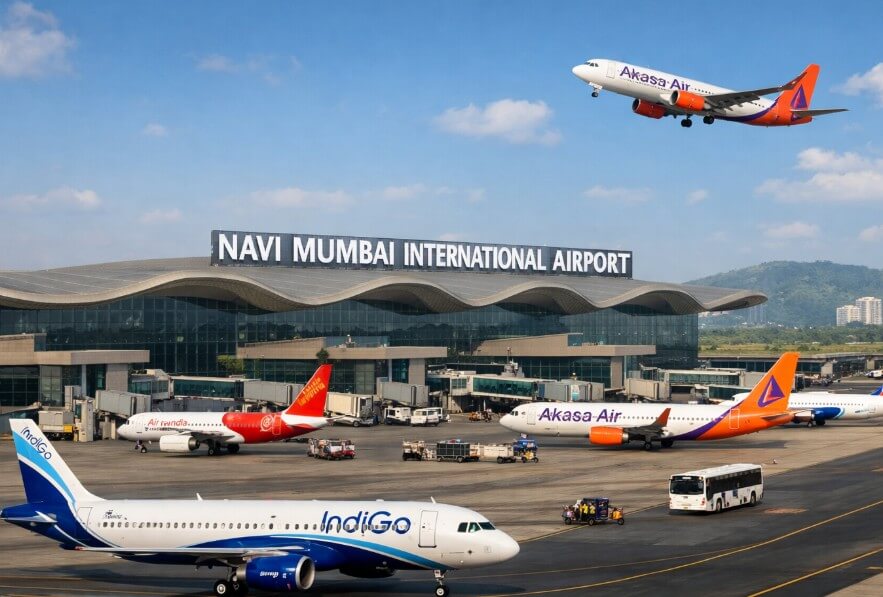
A Long-Awaited Second Airport for Mumbai
Navi Mumbai International Airport (NMI) officially commenced commercial flight operations on December 25, 2025, delivering a major boost to India’s aviation infrastructure and relieving long-standing congestion at Mumbai’s primary airport. The opening represents a critical milestone for the Mumbai Metropolitan Region, which has faced capacity constraints at Chhatrapati Shivaji Maharaj International Airport (BOM) for years.
Located in Ulwe, Navi Mumbai International Airport is designed to serve the growing travel demand of India’s financial capital and its surrounding economic corridors, including Navi Mumbai, Thane, Panvel, and the eastern suburbs.
Airlines Launch Initial Domestic Services
Four airlines—IndiGo, Air India Express, Akasa Air, and Star Air—have launched domestic operations from the new airport. Together, they connect Navi Mumbai with major business and leisure destinations across India, including Delhi, Bengaluru, Hyderabad, Kochi, Ahmedabad, Goa, and Nagpur.
IndiGo is the largest operator at launch, offering services to 13 destinations. Air India Express has begun flights to Bengaluru and Delhi, while Akasa Air connects the airport to Delhi, Goa, Kochi, and Ahmedabad. Star Air is operating services to Goa and Ahmedabad, adding to early route diversity.
Phased Ramp-Up of Airport Operations
During the initial phase, Navi Mumbai International Airport is operating between 8:00 a.m. and 8:00 p.m., with the capacity to handle up to 10 aircraft movements per hour. Authorities have confirmed plans to transition to 24-hour operations from February 2026, enabling further growth in flight schedules.
In the first month of operations, the airport will support 23 scheduled daily departures, increasing to 34 daily departures in the next phase. On opening day alone, the airport handled approximately 30 domestic flights and is expected to process more than 4,000 passengers.
IndiGo Anchors Early Growth
IndiGo’s launch from Navi Mumbai includes flights to key commercial centers such as Delhi, Bengaluru, Chennai, Hyderabad, and Ahmedabad, as well as leisure destinations like Goa. The airline has positioned the new airport as a complementary hub to Mumbai’s existing airport, allowing it to distribute capacity more efficiently across the region.
The carrier plans to gradually expand frequencies while maintaining strong connectivity across both Mumbai airports, supporting business travel, tourism, and regional mobility.
Air India Express and Akasa Air Expansion Plans
Air India Express has described Navi Mumbai as a core pillar of its dual-airport strategy for Mumbai. The airline operates daily flights to Bengaluru and is increasing Delhi frequencies to daily services from January 1, 2026. Its broader Maharashtra network includes extensive operations from Mumbai, Pune, and Nagpur.
Akasa Air, meanwhile, sees Navi Mumbai as a strategic base for long-term growth. The airline has announced plans to scale up to 300 domestic and 50 international weekly departures over time, supporting future expansion into international markets across the Middle East and Southeast Asia.
Modern Passenger Facilities and Infrastructure
Passengers at Navi Mumbai International Airport benefit from modern terminal facilities, including Digi Yatra-enabled touchpoints for faster check-in and boarding. Traditional counters remain available, while retail and dining outlets have been curated to offer affordability alongside local flavors.
The airport spans approximately 1,160 hectares and has been developed under a public-private partnership. Adani Airports Holdings owns 74 percent of the project, with the remaining 26 percent held by CIDCO.
Long-Term Vision and Regional Impact
At full development, Navi Mumbai International Airport is designed to handle up to 90 million passengers annually, supported by two parallel runways, multiple terminals, and large cargo facilities. The first operational phase includes Terminal 1 and a single runway with capacity for 20 million passengers per year.
With improved road and rail connectivity planned, the airport is expected to play a transformative role in regional development while firmly establishing itself as one of India’s most important aviation hubs.
