


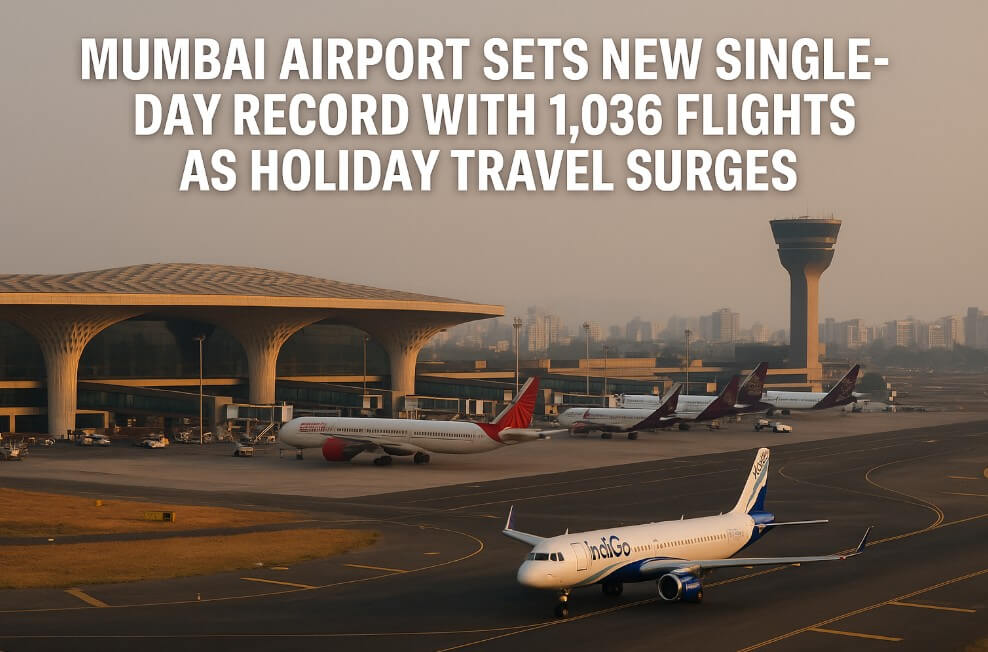
Record-Breaking Day for the World’s Busiest Single-Runway Airport
Mumbai’s Chhatrapati Shivaji Maharaj International Airport (CSMIA) set a new operational record during India’s peak festive travel surge, reinforcing its position as the world’s busiest single-runway airport. The facility logged 1,036 air traffic movements (ATMs) within 24 hours on November 21, 2025, surpassing its previous high set in 2023 and marking one of the most demanding operational days in its history.
Passenger Volumes Approach All-Time High
The record-setting ATM count coincided with near-record passenger traffic. According to airport data, 170,488 travelers moved through CSMIA on the same day—just shy of the airport’s highest single-day total of 170,516 passengers recorded on January 11, 2025. The surge was driven by a mix of domestic and international travel ahead of India’s holiday season.
Of the total passenger volume, 121,527 travelers flew on domestic routes, while 48,961 passengers traveled internationally. Demand remained strong across India’s top metro routes, with Delhi, Bengaluru, Ahmedabad, Hyderabad, and Kolkata among the busiest domestic sectors.
Flight Operations Show Balanced Domestic and International Activity
CSMIA’s 1,036 flight movements consisted of 755 domestic flights and 281 international services. Aircraft operations remained evenly distributed throughout the day, with 520 arrivals and 516 departures, reflecting both strong scheduling efficiency and steady traffic flow.
International traffic was led by high-demand destinations such as Dubai, Abu Dhabi, London Heathrow, Doha, and Jeddah, which continue to generate strong year-round loads from business travelers, expatriates, and leisure passengers.
Technology Investments Strengthen Operational Efficiency
CSMIA’s ability to manage rising passenger and aircraft volumes was supported by significant investments in automation and digital infrastructure. The airport has expanded its Self Baggage Drop units, installed additional self-check-in kiosks, and encouraged broader adoption of digital identity programs such as DigiYatra and FTI TTP. These upgrades reduced wait times and optimized passenger processing during the busy festive period.
The upgraded Airport Operations Control Centre (AOCC) also played a key role. The facility integrates data from air traffic controllers, airlines, ground handlers, and security agencies to monitor real-time conditions across the airport. This coordination helped maintain on-time performance even as the airport experienced heavy pressure on its single-runway system.
A Milestone Built on Scalable Systems
The new ATM record highlights the airport’s capability to accommodate rising demand through a combination of structured processes, digital tools, and a strong focus on safety and operational reliability. CSMIA has long been known for achieving some of the world’s highest traffic volumes under the constraints of a single-runway configuration, making each new milestone a notable operational achievement.
The airport remains one of India’s most important aviation gateways, serving more than 45 million passengers annually and connecting Mumbai to major domestic and global destinations.
Mumbai Airport’s Infrastructure and Services
Mumbai Airport operates two intersecting runways—09/27 and 14/32—but only one can be used at a time, making efficient scheduling critical. Terminal 1 primarily handles domestic services, while Terminal 2 manages both international and domestic flights and is recognized for its extensive art collection and peacock-inspired architecture.
Passengers have access to free Wi-Fi, lounges, charging stations, spa services, airport hotels, and a large duty-free retail zone. Currency exchange counters, ATMs, and GST refund desks support financial needs, while dedicated play areas and specialized assistance cater to families and travelers with limited mobility.
Connectivity to the City
Travelers can reach Mumbai’s city center via prepaid taxis, ride-hailing services such as Uber and Ola, public buses, or suburban trains. Prepaid taxi fares typically range between INR 500 and 600, while metered taxis and app-based rides offer additional options. Public buses provide low-cost travel to nearby railway stations such as Vile Parle and Andheri East.
A Critical Gateway for India’s Aviation Growth
As India’s aviation market expands, CSMIA’s latest record underscores the country’s increasing prominence in global air travel. With a combination of rising passenger numbers, expanding airline networks, and ongoing operational upgrades, Mumbai Airport continues to strengthen its position as a vital hub for business, tourism, and long-haul connectivity.
