


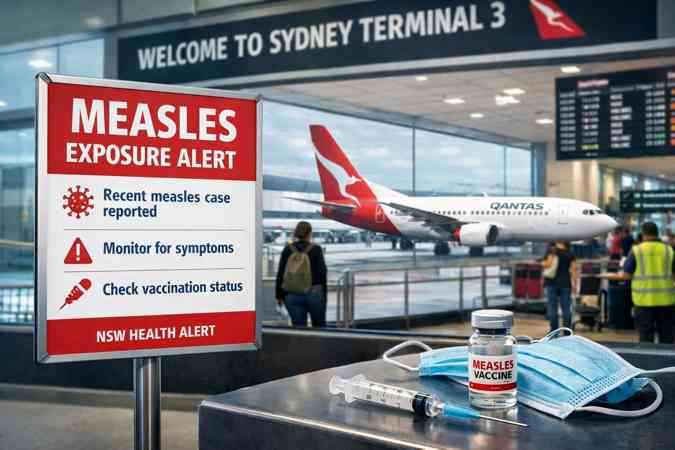
Sydney Airport and Australia’s largest airline are under renewed scrutiny after NSW Health confirmed measles exposure linked to a domestic Qantas flight and airport arrivals facilities, highlighting continued public health risks tied to international travel and infectious disease transmission.
Health authorities have urged Qantas passengers and members of the public who were at Sydney Airport’s Terminal 3 domestic arrivals hall late last month to monitor for symptoms after confirmed exposure to measles. The alert comes as New South Wales records its third measles case in recent days, all connected to travellers returning from Southeast Asia, where multiple outbreaks are currently ongoing.
Exposure Linked to Qantas Flight and Arrivals Hall
NSW Health confirmed that measles exposure occurred on Qantas flight QF748, which travelled from Adelaide Airport to Sydney Airport and landed between 10.30 pm and 11 pm on December 29. The exposure window also includes the Qantas Terminal 3 domestic arrivals hall during the same time period.
Passengers who were on the flight, along with anyone present in the arrivals hall during those hours, have been advised to remain alert for symptoms until January 16. Health officials stressed that exposure risk is limited to the specified times and that there is no ongoing risk at the airport outside those windows.
Additional Alert at Concord Hospital Emergency Department
Beyond the airport, NSW Health has issued a further exposure alert for Concord Repatriation General Hospital. Anyone who attended the hospital’s Emergency Department between 1 pm and 4.10 pm on January 3 is advised to monitor for symptoms until January 21.
Health authorities said these alerts are part of a wider effort to quickly identify and contain potential spread, particularly in high-traffic locations such as hospitals and transport hubs.
Rising Measles Cases Linked to International Travel
The recent cases form part of a broader increase in measles exposure locations across New South Wales. Since early December, more than 50 exposure sites have been identified, including train services, supermarkets, restaurants, multiple hospitals, and both domestic and international terminals at Sydney Airport.
Officials confirmed that all three recent cases involve travellers returning from Southeast Asia, where measles outbreaks are currently being reported in Indonesia, including Bali, as well as Vietnam, Thailand, and the Philippines. NSW Health said there is no continuing risk at any of the identified locations, as exposure risk is confined to specific timeframes.
Contact tracing is underway, with health authorities notifying close contacts where possible and providing guidance on symptom monitoring and vaccination status.
How Measles Spreads and Who Is Most at Risk
Measles is one of the most infectious diseases in the world and spreads easily through the air when an infected person coughs or sneezes. Symptoms typically appear around 10 days after exposure.
Early symptoms often resemble the flu and include fever, cough, tiredness, runny nose, and sore, red eyes. A distinctive rash usually develops a few days later, beginning on the face and spreading across the body.
Health officials note that approximately one in three people with measles may experience complications, such as ear infections, pneumonia, or diarrhoea. In rare cases, the disease can cause brain inflammation or death. Infants, pregnant women, and people with weakened immune systems face a higher risk of severe illness.
Vaccination Urged as Primary Protection
NSW Health continues to emphasize vaccination as the most effective protection against measles. Anyone born after 1965 should have received two doses of the measles vaccine, which is available free of charge in NSW for eligible individuals requiring catch-up doses.
Children typically receive the measles-mumps-rubella (MMR) vaccine at 12 and 18 months. However, children as young as six months may be vaccinated earlier if they are travelling internationally to high-risk areas.
Health officials have urged residents to check their vaccination records and speak with healthcare providers if they are unsure of their immunity status.
Guidance for Those Potentially Exposed
People who were present at the listed exposure locations during the specified times are advised to seek medical care promptly if symptoms develop. NSW Health recommends calling ahead before visiting a GP or hospital so appropriate infection control measures can be put in place and avoiding public places if unwell.
While authorities stress there is no ongoing risk at the identified locations, they continue to urge the public to remain vigilant, particularly when travelling domestically or overseas.
