


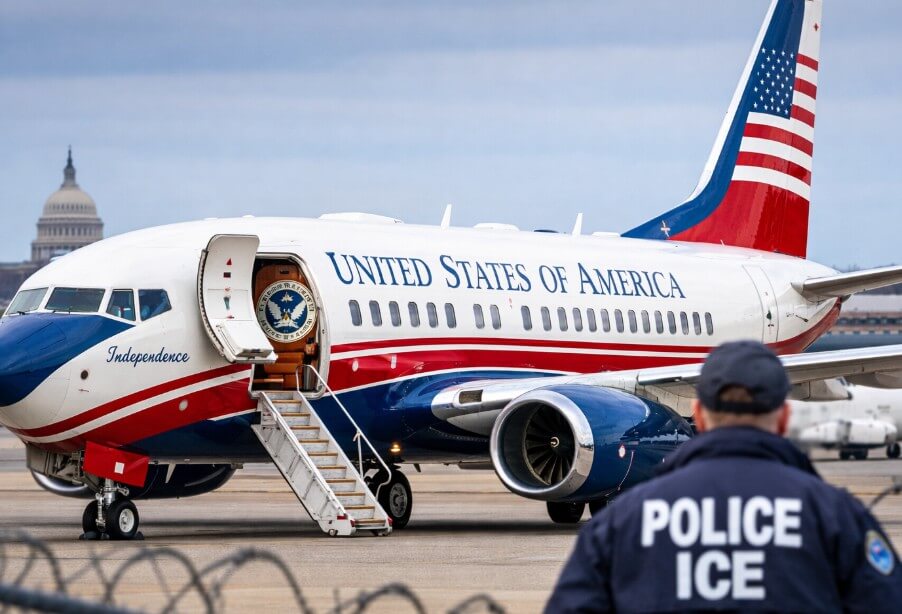
ARLINGTON, Va. — Two U.S. government-linked aircraft departing Washington, D.C., for the Middle East have renewed scrutiny around a Boeing 737 Business Jet (BBJ) featuring a high-end VVIP interior and visible Department of Homeland Security (DHS) markings, raising questions about transparency, fleet strategy, and the use of taxpayer-funded aviation assets.
A 737 BBJ Emerges Alongside DHS Deportation Plans
A 737-8 Boeing Business Jet registered as N471US has appeared publicly with a red, white, and blue livery bearing the words “United States of America” along the fuselage. The aircraft also carries the name “Independence” beneath the cockpit and a large American flag on its tail.
Photographs taken at Ronald Reagan Washington National Airport show a Department of Homeland Security seal mounted inside the main cabin, visible through an open door. Federal Aviation Administration records list the aircraft as registered since October to Valkyrie Aviation Holdings Group LLC, an entity with an Arlington, Virginia address just across the Potomac River from Washington.
The aircraft’s emergence coincides with DHS confirmation that it recently entered a $140 million contract with Daedalus Aviation to acquire six Boeing 737 aircraft to support U.S. Immigration and Customs Enforcement deportation operations. The timing has fueled speculation that N471US could be linked to that effort, despite its apparent luxury configuration.
Political Context and Familiar Livery
The external appearance of N471US closely resembles the livery design selected during President Donald Trump’s first term for the future VC-25B Air Force One aircraft. That design was later reversed by President Joe Biden, who restored plans to retain the Kennedy-era blue-and-white Air Force One color scheme.
In August, the U.S. Air Force stated it was “implementing a new livery requirement for VC-25B,” without providing details. The visual parallels between N471US and the previously proposed presidential aircraft paint scheme have added a symbolic and political dimension to the debate over the jet’s role.
Interior Configuration Points to Executive Transport
The aircraft, manufacturer serial number 61329, has been operational since July 2021 and remains listed for sale through Avjet Global. Marketing materials describe a five-zone VVIP cabin designed for 17 passengers, with only 672 total flight hours and 154 landings.
The layout includes a forward crew rest area, a fully equipped galley, multiple lounges with high-definition monitors, a stand-up wet bar, and both a guest suite and a master suite featuring full-size beds and bathrooms with stand-up showers. Aviation analysts note that the cost and complexity of such an interior make it ill-suited for deportation or other high-density transport missions, aligning instead with senior leadership or continuity-of-government travel requirements.
Maintenance, Repainting, and Testing Timeline
Before adopting its current registration, the aircraft flew as N702F. In late September, it traveled from Las Vegas to Dallas Love Field and then to Ardmore Municipal Airport in Oklahoma, home to King Aerospace, a firm known for VVIP modification work and extensive U.S. government contracts.
The jet later flew to Chennault International Airport in Louisiana, a facility frequently used for repainting and modification of government aircraft, before returning to Ardmore for additional flights consistent with testing or crew training. By mid-December, N471US had arrived at Joint Base Andrews, a hub for U.S. military and executive transport operations.
Overseas Movements Raise Further Questions
Shortly after appearing at National Airport, the aircraft departed for overseas destinations, including Chania International Airport in Crete and Amman, Jordan, before continuing to Abu Dhabi. A U.S. Coast Guard C-37B Gulfstream G550, operated under DHS authority and routinely used to transport senior leadership, flew similar routes within days.
The identities of the passengers and the purpose of the travel have not been disclosed. DHS and the White House did not respond to requests for comment at the time of writing.
Scrutiny of DHS Aviation Strategy
DHS has separately confirmed plans to replace aging Coast Guard Gulfstream aircraft with newer models equipped with secure communications, at an estimated cost of $170 million to $200 million. Those plans have drawn criticism over timing and priorities, particularly during a recent government shutdown.
The appearance of a luxury-configured 737 BBJ alongside deportation-focused fleet acquisitions has intensified long-standing concerns about government aircraft use. From its interior layout to its operational routing, N471US appears far more consistent with VIP transport than immigration enforcement.
As international flights continue, unanswered questions remain about the jet’s ownership structure, mission profile, and long-term role within DHS aviation assets, making N471US a focal point in the broader debate over federal aircraft procurement and oversight.
