


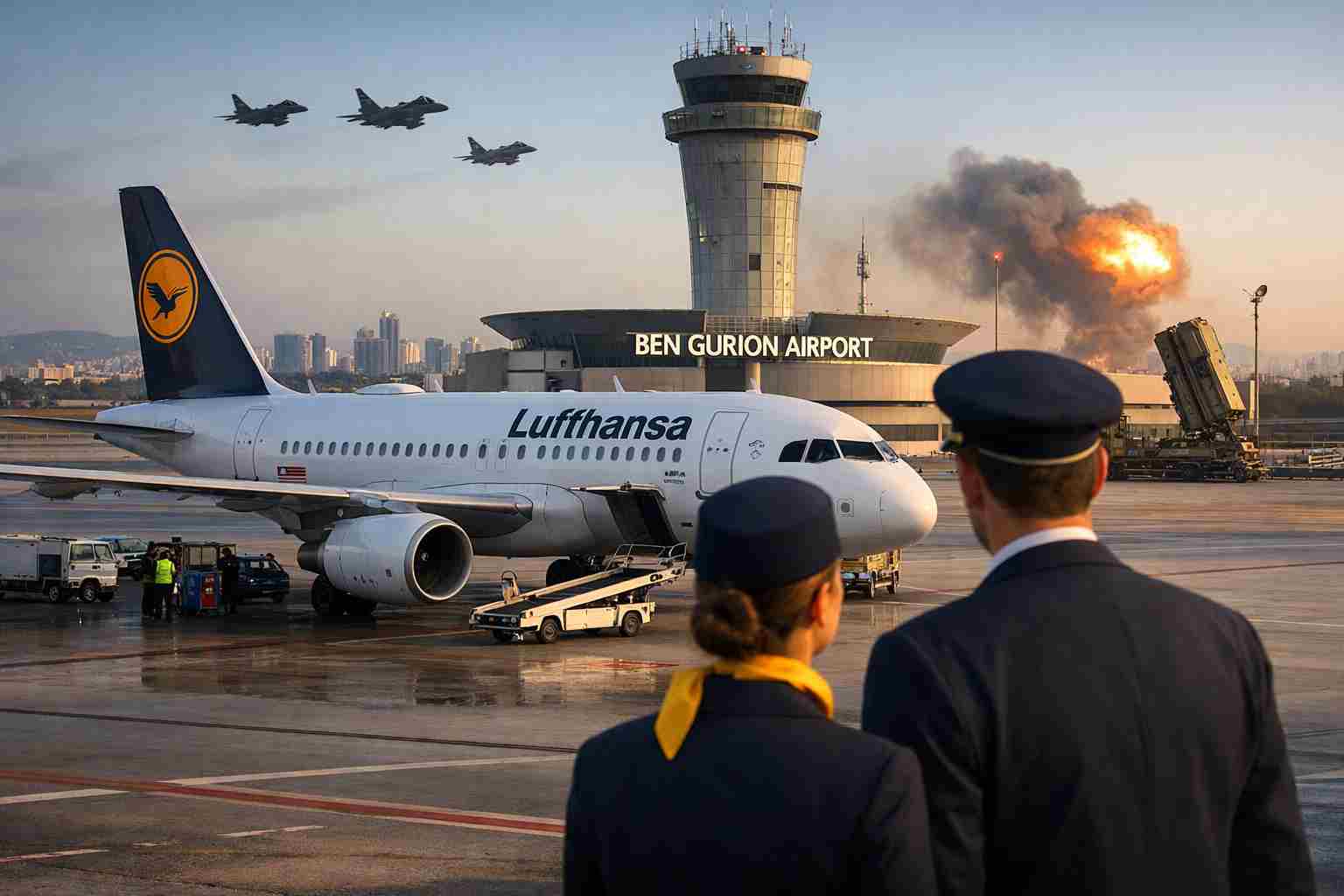
TEL AVIV— Germany’s flagship carrier Lufthansa (LH) is extending its suspension of overnight flights to Israel, shifting all Tel Aviv operations to daytime-only service as regional security concerns intensify and fears grow over a potential military escalation involving Iran.
The policy applies to services operating into Tel Aviv Ben Gurion Airport (TLV) and will remain in effect until at least January 31. Lufthansa Group said flights to Israel will continue, but schedules have been adjusted to ensure arrivals and departures occur during daylight hours, limiting time on the ground and reducing exposure to sudden disruptions.
The move underscores how quickly geopolitical instability in the Middle East can reshape airline operations, forcing carriers to make scheduling decisions that balance demand, safety, and operational continuity.
Daytime-Only Operations Through Jan. 31
Lufthansa’s latest adjustment reflects growing caution across global aviation as tensions in the region remain elevated. By eliminating nighttime services, the airline can operate round-trip flights that allow crews to return to Europe shortly after landing in Israel, avoiding overnight stays that could become risky if conditions change without warning.
The shift also helps reduce uncertainty tied to potential airspace restrictions. Airlines operating into conflict-adjacent zones often face limited lead time when authorities impose closures, forcing rapid cancellations and leaving crews stranded away from home bases.
Lufthansa Group Airlines Also Affected
The suspension of nighttime services is not limited to Lufthansa’s mainline operation. The policy extends across Lufthansa Group carriers, including Austrian Airlines and SWISS, aligning schedules to ensure crews are not required to remain overnight in Israel.
In addition to Tel Aviv, the revised operational approach applies to select services to Amman, Jordan, signaling that Lufthansa is assessing broader regional risk patterns rather than focusing solely on Israel’s airspace.
Under the updated schedule, aircraft are planned to complete quick turnaround flights, with crews remaining onboard or returning without extended ground time. Lufthansa said this approach significantly reduces operational exposure should airspace restrictions or military action occur unexpectedly.
Why Crew Safety Is the Central Issue
Lufthansa has emphasized that crew safety is the primary driver behind the decision, rather than concerns about aircraft security.
Overnight operations typically require flight crews to remain in Israel for extended periods due to European flight time limitation rules. These regulations restrict how long pilots and cabin crew can remain on duty, making it impractical to operate overnight arrivals and then immediately return to Europe without exceeding legal duty limits.
As a result, crews on nighttime flights would normally be required to lay over in Tel Aviv. In a volatile security environment, that increases the risk of personnel being stranded if flights are abruptly suspended or if airport operations are disrupted.
By operating only during the day, Lufthansa aims to ensure crews spend minimal time on the ground—often little more than an hour—before departing back to Europe. That reduces exposure to potential escalations and allows the airline to maintain more predictable crew rotations.
Regional Airspace Uncertainty Adds Pressure
The airline’s decision follows a tense period in which airspace closures in the region appeared increasingly likely.
Iran temporarily shut its airspace earlier this week amid speculation that the United States could authorize military strikes, before diplomatic signals eased immediate fears. While the immediate risk of escalation may have softened, Lufthansa’s extended daytime-only policy indicates the carrier is preparing for volatility that could return quickly.
For airlines, even short-lived airspace restrictions can trigger cascading disruptions, including aircraft repositioning challenges, crew scheduling breakdowns, and passenger rebooking costs.
Industry Precedent Drives Airline Caution
Lufthansa’s approach mirrors previous incidents in which foreign airlines faced operational and personnel challenges while flying into Israel during periods of conflict.
In April 2024, United Airlines was forced to evacuate pilots and flight attendants from Tel Aviv after flights were cancelled amid rising military tensions. That episode highlighted the complexity of protecting staff while maintaining service to high-demand markets during unstable periods.
Similar concerns have surfaced following past missile attacks near Tel Aviv Ben Gurion Airport, including an incident in which a ballistic missile launched by Houthi forces in Yemen landed close to the airport perimeter.
While Israel’s air defense systems remain robust, airlines have increasingly taken preventive steps to reduce the risk of disruption and protect employees operating in the region.
Legal risks have also emerged. In one recent case, a Delta Air Lines flight attendant filed a lawsuit alleging retaliation after refusing to immediately operate a return flight following a missile attack near the airport, highlighting the human and operational strain airlines face in conflict zones.
A Defensive Strategy Likely to Continue
Lufthansa’s decision to suspend overnight flights to Israel underscores how rapidly shifting geopolitical risks can reshape airline operations. By prioritizing crew safety and minimizing ground exposure, the carrier is adopting a defensive strategy that may become increasingly common if regional tensions persist.
For passengers, the move could mean fewer scheduling options, especially for late-night departures and early-morning arrivals. For Lufthansa and other international carriers, however, the adjustment represents a risk-management step aimed at maintaining service while limiting the chance of crew being caught in an abrupt escalation.
As security conditions remain fluid, Lufthansa’s approach signals that airlines are increasingly willing to redesign flight networks in real time—favoring operational resilience and staff protection over traditional scheduling patterns.
