


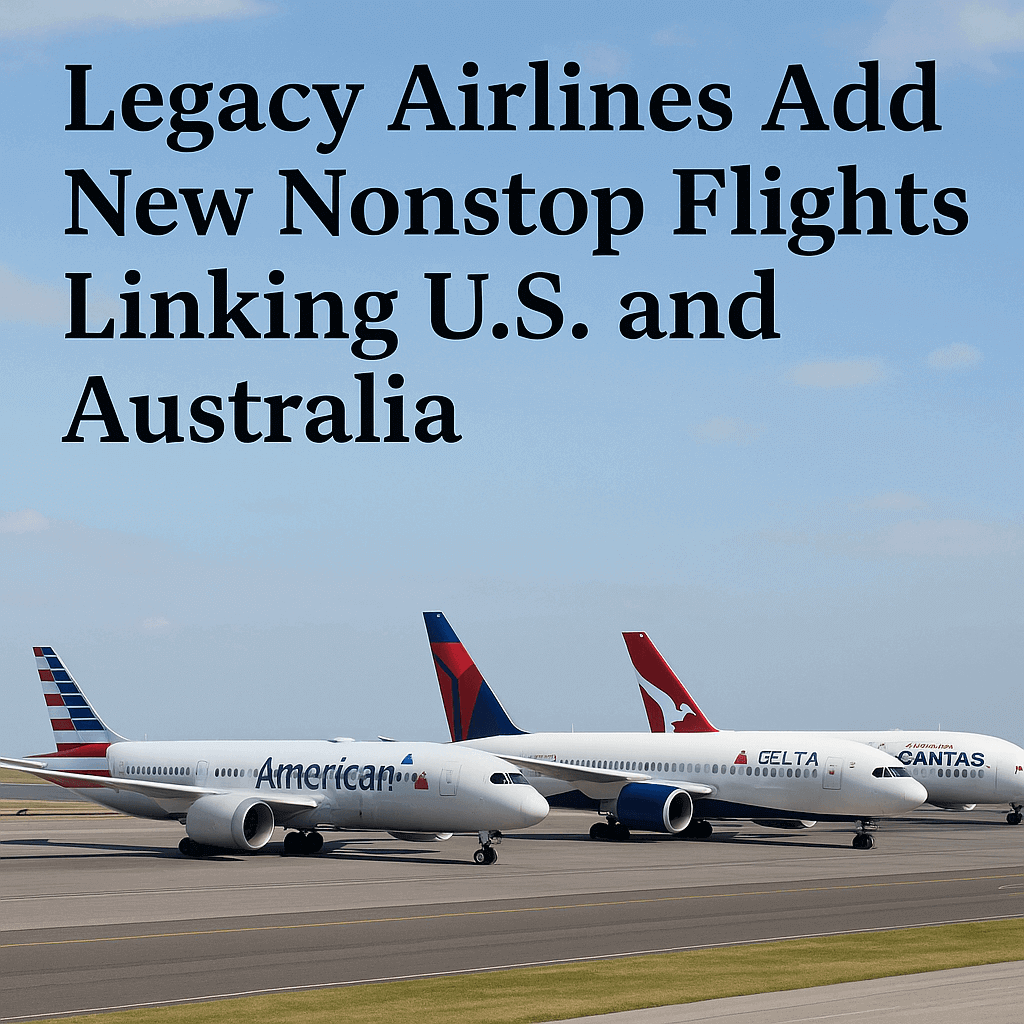
American Airlines, Delta Air Lines, United Airlines, and Qantas are set to expand transpacific travel with four new nonstop routes connecting major U.S. gateways to Australia, timed to coincide with the southern hemisphere’s peak summer travel season. The additions, beginning in December 2025 and January 2026, underscore a surge in U.S.-Australia demand fueled by favorable exchange rates, strong tourism growth, and deepening airline partnerships.
A Growing Travel Corridor
Australia has emerged as one of the fastest-growing long-haul destinations for U.S. travelers. According to Forbes, visitor numbers from the United States climbed 8% year over year between April 2024 and April 2025, with 711,000 Americans traveling Down Under during that period. The U.S. is now Australia’s third-largest inbound market, behind China and New Zealand.
Industry observers note that demand began climbing before the pandemic and rebounded sharply after border restrictions eased in 2022. A strong U.S. dollar — near a five-year high and about 20% above its 2021 low — has bolstered affordability, making Australia an especially attractive choice for winter-weary Americans seeking value abroad.
New Routes at a Glance
The rollout of four nonstop routes over an eight-week period will expand access across five U.S. airports and four Australian cities.
-
American Airlines will launch flights from Los Angeles (LAX) to Brisbane (BNE) on December 5, 2025. The service will operate three times weekly on Boeing 787-9 Dreamliners and complement Qantas flights on the same route, collectively offering up to seven weekly departures.
-
Delta Air Lines will add Los Angeles–Melbourne (MEL) flights in December 2025, strengthening connectivity to Australia’s cultural capital.
-
United Airlines will begin nonstop service between San Francisco (SFO) and Adelaide (ADL) on December 11, 2025. The route represents the first-ever nonstop link between the U.S. and Adelaide, opening direct access to South Australia’s wine country and arts scene.
-
Qantas will resume Dallas-Fort Worth (DFW) to Sydney (SYD) flights in January 2026 using Airbus A380 aircraft, enhancing capacity from the Oneworld alliance’s key Texas hub.
Combined, the new services add to the approximately 20 U.S.–Australia routes already in operation by six carriers, led by Qantas and United.
Why Australia Resonates
The appeal of Australia extends beyond its favorable currency dynamics. Sydney offers iconic landmarks such as the Opera House and Harbour Bridge; Melbourne is known for its arts, sports, and coffee culture; Brisbane serves as a gateway to the Great Barrier Reef; and Adelaide provides proximity to the Barossa Valley and a thriving culinary scene.
Events like the Australian Open, Melbourne Cup, and international cricket matches draw sports enthusiasts, while outdoor adventurers are drawn to hiking, diving, and surfing. Culinary tourism is also growing, with Australia’s blend of Pacific Rim and European influences and globally recognized wine production.
Airline Alliances and Market Share
The transpacific expansions are strategically significant. Qantas and American Airlines, in the fourth year of their joint venture, now boast the most comprehensive U.S.–Australia network, with 28,600 weekly seats and a market share of 54.5%. United holds 28.2% of the market, while Delta accounts for 8.2%.
All three alliances — Oneworld, Star Alliance, and SkyTeam — are leveraging loyalty programs to capture premium passengers. Frequent flyers gain benefits such as reciprocal mileage earning, upgrades, and lounge access, smoothing the journey across long-haul routes.
Economic Impact and Premium Travel
Beyond tourism, the airlines forecast meaningful economic benefits for Australian cities. Delta’s Brisbane service alone is projected to add $135 million to Queensland’s economy over three years. United’s entry into Adelaide is expected to boost South Australia’s exposure to both leisure and business travelers.
The carriers are also courting high-spending passengers. American’s Dreamliners feature 51 Flagship Suite seats and 32 Premium Economy seats, while Qantas’ A380 service offers lie-flat beds and expanded amenities. Both airlines emphasize seamless experiences for premium customers through priority check-in, advanced in-flight entertainment, and lounge access.
Strategic Timing
The timing of the launches is no accident. Aligning with Australia’s December-to-February summer season, the expanded service provides U.S. travelers escaping winter with direct access to beaches, cultural festivals, and outdoor adventure. For business travelers, the flights strengthen bilateral ties between two countries whose trade and investment flows continue to deepen.
Industry analysts say the expansion highlights the resilience of transpacific demand. With more nonstop options than ever before, U.S. travelers will have greater flexibility, while Australian tourism boards anticipate record arrivals in 2026.
