


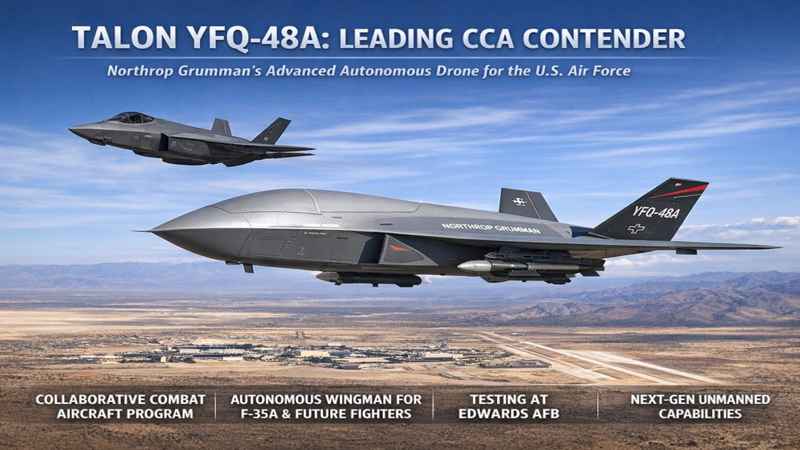
Northrop Grumman’s Talon autonomous drone has emerged as a leading contender in the United States Air Force’s Collaborative Combat Aircraft (CCA) program, marking a significant milestone in the service’s effort to integrate semi-autonomous systems into frontline fighter operations. Now designated the YFQ-48A, the Talon represents a key prototype as the Air Force accelerates development of uncrewed aircraft designed to operate alongside piloted fighters in future conflicts.
The Air Force confirmed in December that Talon is advancing within the CCA program, which is focused on pairing autonomous aircraft with crewed platforms such as the F-35A and the future F-47. Testing and development are taking place across major Air Force installations, including Edwards Air Force Base (EDW), long regarded as the center of U.S. flight testing and evaluation.
A Central Pillar of Air Force Modernization
The CCA program is a cornerstone of the Air Force’s broader modernization strategy. By integrating semi-autonomous wingmen into combat formations, the service aims to extend mission reach, enhance survivability, and reduce risk to pilots in contested environments.
Under the concept, CCAs will operate with limited pilot input, performing roles such as combat support, intelligence gathering, communications disruption, and acting as decoys. Affordability is a defining requirement, allowing the Air Force to absorb losses without imposing significant strain on budgets or force readiness.
The YFQ-48A designation places Talon among a small group of officially recognized CCA prototypes. It follows Anduril’s YFQ-44A and General Atomics’ YFQ-42A, making it the third platform to receive formal recognition. The “Y” prefix denotes prototype status and will be removed once a system reaches production.
Competitive Path to Fielding Autonomous Wingmen
The Air Force awarded contracts for the first increment of CCAs in April 2024 to Anduril and General Atomics, with flight testing beginning in 2025. Additional awards for a second increment are expected as the program expands and requirements mature.
Rather than selecting a single prime contractor early, the Air Force is pursuing a continuous competition strategy to encourage innovation and control costs. This approach is intended to keep multiple vendors engaged as the service refines operational concepts and technical requirements. Defense News reported that Air Force leaders view this strategy as essential to rapidly advancing autonomous combat systems while maintaining industrial competition.
Northrop Grumman’s inclusion signals that the company remains a serious competitor as the program evolves beyond its initial phases.
Northrop Grumman’s Rapid Development Approach
Northrop Grumman introduced Project Talon in December 2024, highlighting a development approach centered on modular manufacturing and mission flexibility. According to the company, Talon was designed, built, and prepared for flight in less than two years, an unusually rapid timeline for a new aircraft program.
A key enabler of that speed was Northrop’s Beacon autonomous testbed ecosystem, which allowed engineers to test avionics software in live environments before flight. This approach helped reduce integration risk and compress development schedules.
Reports indicate that Talon represents a significant redesign from Northrop Grumman’s earlier CCA proposal. The current configuration is lighter, uses fewer parts, and can be manufactured more quickly. These changes were made to better align with Air Force priorities around affordability, scalability, and rapid production.
International Interest and Operational Implications
Beyond U.S. requirements, Northrop Grumman sees international potential for Talon. The company has stated that the platform is intended to support coordinated operations between crewed and uncrewed aircraft for both U.S. and allied forces. This capability is viewed as particularly valuable in high-threat environments where survivability, flexibility, and distributed operations are critical.
Air Force leadership has emphasized that progress across multiple CCA prototypes, including Talon, supports the service’s objective of accelerating the deployment of autonomous combat systems while strengthening competition within the defense industrial base.
Shaping the Future of Air Combat
The development of Talon and other CCAs reflects a broader shift toward scalable, autonomous systems designed to complement crewed fighters rather than replace them. As testing continues and the program advances through future increments, the Air Force expects multiple industry partners to compete for production opportunities.
If successful, CCAs like the YFQ-48A could fundamentally reshape how air combat operations are conducted, extending the effectiveness of U.S. and allied airpower while keeping costs and risk under control.
