


Regulators Cite Sharp Capacity Reduction on Incheon–Frankfurt Route
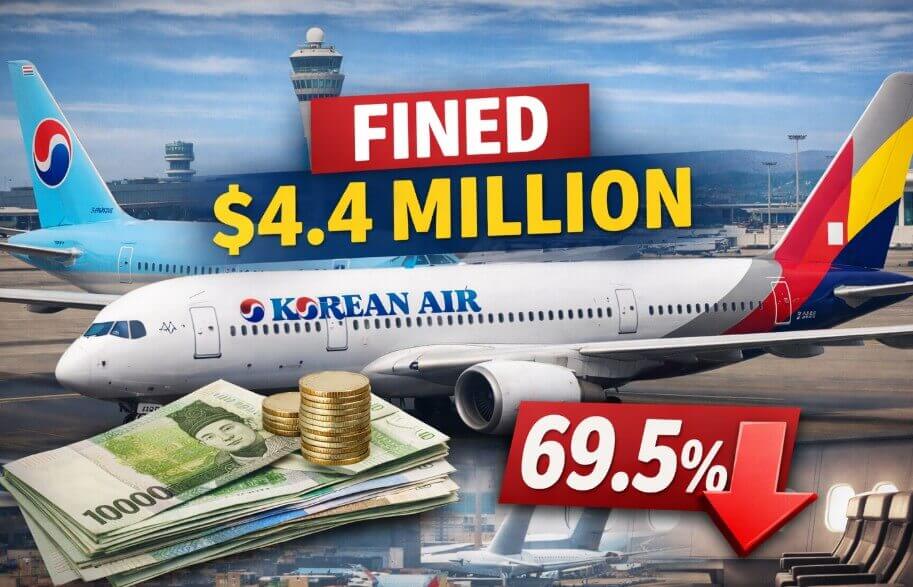
South Korea’s competition authority has fined Korean Air and Asiana Airlines a combined 6.46 billion won, or roughly $4.4 million, after determining that the carriers violated legally binding conditions tied to their ongoing merger by failing to maintain required seat capacity on a major international route.
The Fair Trade Commission (FTC) said seat supply on flights between Seoul’s Incheon International Airport and Frankfurt Airport dropped to 69.5% of 2019 levels, significantly below the minimum threshold mandated under the merger’s corrective measures. The enforcement action highlights intensifying regulatory oversight as the two airlines move toward full integration, which is targeted for completion by 2027.
Details of the Violation
According to the FTC, the merger approval required the combined airline group to maintain seat capacity at no less than 90% of pre-pandemic levels on routes identified as having heightened competition risks. The requirement was designed to prevent service reductions that could lead to higher fares or fewer choices for consumers.
Between December of last year and late March, capacity on the Incheon–Frankfurt route fell 20.5 percentage points below that mandated level. Regulators found that despite the shortfall, the airlines continued operating the route without restoring capacity, triggering enforcement penalties.
As a result, Korean Air was fined 5.88 billion won, while Asiana Airlines received a separate fine of 580 million won. The FTC noted that enforcement fines are imposed when companies subject to merger remedies fail to comply with legally binding conditions.
Merger Approved With Conditions
The Korean Air–Asiana merger, one of the largest airline consolidations in Asia, received conditional approval from the FTC in December 2024. Regulators concluded that while the deal could improve financial stability in South Korea’s aviation sector, it posed risks to competition without strong safeguards.
Seat capacity requirements were among the key behavioral remedies introduced to ensure pricing stability and sufficient service levels during the transition period. The FTC emphasized that these obligations remain in effect until all merger remedies, including structural measures, are fully implemented.
Route Capacity and Consumer Impact
The Incheon–Frankfurt route is considered a strategically important long-haul market linking South Korea to Europe. Regulators said maintaining adequate capacity on such routes is critical to preventing reduced competition and protecting passengers from potential fare increases.
The FTC’s findings suggest that authorities are closely monitoring not only overall compliance but also route-specific performance. The enforcement action underscores the regulator’s willingness to intervene when conditions are not met, rather than relying on voluntary corrective action by the airlines.
Structural Remedies Still Pending
Beyond behavioral obligations, the merger approval includes extensive structural remedies aimed at addressing long-term competition concerns. Korean Air and Asiana are required to transfer slots and traffic rights on 26 international routes and eight domestic routes to rival carriers over a 10-year period.
The affected international routes include high-demand long-haul markets such as Incheon–New York, where regulators identified a heightened risk of market dominance following the merger. Until these transfers are completed, both airlines remain subject to strict operational oversight.
The FTC has stressed that corrective measures remain enforceable throughout the entire remedy period and that future violations could result in additional penalties.
Broader Oversight of Pricing and Service
In addition to capacity requirements, behavioral remedies limit average fare increases and mandate the maintenance of service standards, including seat spacing and free baggage allowances. These provisions are intended to prevent service degradation while the airlines consolidate operations.
Regulators said such measures are essential to balancing the benefits of consolidation with the need to protect consumers in a market with limited competition.
Outlook for the Merger
The $4.4 million fine sends a clear signal that South Korean regulators intend to strictly police compliance with merger conditions as Korean Air and Asiana move closer to integration. With the 2027 target still several years away, the airlines are expected to remain under close scrutiny to ensure capacity, pricing, and service commitments are upheld.
For the aviation sector, the enforcement action underscores the regulatory challenges of large-scale consolidation in a post-pandemic environment, where recovery efforts must align with competition rules and consumer protections.
