


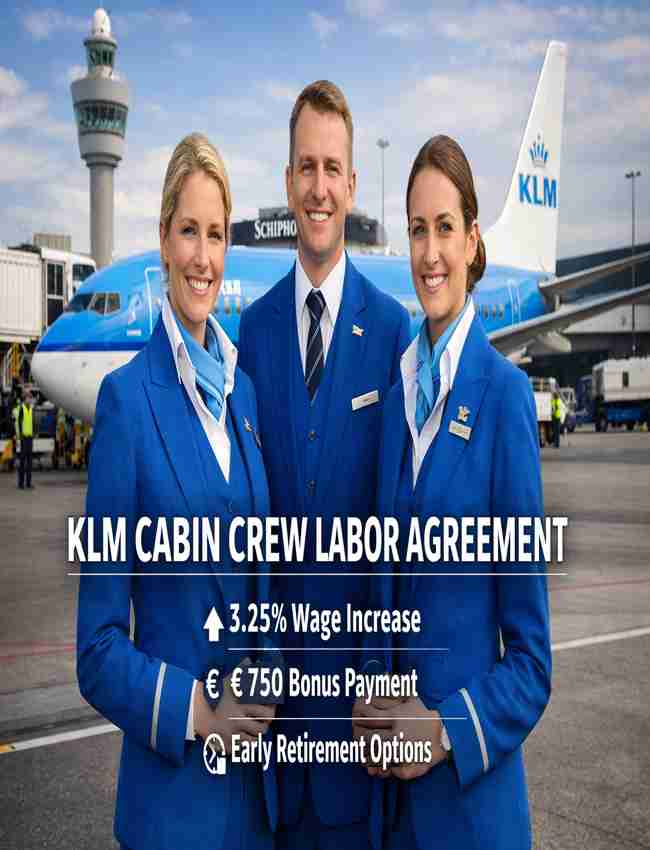
KLM Royal Dutch Airlines has reached a new two-year collective labor agreement with its cabin crew unions, bringing an end to a prolonged and disruptive negotiation period that strained operations at Amsterdam Schiphol Airport. The deal, approved by union members, provides structured wage increases, a one-time net payment, and revised work and retirement arrangements, helping restore labor certainty at one of Europe’s most critical aviation hubs.
The agreement takes effect retroactively from March 1, 2025, and will remain in force through Feb. 28, 2027. It concludes months of talks marked by strikes, legal disputes, and widespread flight cancellations, underscoring the operational and financial challenges airlines face amid tight labor markets and persistent cost pressures.
Background of Labor Unrest at Schiphol
Negotiations between KLM and its cabin crew unions unfolded against a backdrop of significant operational strain. Repeated industrial actions at Amsterdam Schiphol Airport forced the airline to cancel hundreds of flights, disrupting travel plans for passengers and placing added pressure on KLM’s network reliability.
The dispute highlighted the airline’s vulnerability to staffing shortages at its primary hub, while also testing management’s ability to maintain cost discipline in an environment of rising inflation and intense competition. The cabin crew talks followed similar labor tensions involving ground staff, which earlier required mediation by a former government minister to reach resolution.
Details of the Salary Increase
Under the new contract, cabin crew will receive a cumulative wage increase of 3.25 percent over the two-year period. The pay raises are structured in three phases: a 1 percent increase in December 2025, followed by a 1.25 percent increase in July 2026, and a final 1 percent increase in January 2027.
In addition to the base salary adjustments, employees will receive a one-time net payment of €750 in January 2026, calculated on the basis of full-time employment. The payment is intended to help offset inflationary pressures without permanently increasing KLM’s fixed cost base, reflecting a compromise between labor demands and management’s financial constraints.
Changes to Work Rules and Employability
Beyond compensation, the agreement includes several revisions to work rules designed to improve long-term employability and flexibility. The existing 80-90-100 scheme—allowing older employees to reduce working hours while continuing full pension accrual—will remain in place under the new framework.
The deal also introduces a temporary early retirement arrangement, offering eligible cabin crew a structured pathway to exit the workforce. Additionally, KLM has agreed to a return policy for employees who transition into ground-based roles, enabling them to rejoin cabin service under defined conditions.
These measures aim to balance workforce sustainability with operational needs, particularly as the airline manages an aging employee base and fluctuating demand.
Alignment With Broader Labor Agreements
The cabin crew settlement mirrors the framework reached earlier with KLM’s ground staff. That agreement followed three strikes at Schiphol and several court proceedings, which together resulted in extensive flight disruptions. By aligning the cabin crew deal with prior settlements, KLM has created a more consistent labor framework across key employee groups.
Union representatives characterized the outcome as restrained but realistic, citing the airline’s ongoing cost-cutting initiatives. Management, meanwhile, emphasized the importance of securing agreements with all cabin crew unions to ensure predictability and labor peace.
Operational and Business Impact
From an operational standpoint, the agreement significantly reduces the risk of near-term disruptions at Amsterdam Schiphol Airport. With clearer work rules and improved staffing certainty, KLM expects greater schedule reliability and smoother network planning, particularly during peak travel periods.
For passengers, the deal lowers the likelihood of strike-related cancellations. For the airline, it supports broader productivity and cost-control efforts at a time when European carriers are under pressure to balance financial discipline with workforce retention.
Bottom Line
KLM’s two-year labor agreement with its cabin crew brings much-needed stability after a period of intense negotiation and operational disruption. While the financial gains for employees are moderate, the deal secures labor peace, aligns with earlier ground staff settlements, and reinforces continuity at Amsterdam’s primary aviation hub. For KLM, the agreement represents a critical step toward restoring operational resilience while maintaining control over its long-term cost structure.
