


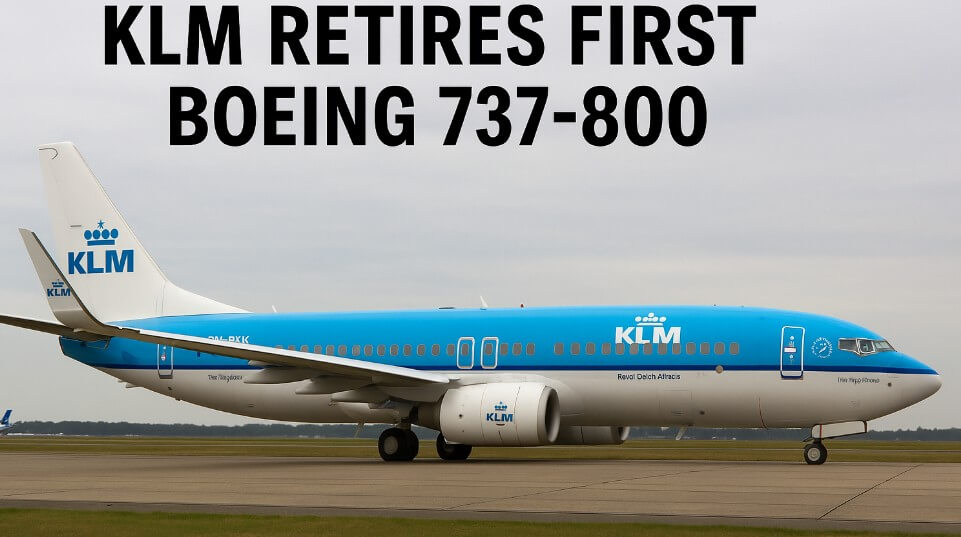
KLM has officially retired the first Boeing 737-800 in its fleet, marking a significant milestone in the Dutch carrier’s €7 billion fleet modernization program. The aircraft, registered PH-BXK, ended its 25-year career this month after completing a final passenger service to Amsterdam Schiphol Airport. Its withdrawal signals the start of a multi-year transition toward next-generation Airbus narrowbody aircraft that will redefine KLM’s European network operations.
The aircraft was ferried to Twente Airport following its retirement, where it entered a structured dismantling and recycling program led by AELS, a Netherlands-based specialist in end-of-life aircraft processing. The move reflects KLM’s broader sustainability roadmap, which integrates circular-economy practices into fleet renewal.
A Carefully Managed Send-Off for a Long-Serving Workhorse
PH-BXK flew thousands of rotations across Europe over more than two decades, forming part of KLM’s backbone for short- and medium-haul travel. At Twente, technicians have begun removing key components such as engines and the auxiliary power unit. According to KLM, these parts will return to the airline’s active inventory after full inspection and certification, extending their operational life and reducing the need for newly manufactured materials.
The dismantling work is expected to yield between 800 and 1,000 reusable components. These include flight-critical systems, avionics, and cabin equipment, which will be repurposed to support maintenance efficiency across the remaining 737 fleet. Once these items are extracted, the aircraft’s exterior branding and interior materials—including insulation blankets—will be removed and separated for potential reuse. The remaining structure will then be processed for raw-material recycling, with the aluminum fuselage ultimately re-entering industrial supply chains.
Sustainability at the Center of KLM’s Strategy
KLM’s collaboration with AELS is designed to ensure the highest standards of environmental performance throughout the dismantling cycle. Retiring older aircraft while salvaging reusable components helps reduce waste and lowers the carbon footprint associated with traditional aircraft disposal.
The airline’s fleet plan anticipates accelerated retirement of its Boeing 737-700 and 737-800 aircraft beginning in 2026, coinciding with increased deliveries of Airbus A321neo jets. AELS has already confirmed that a second KLM 737-800 will arrive in January for processing, reinforcing the ongoing nature of the transition.
Each airframe will undergo the same systematic approach to maximize recovery of reusable and recyclable materials, supporting KLM’s long-term emissions and waste-reduction commitments.
Airbus A320neo Family to Anchor KLM’s European Operations
The departure of PH-BXK highlights a strategic shift as KLM begins moving from a predominantly Boeing narrowbody fleet to the Airbus A320neo and A321neo families. These new aircraft offer meaningful improvements in fuel efficiency, noise reduction, and passenger experience. Their increased seating capacity is expected to strengthen KLM’s competitive position on high-frequency European routes, where operational economics are critical.
The modernization extends well beyond the 737 replacement effort. KLM Cityhopper is continuing to integrate Embraer E195-E2 jets, which also deliver lower emissions and operating costs. On long-haul routes, the airline has introduced additional Boeing 787-10 aircraft, enhancing efficiency and reliability across transcontinental services.
Beginning next year, KLM will phase in Airbus A350-900 aircraft to replace older Boeing 777-200ERs and Airbus A330s, significantly reducing fuel burn per seat. The cargo division will also undergo a major modernization with the arrival of three Airbus A350F freighters, designed to offer improved payload capability with lower environmental impact.
A Symbolic and Operational Turning Point
While the retirement of a single aircraft might appear routine in a large carrier’s lifecycle, the departure of PH-BXK represents an inflection point for KLM. The move signals not only the beginning of a gradual phase-out of the Boeing 737 fleet but also the tangible start of a new era defined by efficiency, sustainability, and modernization.
With more retirements planned and A321neo deliveries on the horizon, KLM’s next-generation fleet is beginning to take shape. The transition underscores the airline’s strategy to balance environmental progress with operational performance, benefiting both European and long-haul passengers as the carrier refreshes nearly every segment of its fleet.
KLM’s fleet renewal is expected to unfold over several years, reshaping its operations and reinforcing its position in a competitive European aviation market.
