


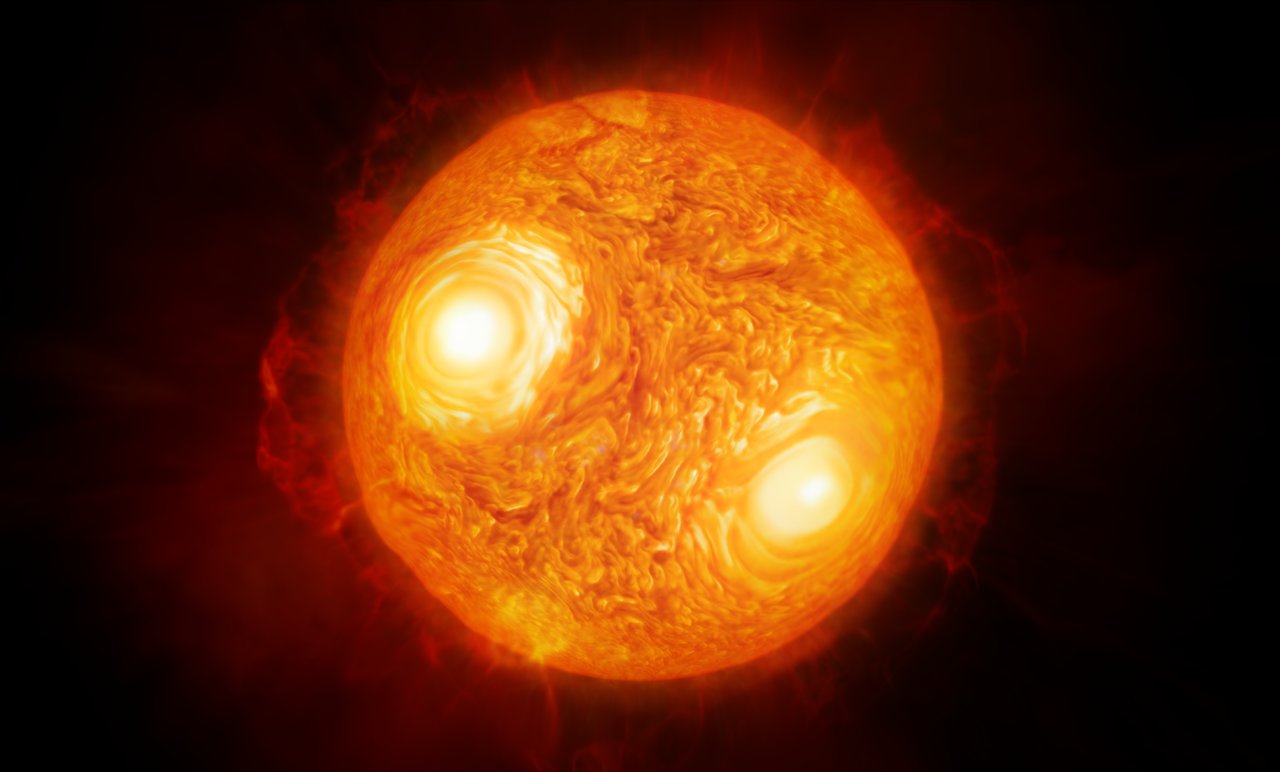
Dark matter makes up the majority of matter in the universe, but we can’t see it. At least not directly. Whatever dark matter, it must interact with everything else in the universe through gravity, and astronomers have found that if too much dark matter collects inside red giant stars, it will likely reduce its lifespan in half.
When stars love our sun near the end of their lives, they stop incorporating hydrogen into their cores. Instead, fusion occurs in an envelope surrounding a dense core of inert helium – the ash left over from that nuclear reaction. Over hundreds of millions of years, this core contracts (after all, nothing inside it generates the energy to keep it swollen), which causes it to heat up.
At the same time, due to the overheating of the core, the rest of the stars swell, enlarging to ridiculous proportions as a red giant.
Astronomers can estimate the ages of red giant stars by studying the complex physics of the nucleus, and track how long helium can continue to heat up until it reaches the critical threshold needed to undergo its own nuclear fusion, leading to the final final stages of a star.
It is a very straightforward astrophysical calculation.
That is, it is quite simple unless something hinders the work.
Dark heart
Completely unrelated to the red giants, astronomers are currently baffled about the nature of dark matter, which is one that makes up nearly 80% of all matter in the universe, yet is completely invisible. We are not completely sure what dark matter is, but we are quite confident that it is a type of particle, as yet completely unknown to the Standard Model of particle physics.
Whatever dark matter is, it must interact with ordinary matter through gravity, because that’s how we have been able to detect it so far. Beyond that, it may be possible for dark matter to form clumps, or regions of high density within normal matter bodies such as stars and planets.
Astronomers have already investigated the consequences of accumulating dark matter in normal star hearts, but new research has revealed what happens to red giants near the end of their lives.
Short version: Not pretty.
According to a paper recently published in the preprint journal arXiv, when a very large amount of dark matter sits inside a giant star, it causes the helium core to contract more than usual. This increased intensity raises the temperatures, which in turn leads to an increase in luminosity, which continues to make the future evolution of the star much shorter.
The effects are dramatic. If dark matter makes up just 10% of the mass of the red giant’s core, temperatures jump by 10%, luminosity doubles, and the life of the red giant is halved.
We don’t know how much dark matter – if any – is contained within red giants, but future studies of this group of dying stars may reveal clues to one of the most mysterious materials in the universe.
