


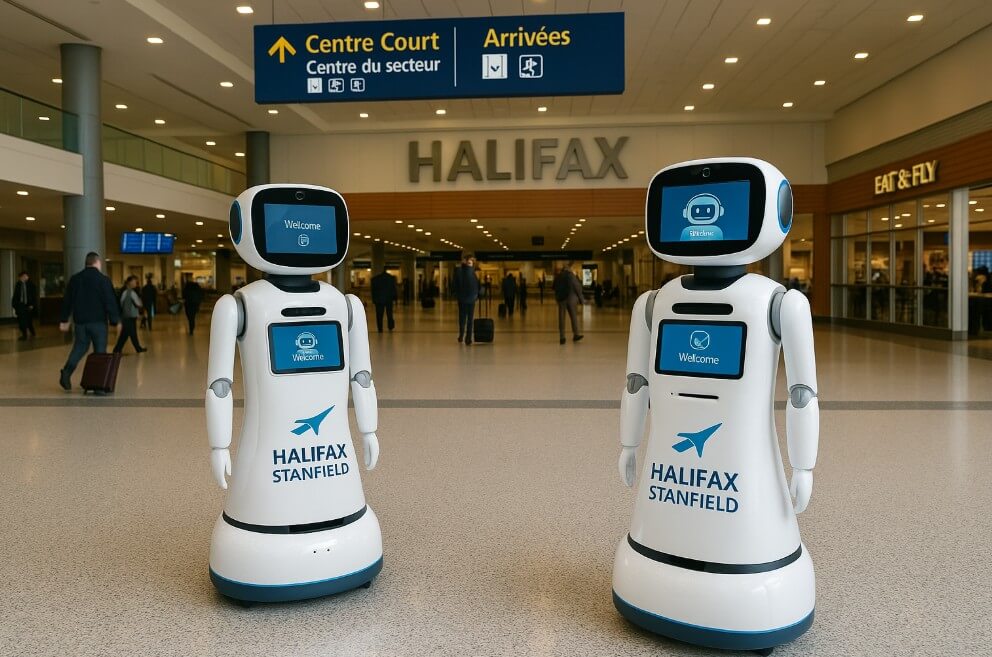
Halifax Stanfield International Airport is testing a pair of service robots designed to guide travelers and provide real-time information, in a move that underscores the airport’s growing focus on customer experience and operational efficiency.
The initiative, developed in partnership with Halifax-based Maritime Robotics, places the airport among a select group of North American hubs experimenting with advanced robotics to streamline wayfinding and enhance passenger services.
A New Layer of Passenger Assistance
The pilot program, now underway, has deployed two interactive robots in high-traffic areas: the pre-security Centre Court and the Arrivals hall. Equipped with advanced voice recognition and touch-screen interfaces, the robots serve as an information hub for travelers.
Passengers can request updates on flight schedules, check weather conditions, or access details on airport amenities through either voice prompts or screen navigation. For destinations within a defined perimeter of the terminal, the robots offer more than just directions—they physically guide passengers to their requested locations.
For destinations outside their escort range, the machines generate a digital wayfinding map, allowing travelers to continue independently. This dual functionality is designed to improve accessibility and efficiency during peak travel times when human staff are stretched thin.
Airport officials say the robots are not a replacement for staff but a complement, providing an additional layer of support to ensure passengers have a smoother, less stressful experience.
Technology Meets Traveler Engagement
Halifax International Airport Authority (HIAA) officials describe the initiative as part of a broader strategy to integrate technology into daily operations. Tiffany Chase, HIAA’s Director of Marketing, Communications, and Customer Experience, framed the deployment as a milestone for the airport.
“Our partnership with Maritime Robotics underscores our dedication to innovation and efficiency,” Chase said. “These robots not only improve wayfinding but also add an engaging element to the passenger experience, blending functionality with a modern, user-friendly design.”
The airport, which has steadily expanded its passenger services in recent years, views robotics as a natural next step in adapting to evolving traveler expectations. While many airports have embraced mobile apps and self-service kiosks, physical robots remain rare in North America, placing Halifax Stanfield in an experimental but potentially influential position.
Local Innovation With Global Potential
For Maritime Robotics, the project represents both a business opportunity and a point of pride. The Halifax-based firm specializes in human-assistive robotics, and leaders see the airport trial as a chance to showcase what local innovation can achieve in a global travel hub.
“Deploying this technology at Halifax Stanfield is a milestone for our community,” said Huijing He, Director of Maritime Robotics. “It’s about more than innovation—it’s about enhancing the travel experience and positioning our airport as a leader in the future of aviation.”
Industry observers note that airports worldwide are increasingly seeking automation to reduce bottlenecks, provide multilingual support, and create consistency in customer service. Maritime Robotics’ presence in this space highlights the potential for Canadian-developed solutions to gain international traction.
Looking Ahead
The pilot program is expected to run for several months, during which the airport will gather passenger feedback and operational data. The results will help determine whether Halifax Stanfield adopts the robots permanently or expands their use to other terminal areas.
If successful, the robots could join a suite of customer service tools aimed at improving navigation and traveler satisfaction, particularly for first-time visitors or those unfamiliar with the airport layout. They may also serve as a model for other Canadian airports exploring how emerging technologies can bolster service quality.
For now, Halifax Stanfield officials are encouraging travelers to interact with the robots during their next trip. The machines are designed to be approachable, with friendly interfaces that blend functional information delivery with interactive engagement.
By combining local expertise with cutting-edge robotics, Halifax Stanfield and Maritime Robotics are betting that traveler expectations can be met not only through efficiency but also through innovation. For passengers, the technology may soon become part of the routine airport experience—an escort to their gate, a guide to their baggage carousel, or simply a source of reassurance amid the bustle of travel.
The trial is an experiment in blending human service with machine precision, one that could redefine the standard for customer care in Canada’s airports. And as Chase emphasized, it’s about more than just navigation: “These robots not only improve wayfinding but also add an engaging element to the passenger experience.”
