


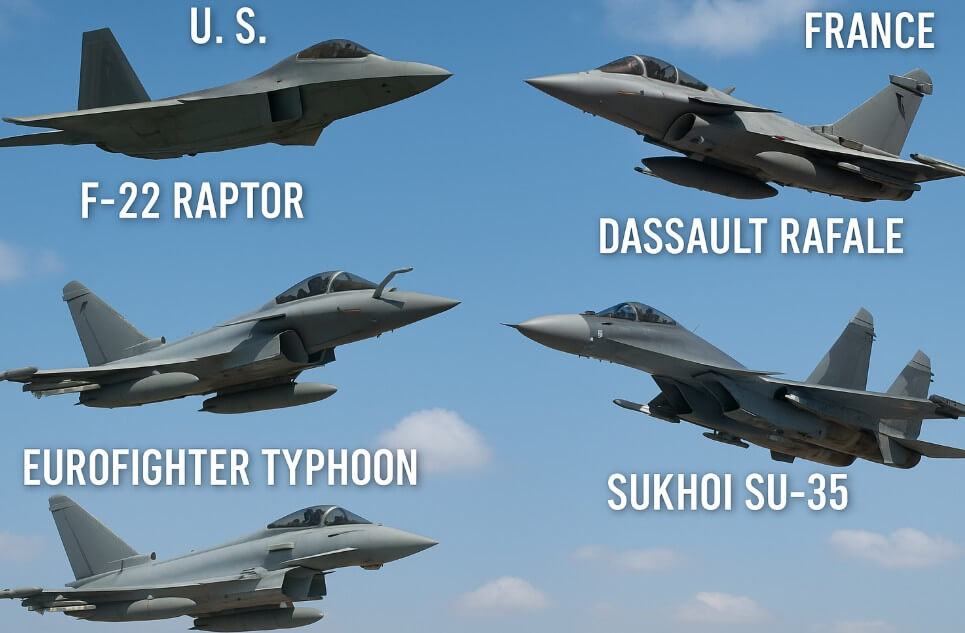
As geopolitical tensions rise and nations accelerate investments in next-generation military technology, the world’s most advanced fighter aircraft continue to shape national defense strategies. In 2025, seven leading jets stand out for their enduring influence, technological sophistication, and proven combat performance.
U.S. F-22 Raptor: Dominance With a Price Tag
The F-22 Raptor remains one of the most formidable air-superiority fighters ever developed. Produced jointly by Boeing and Lockheed Martin and entering service in 2007, the jet extends its capabilities far beyond dogfighting, performing ground strikes, electronic warfare, and intelligence missions.
With a unit cost of roughly $150 million excluding research and development, the F-22 is among the world’s most expensive military aircraft. Its stealth profile and advanced avionics—much of which remains classified—continue to define American air power.
Yet even the Raptor has shown vulnerability. As noted in the press release, “NATO war games conducted in 2009 revealed a surprising vulnerability when the much older but still formidable Dassault Rafale managed to defeat it in simulated combat scenarios.”
F-15 Eagle: A Historic Record of Air Superiority
McDonnell Douglas’s F-15 Eagle continues to hold one of the most impressive combat records in modern aviation. Designed for air superiority and introduced in the 1970s, the F-15 boasts more than 100 aerial victories without a single loss.
Its performance has made it a staple for U.S. allies such as Japan and Saudi Arabia. Modern variants—including the F-15E Strike Eagle—ensure the aircraft remains relevant amid evolving threats.
As the press release highlights, “the F-15 stands as perhaps the most successful fighter of the modern era.”
Dassault Rafale: France’s Multirole Powerhouse
The Dassault Rafale, developed for both the French Air Force and Navy, entered service in 2001 after a lengthy development process. Its versatility has been demonstrated in multiple conflict zones including Afghanistan and Syria.
Capable of tracking 40 targets simultaneously and engaging four, the Rafale features advanced electronic systems and a proven combat record. Its global footprint continues to grow, with India, Egypt, and Qatar among its buyers.
The aircraft’s competitive edge was showcased during joint exercises when, as stated, its “lethality was dramatically demonstrated when it ‘shot down’ an F-22 Raptor during 2009 exercises.”
Eurofighter Typhoon: A European Collaboration
Developed by the United Kingdom, Germany, Italy, and Spain, the Eurofighter Typhoon remains one of Europe’s premier multirole fighters. Its agility and dogfighting capability make it a strong contender in any modern air-combat scenario.
While often compared to the F-22, defense analysts frequently rank the Typhoon above other fourth-generation fighters. European air forces plan to keep the aircraft operational through the 2030s as they transition toward the upcoming Next Generation Fighter and the BAE Tempest programs.
F-18 Hornet and Super Hornet: Backbone of Naval Aviation
The F-18 Hornet, developed in the 1970s by McDonnell Douglas and Northrop, first entered combat during the 1986 Libya bombing and later supported U.S. operations in both Gulf Wars. Its reliability has made it a long-serving platform for both the Navy and allied nations such as Australia and Spain.
The Super Hornet variant, featuring upgraded avionics and expanded capabilities, has extended the airframe’s service life and ensured its continued relevance in modern naval operations.
Russia’s Sukhoi Su-35: A Modernized Powerhouse
The Sukhoi Su-35, Russia’s most advanced operational fighter, represents a heavily modernized evolution of the Su-27. Achieving full operational status in 2018, it combines high maneuverability, advanced sensors, and a broad weapons suite.
Although designed primarily for air superiority, the Su-35’s ground-attack capabilities make it a versatile multirole option for Russia’s air forces—a key consideration as global defense competition intensifies.
F-16 Fighting Falcon: A Global Favorite
The F-16 Fighting Falcon remains one of the world’s most widely adopted fighter jets, serving air forces from Turkey to Brazil. Designed by General Dynamics and entering U.S. service in the late 1970s, the aircraft evolved from an air-superiority fighter to a multirole platform known for its affordability and reliability.
The latest F-16V variant incorporates major avionics upgrades, positioning the Fighting Falcon to remain operational for years to come.
Aviation Technology Continues to Push Boundaries
As the press release concludes, these aircraft remind observers of “humanity’s strange duality—creating objects of both terrible destruction and breathtaking beauty.” While new models are in development worldwide, the seven fighters highlighted here remain the core of global air-combat capability in 2025—platforms built to deter conflict yet ready for deployment at a moment’s notice.
