


Let us turn back again the hands of time. Just before extinction knocked dinosaurs off their pillar, before the “Good Dying” extinction wiped out 95 p.c of all organisms – we experienced the Paleozoic Era.
All through this age in Earth’s background, concerning 541 million and 252 million decades ago, arthropods (animals with exoskeletons this sort of as insects, crustaceans, scorpions, and horseshoe crabs) ended up discovering the extremes of dimension, from tiny to enormous.
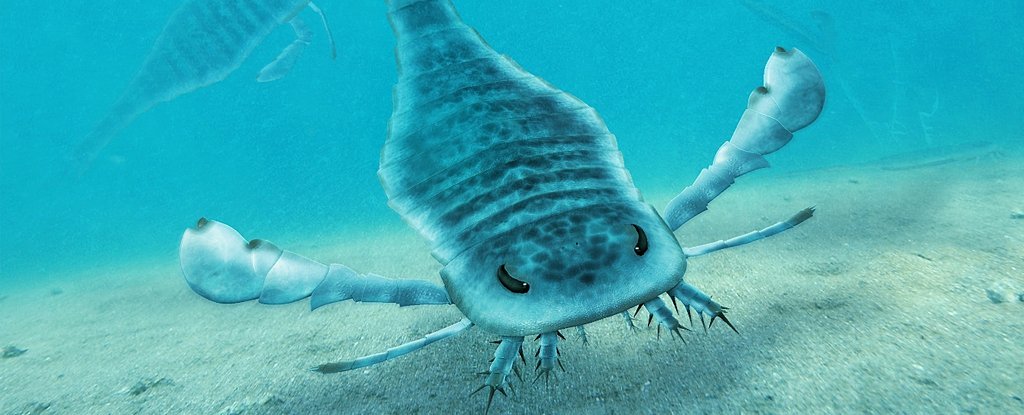
In fact, some Paleozoic arthropods symbolize the major animals on Earth at the time. If you have been to just take a swim in the Paleozoic oceans, you might have been privileged (or unlucky) more than enough to find just one of the most fearsome of these extinct arthropods: the sea scorpions, Eurypterida.
Our new exploration, published in Gondwana Investigate, is the most extensive selection of details on these interesting creatures that once roamed Australian waters.
 400-million-yr-previous Eurypterus remipes fossil. (H. Zell/Wikimedia/CC BY-SA)
A sight to behold
While Eurypterida appeared broadly like scorpions (with a comparable physique shape, albeit constructed for swimming), they ended up not. They have been much more like the cousins of modern day scorpions.
An remarkable aspect of the sea scorpion evolutionary tale is how they in shape into the narrative of Paleozoic gigantism.
Sea scorpions consist of the major maritime predators to have ever arisen in the fossil report, such as one particular species believed to have been a lot more than 2.5 metres prolonged (8 foot long), Jaekelopterus rhenaniae. Again then, some of these giants have been effectively in the same area in their foodstuff net as the modern-day terrific white shark.
These probable agile swimmers would have used their significant front limbs, armed with claws, to seize their prey, which they would then crush among the teeth-like structures on their legs (named gnathobasic spines).
While we are not certain particularly what these significant animals ate, it’s probably fish and scaled-down arthropods would have been on the menu. And if people experienced been all over swimming in the sea, possibly us much too!
 The sizing of the biggest extinct sea scorpions, relative to a human. (Slate Weasel/Wikimedia/Modified)
A interesting (but murky) record
Australia is well known for its array of curious animals, like distinctive present day species this sort of as the platypus. And this uniqueness extends considerably into the fossil file, with sea scorpions becoming a scenario in place.
But the scientific history and analyze of Australian sea scorpions has been patchy. The first documented specimen, printed in 1899, consisted of a fragmented exoskeleton area identified in Melbourne.
Prior to our new study inspecting the completeness of the team in Australia, there ended up about ten documents – and only just one other attempt to pool every thing with each other. As these types of, the variety and unfold of these fossils was pretty unsure.
For us, revisiting these wonderful fossils resulted in a number of outings to distinctive Australian museums. We also experienced specimens sent to us at the University of New England to examine in particular person.
This journey of paleontological discovery uncovered lots of sea scorpion fossils than hadn’t beforehand been famous. As a final result, we now have proof of a attainable six different teams that existed in Australia.
Collating these specimens together in our most latest publication, we illustrate the Pterygotidae (the relatives of sea scorpions that arrived at 2.5 metres lengthy) dominated the group’s Australian fossil record. Although this experienced been famous right before, the abundance of substance from distinct locations and time intervals, specially from Victoria, was surprising.
 Illustrations and timeline of Pterygotidae sea scorpions in blue, and Adelophthalmidae in orange. (Bricknell et al., Gondwana Researcher, 2020)
Back to the source
Other than showcasing the biggest range of Australian sea scorpions, our paper also outlines the over-all deficiency of data on these animals.
Inspite of there becoming a lot fragmented material, there is only one (mostly) total specimen, Adelophthalmus waterstoni, measuring just 5.7cm prolonged.
Long run research will contain revisiting the websites where by these specimens have been at first gathered, in the hope of getting extra finish specimens. Not only will this assistance doc Australian sea scorpion species improved, it will also permit for a additional total comprehending of the environments in which they lived.
Finally, a person thing is clear – there is substantially left to uncover about these titans that swam by Australia’s prehistoric oceans.
The authors thank Natalie Schroeder Geoscience Australia for her support with this job.
Russell Dean Christopher Bicknell, Post-doctoral researcher in Paleobiology , College of New England and Patrick Mark Smith, Technical Officer – Paleontology, Australian Museum.
This report is republished from The Conversation under a Innovative Commons license. Read the original article.
