


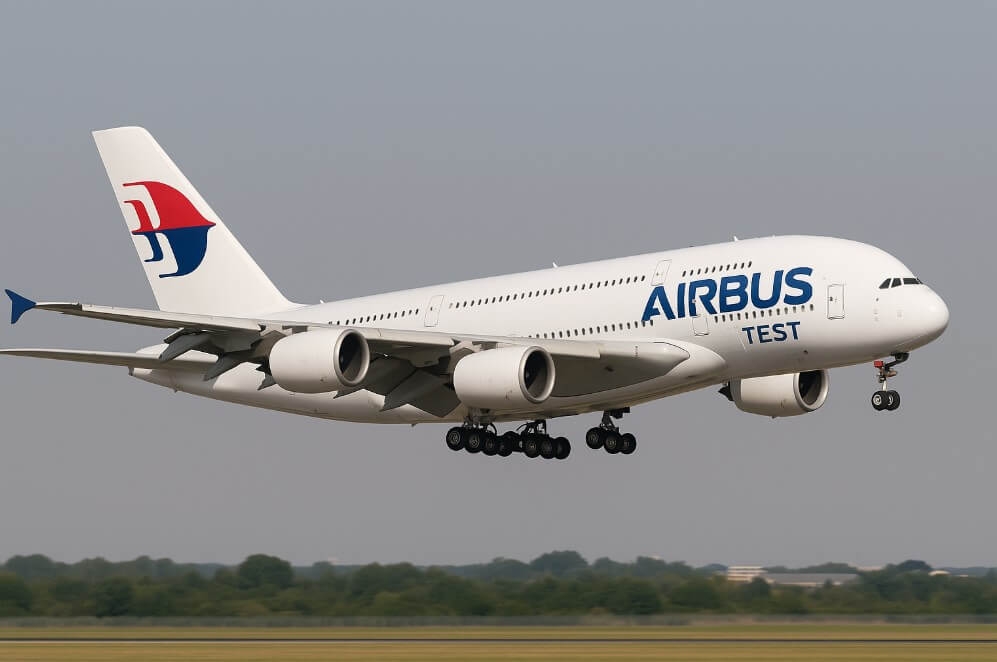
ABU DHABI — The world’s largest passenger jet, a former Malaysia Airlines Airbus A380, has taken flight once again after nearly three years on the ground — not as a commercial airliner, but as a new platform for Airbus’s next phase of aviation innovation.
The 12-year-old aircraft, once registered as 9M-MNF, departed Tarbes, France (LDE) for Abu Dhabi, United Arab Emirates (AUH) on October 1, 2025, drawing widespread attention from aviation watchers eager to learn its fate. Now registered as 2-JAYN, the superjumbo is owned by Airbus Financial Services and is set to undergo heavy maintenance at Etihad Engineering before being converted into a test aircraft. Despite rumors circulating online, the A380 will not be returning to passenger service.
From Flagship to Testbed
Malaysia Airlines first took delivery of the jet in March 2013 as the 100th A380 ever produced. During its nine years in service, the aircraft logged fewer than 24,000 flight hours across just under 2,300 flights — a relatively low total for a widebody of its size. The limited utilization reflected the airline’s broader challenges in operating the double-decker jet efficiently on its network.
By 2022, the carrier retired all six of its A380s, ending Malaysia’s chapter with the superjumbo. Following its retirement, the aircraft spent several years in storage before changing hands twice — re-registered as EI-HKF in March 2023 and later as 2-JAYN in March 2024, both under Airbus ownership.
Before its recent long-haul flight, the A380 conducted a two-hour test sortie over southern France on September 26, signaling the beginning of its reactivation process. The subsequent 6-hour, 35-minute flight to Abu Dhabi confirmed the aircraft’s airworthiness as it prepared for its new mission.
A Technical Rebirth
While the aircraft’s reappearance stirred speculation about a possible airline revival, Airbus’s intent is entirely technical. The company plans to repurpose the A380 as a platform for advanced testing — likely focusing on sustainable aviation technologies and next-generation flight systems.
Etihad Engineering, one of the Middle East’s largest independent MRO providers, will oversee the maintenance phase of the transition. However, the aircraft will not join Etihad Airways’ passenger fleet. Although Etihad has reactivated several of its own A380s for commercial operations, its current fleet plans do not extend beyond those aircraft.
“This particular A380’s new role underscores how Airbus continues to extract long-term value from its engineering assets,” an industry observer noted. “Even after its retirement from passenger service, the platform remains invaluable for testing the future of flight.”
The move follows a similar reactivation of another ex-Singapore Airlines A380 earlier this year, though that project’s purpose remains undisclosed. The two revivals are believed to be unrelated, with Airbus’s involvement in the Malaysia Airlines aircraft pointing toward an internal development program rather than commercial use.
Continuing the A380 Legacy
The A380, first introduced in 2007, was hailed as a technological marvel and the pinnacle of long-haul luxury travel. Yet, despite its popularity with passengers, the aircraft proved economically challenging for many airlines amid shifting market demand toward smaller, more fuel-efficient twinjets.
Malaysia Airlines’ withdrawal of its A380s mirrored a global trend that saw carriers such as Air France, Thai Airways, and Qatar Airways either retire or scale back their fleets. Only a handful of operators, including Emirates and British Airways, continue to fly the aircraft in regular passenger service.
For Airbus, however, the A380’s immense size and advanced design continue to make it an ideal testbed for research and development. Converting the ex-Malaysia Airlines jet for experimental use allows the manufacturer to conduct large-scale evaluations of new systems, materials, and green technologies — including hydrogen propulsion, advanced aerodynamics, and alternative fuel systems.
A Second Life in the Skies
Rather than being dismantled for parts or scrapped, the aircraft’s transformation into a research platform represents a fitting continuation of its service to aviation.
Its reactivation marks what many see as a symbolic moment for the A380 program — a quiet evolution from commercial grandeur to technological experimentation.
As Airbus refocuses on sustainability and next-generation flight systems, the once-celebrated superjumbo may yet help shape the future of aviation — not by carrying passengers, but by carrying innovation forward.
Stay tuned with us. Further, follow us on social media for the latest updates.
